

Facts can educate us. Statistics can inform us. Research can help us understand a problem.
But stories have the power to change hearts.
For many people, their understanding of mental health is shaped not by personal experience, but by what they see in the media, hear from others, or assume based on stereotypes. Mental illness is often discussed through labels, diagnoses, and clinical terms, which can sometimes make it feel distant or difficult to understand.
As a result, stigma continues to be one of the greatest barriers to mental health support. People may fear being judged, misunderstood, or treated differently if they speak openly about their struggles. Others may hold misconceptions about mental illness simply because they have never had the opportunity to hear from someone living with it.
One of the most effective ways to break down these barriers is through human connection.
That is the idea behind NAMI’s In Our Own Voice.
What Is In Our Own Voice?
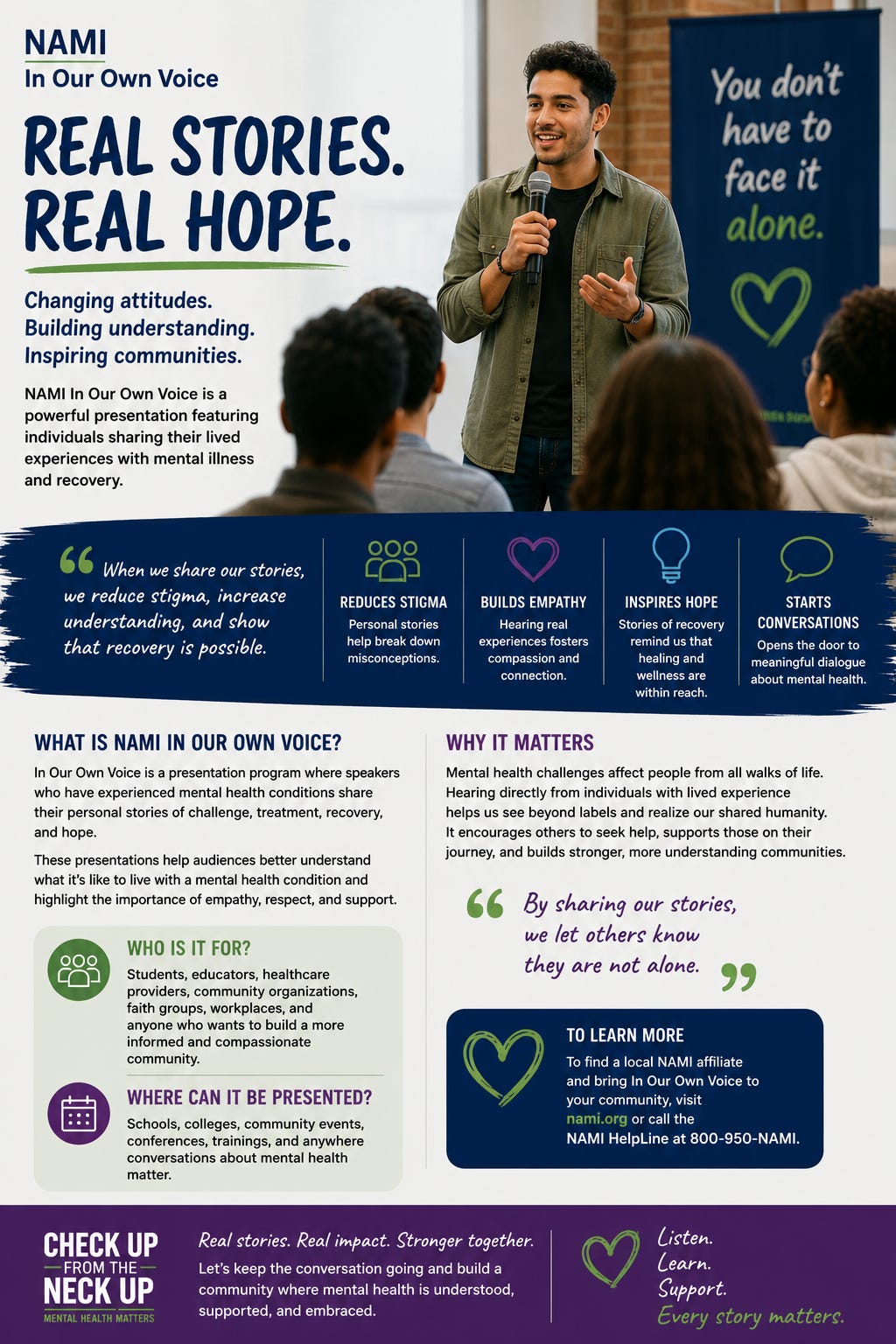
In Our Own Voice is a presentation program developed by the National Alliance on Mental Illness (NAMI) that features individuals sharing their personal experiences living with mental health conditions and navigating recovery.
Rather than focusing solely on facts and definitions, the program centers the voices of people with lived experience. Presenters openly discuss their journeys, including the challenges they faced, the support they received, the obstacles they overcame, and the hope they found along the way.
The goal is simple but powerful: to help audiences better understand mental health through real people and real stories.
These presentations can be delivered in schools, colleges, workplaces, community organizations, faith communities, healthcare settings, and other spaces where conversations about mental health can make a difference.
Why Stories Matter
When people hear a diagnosis, they often imagine a condition.
When people hear a story, they meet a person.
Stories help us move beyond labels and stereotypes. They remind us that mental health conditions affect individuals from every background, profession, age group, and community.
A personal story can reveal what it feels like to struggle with anxiety, depression, bipolar disorder, schizophrenia, or another condition in ways that statistics alone cannot capture. It can help audiences understand not only the challenges involved, but also the resilience, courage, and humanity of those experiencing them.
Stories create empathy.
And empathy creates understanding.
Reducing Stigma Through Lived Experience
Stigma thrives in silence.
When mental health remains hidden or misunderstood, myths and misconceptions often fill the gap. People may assume that mental illness is rare, that recovery is impossible, or that individuals experiencing mental health challenges are somehow different from everyone else.
Programs like In Our Own Voice challenge those assumptions.
By hearing directly from individuals who have experienced mental health conditions, audiences gain a more accurate understanding of what mental illness looks like and how recovery can occur. Presenters demonstrate that mental health challenges are not signs of weakness or personal failure. They are health conditions that can be managed, treated, and navigated with appropriate support.
For some audience members, these presentations may be their first meaningful conversation about mental health. For others, they may provide reassurance that they are not alone in their own experiences.
In both cases, the impact can be profound.
The Importance of Hope
One of the most powerful messages embedded within In Our Own Voice is the message of hope.
Mental health challenges can often leave individuals and families feeling overwhelmed or isolated. Recovery may seem uncertain, particularly during difficult periods.
By sharing stories of resilience and healing, presenters offer something many people desperately need: evidence that recovery is possible.
Recovery does not always mean that challenges disappear completely. Rather, it means that individuals can build meaningful lives, pursue their goals, maintain relationships, and find purpose despite the obstacles they may face.
Hope is not simply an emotion. It is a resource.
And for many people, hearing another person’s story can be the first step toward finding it.
Why This Matters for Our Community
At Check Up From the Neck Up, we believe that education is essential, but education alone is not enough.
Communities become stronger when people are willing to listen to one another’s experiences. Real understanding occurs when knowledge is combined with empathy.
Programs like In Our Own Voice help communities move beyond awareness and toward connection. They encourage honest conversations about mental health while creating spaces where people feel seen, heard, and understood.
For schools, community organizations, faith communities, healthcare providers, and workplaces throughout Cleveland and beyond, this program offers an opportunity to reduce stigma, build compassion, and strengthen support networks.
Every community has individuals who are struggling silently. Every community also has individuals whose stories can inspire understanding and healing.
In Our Own Voice helps bring those stories into the light.
Looking Forward
Changing attitudes about mental health requires more than information. It requires human connection.
When people share their experiences openly, they challenge misconceptions, reduce stigma, and remind others that they are not alone. They demonstrate that mental health conditions do not define a person’s worth, potential, or future.
Programs like NAMI’s In Our Own Voice remind us that every person has a story, and every story has the power to create understanding.
By listening, learning, and engaging with one another, we can build communities where mental health is not hidden behind silence, but discussed with honesty, compassion, and hope.
Sometimes the most powerful way to change a conversation is simply to let someone speak in their own voice.