

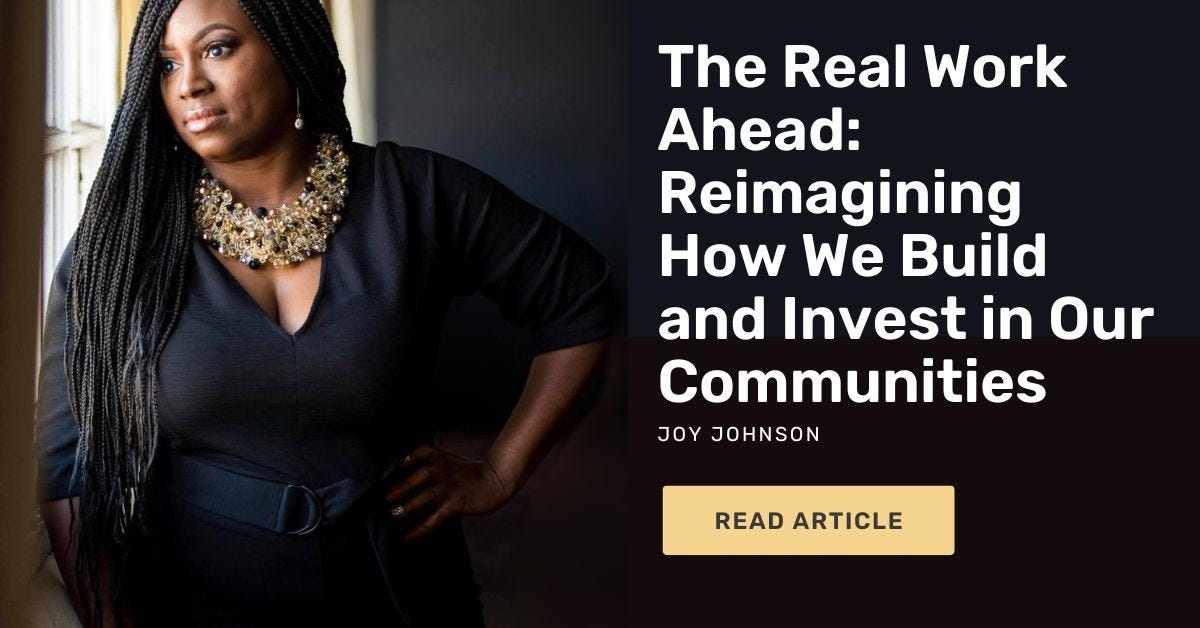
After twenty-three years of working in community development — all of them at Burten Bell Carr Development, Inc. — I’ve learned something simple but undeniable:
Our communities are full of potential, but our systems are not.
For more than two decades, community development has been my life’s work. I walked into BBC as a young professional straight out of college, and I was blessed with the opportunity to grow, learn, lead, and eventually become Executive Director in 2020. I am proud of the work I’ve done, the teams I’ve led, and the neighborhoods we fought for together.
But I am beginning this new chapter because I believe there are conversations we must have — openly, honestly, and constructively — if we are ever going to heal the broken ecosystem that shapes community development, real estate development, and economic opportunity in historically disinvested communities.
This column will never be a place for finger-pointing, gossip, or “poor me” narratives.
That is not who I am.
That is not what this moment requires.
And that is not what our communities need.
This series is about illumination — not retaliation.
It is about solutions — not bitterness.
It is about building — not tearing down.
Why I’m Writing This Series
When I stepped into the Executive Director role at BBC in 2020, I quickly saw that our challenges were far bigger than any one organization. What many people interpret as “organizational failure” in our Black, Brown, and low-income neighborhoods isn’t about individual shortcomings — it’s about a system misaligned with the outcomes it claims to pursue.
We have:
- A broken system for funding community development corporations (CDCs)
- A broken system for deploying healing and resources
- A broken real estate development ecosystem in Black, Brown and Appalachian communities
- A broken model for how we expect CDCs to function
- A broken pipeline for capital, talent, and long-term sustainability
These are not whispers. These are facts that show up in every metric: reinvestment gaps, life expectancy gaps, abandoned properties, property-value disparities, and the painfully slow pace of change in neighborhoods that have waited decades for fairness.
Let me give one example — because the numbers speak louder than opinion:
West Side Market: $70 million investment in one building, with $15 million of that West Side Market funding alone coming from the City of Cleveland.
Southeast Cleveland Neighborhoods (combined): $15 million investment
One market receives what entire neighborhoods on the East Side collectively receive.
That is not about individuals.
That is about a systemic prioritization pattern.
Why What Happened at BBC Matters — But Not for the Reasons People Think
Anyone who knows me knows I am not afraid to ask hard questions:
- Why are CDCs expected to do everything?
- Why are CDCs asked to handle social services, crime reduction, health disparities, and real estate development — all at once?
- Why are organizations established to build real estate being treated as if they are designed to do social services work?
I’ve said it before and I’ll say it again:
Asking a CDC to perform social services is like asking a firefighter to perform heart surgery—they may be brave and willing, but they simply haven’t been trained for that task.
It’s not about effort.
It’s about position, purpose, and design.
And when roles are misaligned, entire communities lose.
This isn’t a BBC problem.
This is a systemic problem across Northeast Ohio — and across the country.
My Work Continues — Because My Commitment Continues
I may no longer be inside one building, but I am still:
- Active in the community
- Active in real estate development
- Active in economic development
- Active in policy discussions
- Active in regional and national models that actually work
Over the years, I’ve traveled the country studying what other cities have done right:
- Inclusive development in Atlanta
- Equitable capital models in Minneapolis
- Community-led real estate in Baltimore
- Public-private alignment structures in Chicago
- Developer-capacity ecosystems in Detroit
I brought those lessons home with the intention of implementing them in Cleveland, and I still intend to share what I’ve learned — openly and generously — because our community deserves that.
This series will be a place where I:
- Share the truths I’ve witnessed
- Highlight successful models from around the country
- Break down systemic barriers in plain language
- Offer practical solutions
- Encourage collaboration
- Inspire leaders, residents, and practitioners
- Build bridges across sectors
My goal is simple:
Help our communities avoid the pitfalls that have held us back and build a healthier, more equitable development ecosystem.
An Invitation
I invite you to walk with me on this journey.
Not as critics, but as collaborators.
Not as spectators, but as co-architects of a better system.
Because we can only fix what we are willing to acknowledge.
And we can only heal what we are willing to examine together.
My hope is that you read this column weekly, share it with others, discuss the ideas in your circles, and — if you’re a leader, policymaker, developer, or funder — consider bringing me into the room to help navigate these complexities.
After twenty-three years inside the system, I don’t want to complain about it.
I want to help fix it.
And I want us to fix it together.
This is the beginning of that conversation.
A long overdue one.
A necessary one.
And a hopeful one.
— Joy Johnson
With more than two decades of experience in community development, real estate strategy, and organizational leadership, Joy Johnson brings a seasoned, solutions-focused voice to the field. She is committed to helping communities and institutions avoid systemic pitfalls and build models that truly work. To reach Joy call at (216) 238-2235
Citations & Sources
West Side Market Funding:
Groundbreaking for the transformation of the West Side Market
Southeast Cleveland Funding:
$15 million revitalization plan in the works for Cleveland’s Southeast Side
Urban Institute – Community Development Funding Gaps:
https://www.urban.org/policy-centers/metropolitan-housing-and-communities-policy-center
Brookings Institution – Equitable Development:
https://www.brookings.edu/articles/the-power-of-place-and-the-limits-of-local-control/
Minneapolis Equitable Development Scorecard:
https://www.mncompass.org/equitable-development-scorecard
Detroit Strategic Neighborhood Fund:
Atlanta Beltline Equitable Development Plan:
It appears that the Westside CDCs are not taking the same hit as the Eastside CDCs. It’s unfortunate.