

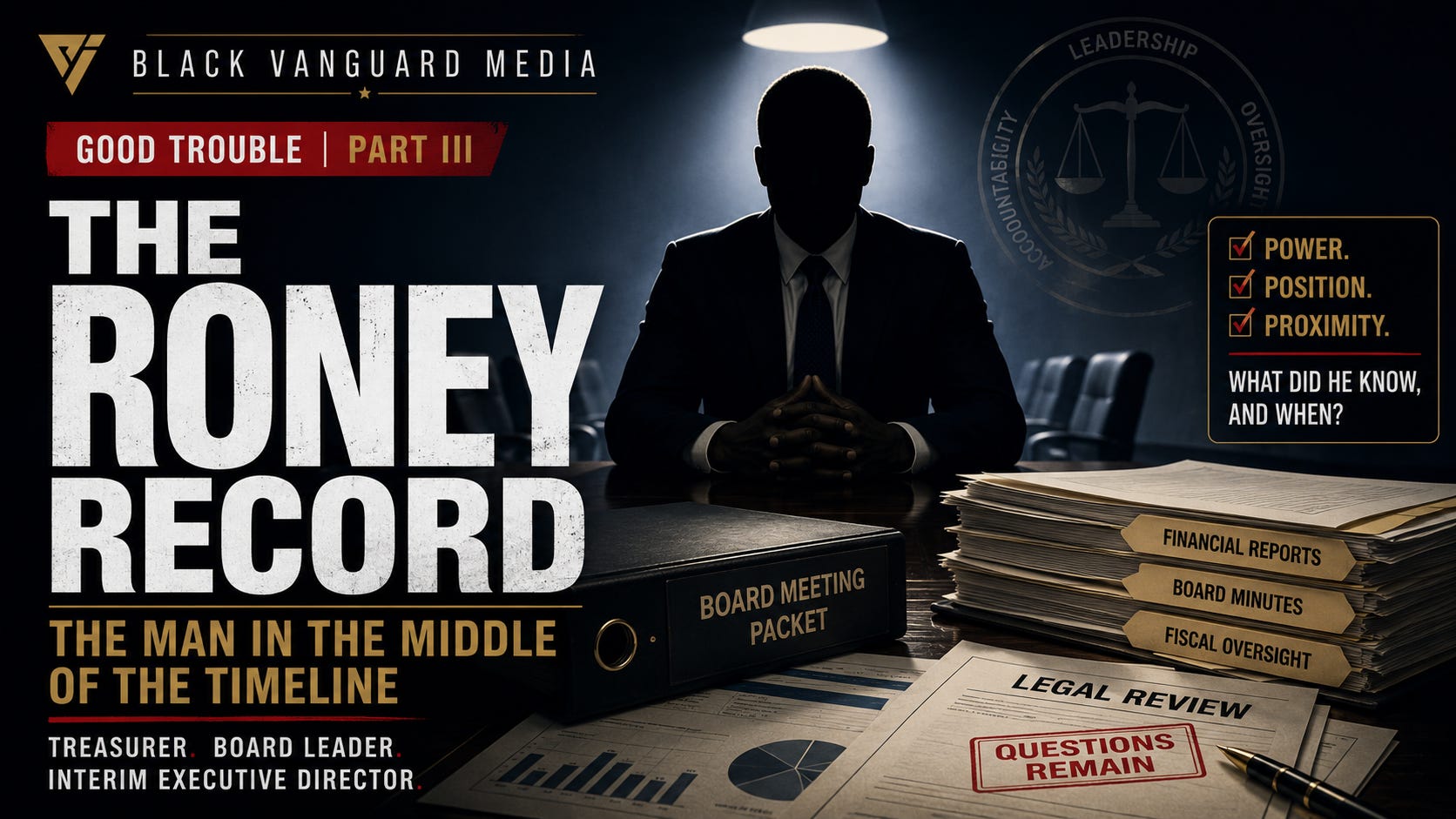
From Treasurer to Board Leader to Interim Executive Director — and the Governance Questions BBC Cannot Avoid
Every governance crisis has a timeline.
And every timeline has a point where the excuses stop working.
For Burten, Bell, Carr Development, Inc., that point is David Roney.
Not because one person alone explains everything that happened at BBC. That would be too simple, and the purpose of this series is not to replace one scapegoat with another.
But the record surrounding Roney’s role is too central to ignore.
He was not a stranger to BBC.
He was not a passive observer.
He was not someone who appeared only after the problems began.
Roney was connected to BBC’s board leadership. He was tied to financial oversight. He later became Board President. He then became Interim Executive Director after Joy Johnson was removed. And, according to BBC’s own court filing, the board believed he had counsel handling the lawsuit filed by FCB and Urban Voice Public Media — only for BBC to later claim that unopened mail addressed to Roney included the motion for default judgment and hearing notice.
That is not a side issue.
That is the story.
Because if BBC now wants to blame Joy Johnson, Darvio Morrow, First Class Broadcasting, Urban Voice Public Media, or Jerry Primm, then the public must first ask what happened inside BBC’s own leadership structure after the people now being blamed were no longer in control.
What did Roney know?
What did the board know?
What did BBC’s board leadership do with the information it had?
And why is BBC now trying to shift attention away from the very governance failures that unfolded under its own post-Joy leadership?
The Man in the Middle of the Timeline
The Roney record matters because he appears at multiple critical points in BBC’s crisis.
He was tied to financial oversight before Joy Johnson’s removal.
He was part of the leadership structure after Joy was removed.
He communicated with Darvio Morrow regarding WOVU financial information.
He was involved in the post-Joy handling of WOVU-related matters.
He became Interim Executive Director.
And BBC’s own legal filing places him at the center of the explanation for why the organization failed to timely respond to litigation.
That is a remarkable concentration of responsibility.
It also creates a major problem for BBC’s current narrative.
BBC cannot credibly claim that all roads lead back to Joy Johnson when so many of the most damaging events occurred after Roney and the board had control.
Joy was gone.
Roney was in leadership.
Jamie Parker was Board President.
The board had authority.
The organization had responsibility.
And yet, the problems did not disappear.
They escalated.
The Treasurer Question
Before any organization blames an executive director for financial strain, the board must answer one question:
Where was the financial oversight?
That question matters because nonprofit boards do not exist merely to support leadership when things go well and abandon responsibility when things become difficult. Boards have fiduciary duties. They are responsible for financial oversight, organizational stability, internal controls, risk management, and executive supervision.
That is especially true for the treasurer.
The treasurer’s role is not symbolic. It is not honorary. It exists because finances matter. The treasurer is expected to understand the organization’s financial condition, ask questions, review reports, monitor risks, and ensure that the board is not operating blindly.
So when BBC now points to financial problems as evidence against Joy Johnson, the public has a right to ask:
What did David Roney know when he was responsible for financial oversight?
What financial reports did he review?
What risks did he identify?
What corrective actions did he recommend?
What did he communicate to the board?
What did the board do in response?
If WOVU was financially burdensome, that should not have been a surprise to the treasurer.
If city funding delays were affecting cash flow, that should not have been a surprise to the treasurer.
If BBC needed stronger financial systems, that should not have been a surprise to the treasurer.
If reimbursement delays, contracts, invoices, staff payments, and operational strain were creating instability, that should not have been discovered only after Joy was removed.
That is why the attempt to blame Joy alone is so weak.
A board cannot ignore the person responsible for financial oversight while blaming the executive director for the existence of financial problems the board had a duty to understand.
Joy Warned. The Board Had a Duty to Govern.
Part II of this series explained why Joy Johnson cannot be fairly blamed for problems she had already warned about.
Part III asks the next question:
What did the board do with those warnings?
Joy documented financial strain. She raised concerns about city delays. She discussed funding uncertainty. She addressed the burden of WOVU. She worked on continuity planning, modernization, and solutions.
But warnings only matter if the people receiving them govern responsibly.
If Joy warned BBC about cash-flow issues, the board had a duty to act.
If Joy warned that WOVU was a drain on BBC resources, the board had a duty to act.
If Joy identified the need for a sustainable model, the board had a duty to evaluate that model honestly.
If Joy asked for support, oversight, or strategic direction, the board had a duty to provide it.
That is why Roney’s role matters.
If he had financial oversight responsibilities, then the board’s later attempt to cast Joy as the sole source of BBC’s problems becomes even more questionable. The organization was not supposed to be governed by one person. It had a board. It had officers. It had fiduciary responsibilities. It had financial oversight structures.
If those structures failed, that failure belongs to the board.
The Board Asked for Relief — Then Blamed the Person Who Pursued It
One of the most important facts in this entire series is that BBC’s board had asked Joy Johnson to identify a way for WOVU to stop draining BBC’s resources.
That changes the whole story.
Joy did not wake up one day and decide to hand WOVU to an outside partner for no reason. WOVU had become financially burdensome. BBC had limited nonprofit resources. The station required programming, technical support, underwriting strategy, media expertise, and digital growth. The old model was not sustainable.
The board knew that.
The board asked Joy to find a solution.
The FCB relationship was her answer to that board-recognized problem.
So when BBC now tries to frame the FCB relationship as suspicious, the public should ask:
Suspicious to whom?
To the same board that wanted WOVU to stop draining BBC?
To the same organization that needed a sustainable model?
To the same leadership structure that benefited from FCB’s work before later attacking it?
A board cannot ask an executive to solve a problem, allow her to pursue a solution, and then later weaponize that solution against her when the politics change.
That is not oversight.
That is revisionism.
And Roney’s role matters because the financial burden of WOVU was exactly the kind of issue a treasurer and board leader should have understood before, during, and after Joy’s decision-making.
From Oversight to Control
The Roney timeline becomes even more important after Joy Johnson’s removal.
Once Joy was gone, BBC’s board and post-Joy leadership had an opportunity to prove their theory.
If Joy was truly the problem, then BBC should have stabilized under new leadership.
If the board had better answers, those answers should have appeared.
If Roney understood the finances, the organization should have become clearer, stronger, and more disciplined.
If the board’s criticism of Joy was justified, the post-Joy period should have shown improvement.
Instead, the record suggests the opposite.
BBC’s problems did not resolve. They intensified.
The WOVU dispute escalated.
FCB and Urban Voice Public Media filed suit.
BBC failed to timely answer.
A default judgment motion followed.
BBC later claimed the board believed Roney had counsel handling the matter.
Unopened mail addressed to Roney reportedly contained critical legal documents.
Roney was later removed as Executive Director.
That sequence raises serious questions about whether BBC’s board had removed the problem — or placed the organization deeper inside one.
The Lawsuit Response Failure
The most damaging part of the Roney record may be BBC’s own explanation for why it missed the deadline to respond to the lawsuit.
According to BBC’s Motion for Leave, the board believed David Roney had retained counsel and that counsel was handling the lawsuit. The filing then explains that after Roney was removed, Jamie Parker received unopened mail addressed to Roney, including the motion for default judgment and hearing notice.
That explanation is extraordinary.
It means BBC’s own position is that a major lawsuit was filed, the organization believed someone was handling it, the matter was not properly tracked, critical mail was apparently unopened, and the organization did not timely respond.
That is a governance failure.
Not a personality dispute.
Not a media dispute.
Not a Joy Johnson problem.
Not a Darvio Morrow problem.
Not a Jerry Primm problem.
A governance failure.
And it sits squarely inside BBC’s post-Joy leadership structure.
If an organization receives a lawsuit, it must respond. If the board believes counsel is handling the matter, someone must verify that counsel has appeared. If legal mail is received, someone must open it. If a default motion is filed, someone must know it. If a hearing is scheduled, someone must track it.
That is basic organizational discipline.
When those things do not happen, the question is not who can be blamed outside the building.
The question is who failed inside the building.
The “Excusable Neglect” Problem
BBC may argue that its failure to timely respond was excusable.
But even if a court grants leave, the public accountability question remains.
How did BBC reach the point where excusable neglect became necessary?
What does it say about BBC’s internal controls that a lawsuit response depended on assumptions about Roney?
What does it say about board oversight that the organization claims it believed counsel was handling the matter but apparently did not ensure that a response was filed?
What does it say about the post-Joy leadership transition that unopened legal mail became part of the explanation?
And what does it say about BBC’s governance culture that, instead of simply acknowledging internal failure, the organization filed a counterclaim that attempts to drag Joy Johnson, Darvio Morrow, FCB, Urban Voice Public Media, and Jerry Primm into a broader blame narrative?
That is why the Roney record matters.
It exposes the weakness of BBC’s deflection strategy.
If BBC’s own leadership failed to handle litigation properly, then attacking others does not solve the problem. It only makes the deflection more visible.
Jamie Parker’s Role Makes the Questions Sharper
David Roney is not the only governance figure in this part of the story.
Jamie V. Parker must also be discussed.
Parker was BBC’s Board President when FCB and Urban Voice Public Media’s station operations were suspended. She later became Interim Executive Director. Publicly available professional materials identify her as an Ohio attorney with experience in labor and employment law, mediation, human resources, compliance-risk mitigation, policy development, and leadership-team conflict resolution.
That matters because BBC’s post-Joy boardroom was not without legal sophistication.
If the board president was an attorney, then the handling of the FCB dispute, the suspension of operations, the lawsuit, the missed response, and the claim of reliance on Roney become even more serious.
The question is not whether Parker was acting as BBC’s lawyer.
The question is whether BBC’s leadership had enough legal sophistication to understand that contracts, suspension notices, litigation deadlines, default motions, and unopened legal mail carry consequences.
That makes the Roney explanation harder to accept as a simple administrative mistake.
A board president with legal training should understand the seriousness of litigation. A board should know that “we thought someone was handling it” is not a governance system. An organization receiving public trust and public resources should have procedures to ensure that legal matters do not disappear into unopened mail.
So the Roney record and the Parker factor must be read together.
Roney was reportedly the person the board believed had counsel handling the lawsuit.
Parker was the board president who suspended FCB/UVPM operations and later became interim executive director.
Both roles are central.
Both raise questions.
And neither supports BBC’s attempt to make Joy Johnson the central villain of the story.
The Communications With Darvio Morrow
The email record also complicates BBC’s attempt to blame Darvio Morrow or FCB for financial confusion.
After Joy’s removal, Roney communicated with Darvio about WOVU’s FY26 budget, contractor payments, funding sources, invoices, and revenue tracking. Those communications show something important: Darvio was not hiding from BBC leadership. He was responding to questions. He was providing information. He was explaining what he knew. He was pointing out that BBC controlled the accounts and internal financial systems.
That matters because BBC’s later narrative tries to make FCB look like the source of the confusion.
But if Roney was asking Darvio for information after Joy’s removal, that means BBC leadership was actively trying to understand WOVU’s finances from inside its own systems.
And if BBC controlled the money, the bank accounts, the books, Bill.com, and payment processes, then blaming FCB for BBC’s internal financial confusion does not hold.
The communications show a more complicated picture:
BBC needed information.
Roney asked for it.
Darvio responded.
BBC still controlled the financial systems.
That is not a clean story of FCB misconduct.
It is a story of BBC trying to reconstruct or understand its own financial picture after Joy was gone.
That again raises the same question:
Where was the oversight before the crisis?
The Deflection Pattern
The Roney record fits a larger pattern.
First, BBC had a financial and operational problem.
Then Joy warned about it and sought solutions.
Then the board removed Joy.
Then Roney and post-Joy leadership took control.
Then the WOVU dispute escalated.
Then FCB and UVPM sued.
Then BBC missed the response deadline.
Then BBC blamed internal confusion and Roney-related handling for the missed response.
Then BBC filed a counterclaim attacking Joy, Darvio, FCB, UVPM, and Jerry Primm
That sequence is important because it reveals the function of the counterclaim.
It does not merely defend BBC.
It redirects attention.
It moves the spotlight away from board oversight, treasurer responsibility, legal-mail mishandling, post-Joy instability, and internal governance failure.
It shifts the story outward.
That is why the public must read the counterclaim carefully.
Legal filings can clarify facts.
But they can also be used to create smoke.
And in this case, the smoke appears designed to obscure the most obvious question:
What happened under BBC’s own leadership after Joy Johnson was removed?
Accountability Cannot Skip the Board
The Roney record also speaks to a broader problem in nonprofit governance.
Too often, boards act as though accountability belongs only to the executive director.
When things go well, the board shares the credit.
When things go badly, the executive becomes the sacrifice.
That is not governance.
A board is responsible for the organization’s health. It approves budgets. It hires and supervises the executive. It monitors finances. It evaluates risk. It oversees strategy. It protects the mission. It ensures legal compliance. It guards public trust.
If BBC had financial problems, the board must answer for its oversight.
If BBC had WOVU problems, the board must answer for its direction.
If BBC had contract problems, the board must answer for its process.
If BBC had litigation problems, the board must answer for its failure to timely respond.
If BBC had leadership transition problems, the board must answer for the decisions it made after Joy was removed.
Roney’s role sits at the intersection of all of those questions.
That is why his record cannot be treated as a footnote.
The Questions Funders Should Ask
Any funder, public official, partner, or community stakeholder evaluating BBC should ask direct questions about the Roney period.
Who was responsible for financial oversight before Joy Johnson was removed?
What role did Roney play in understanding BBC’s finances?
What did the board know about WOVU’s financial burden?
Did the board ask Joy to find a sustainable solution for WOVU?
What documentation did Joy provide?
What financial information did Roney review?
What changed after Joy was removed?
Why did Roney become Interim Executive Director?
What was the process for that transition?
What did Roney tell the board about the lawsuit?
Did counsel actually appear on BBC’s behalf before the response deadline?
Who was tracking the court docket?
Who was responsible for opening legal mail?
Why was mail addressed to Roney reportedly unopened?
Why was Roney removed as Executive Director?
What specific “other issues” led to his removal?
And why is BBC now focusing so much energy on attacking others instead of publicly accounting for those governance failures?
Those questions are not personal attacks.
They are governance questions.
And governance questions are exactly what public-interest institutions must answer.
The Record Points Back to BBC
BBC’s current strategy depends on the public looking everywhere except the boardroom.
Look at Joy.
Look at Darvio.
Look at FCB.
Look at UVPM.
Look at Jerry.
Look at relationships.
Look at suspicions.
Look anywhere except the governance structure that failed.
But the Roney record pulls the story back to where it belongs.
It pulls the story back to financial oversight.
It pulls the story back to board responsibility.
It pulls the story back to leadership transition.
It pulls the story back to legal handling.
It pulls the story back to the question of who had control after Joy Johnson was removed.
That is the point BBC cannot escape.
Once Joy was gone, BBC’s board and new leadership owned the next chapter.
And that next chapter included a lawsuit response failure so serious that BBC had to ask the court for relief from its own missed deadline.
That is not something BBC can explain away by attacking Joy Johnson.
It is not something BBC can explain away by attacking Darvio Morrow.
It is not something BBC can explain away by implying wrongdoing by Jerry Primm.
The Roney record shows that BBC’s crisis was not simply inherited.
It was governed.
And it was governed badly.
This Is the Reckoning
The story of David Roney is not merely about one man.
It is about what happens when a board’s own decisions become the crisis.
It is about what happens when financial oversight fails to prevent confusion.
It is about what happens when leadership transition becomes destabilization.
It is about what happens when a nonprofit removes an experienced executive, replaces her with board leadership, and then sees its problems become public.
It is about what happens when an organization tries to defend itself not by fully accounting for its own failures, but by widening the circle of blame.
That is why Part III matters.
Because before BBC points another finger outward, it must answer for the record inward.
David Roney was treasurer.
David Roney was board leadership.
David Roney became Interim Executive Director.
David Roney was central to BBC’s explanation for the missed litigation response.
David Roney was later removed.
That record demands scrutiny.
And until BBC answers the questions it raises, no funder, public official, partner, or community stakeholder should accept a scapegoat narrative as the truth.
This is not about rumor.
This is not about revenge.
This is not about personality.
This is about governance.
And the Roney record is where the governance story becomes impossible to ignore.