

Most people assume that resources begin with an application.
Experienced community leaders understand they begin much earlier—with relationships.
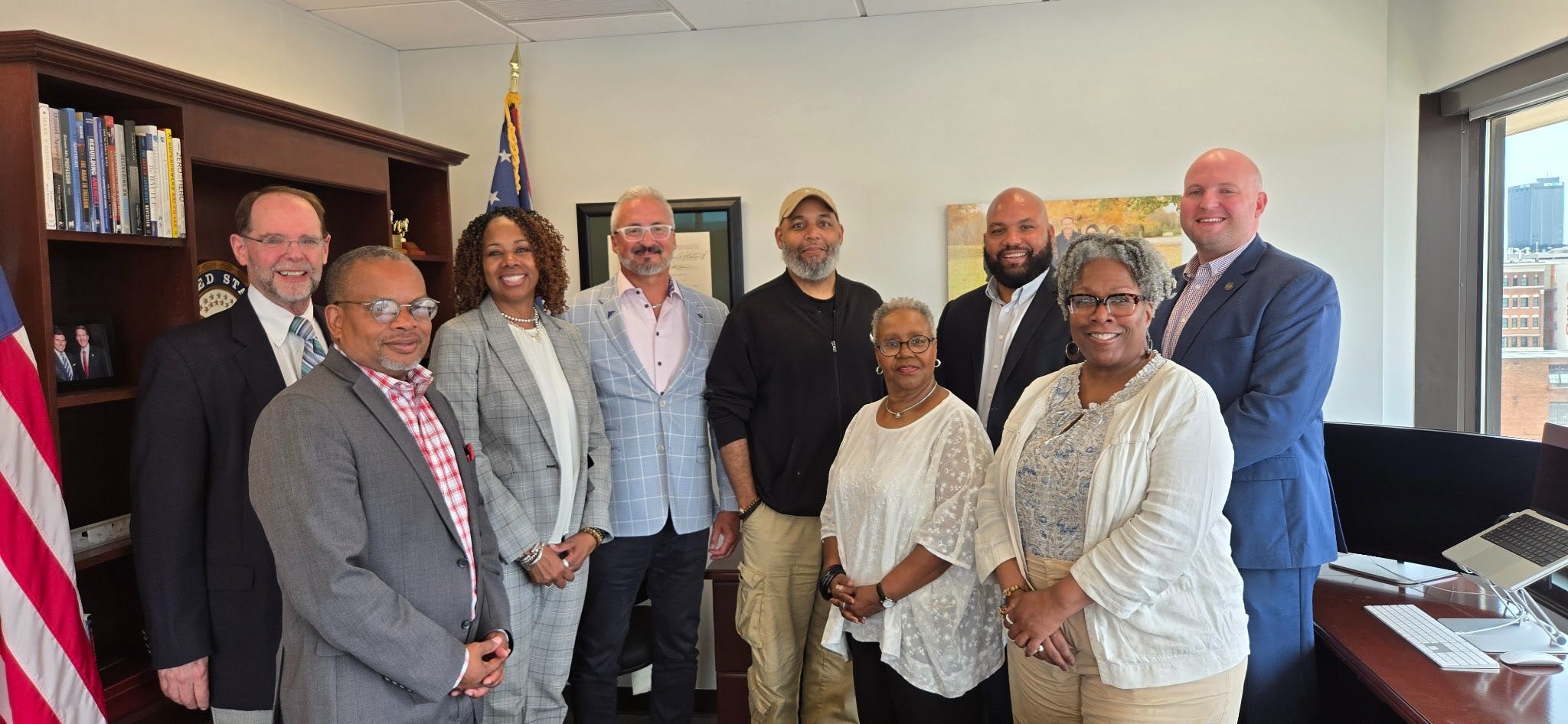
That understanding brought a delegation of community leaders and organizational representatives from across Ohio to Columbus for a collaborative meeting with Tom Evans, Regional Director for U.S. Senator Jon Husted’s Ohio office.
The purpose of the visit was refreshingly simple.
It was not a political meeting.
There were no campaign discussions, no partisan debates, and no requests for political support.
Instead, the delegation gathered around a shared belief that communities are better served when the people leading them understand how government works, know the individuals responsible for shaping policy, and build authentic relationships before those relationships are needed.
In many ways, that simple idea represents a different way of thinking about community development.
Beyond Grants and Funding
Too often, organizations begin looking for government offices only after a grant opportunity is announced or a funding crisis emerges.
By that point, the relationship starts under pressure.
This delegation chose a different path.
The goal was to learn.
To listen.
To introduce one another.
To better understand the work being done across Ohio.
And to begin building relationships that can grow over time.
Those conversations matter because policy does not develop in isolation.
Resources are created, modified, and allocated through people who spend every day studying legislation, listening to communities, and helping public officials understand local needs.
Communities benefit when those conversations begin long before an application is ever submitted.
Staying on the Radar
One message resonated throughout the meeting.
Stay connected.
Continue building relationships.
Do not disappear between funding opportunities.
The reason is straightforward.
As policies change and resources are allocated, decision-makers naturally think about the organizations and communities they know.
It is difficult—if not impossible—to engage people or organizations that you do not know exist.
That isn’t favoritism.
It is simply how human relationships work.
When community leaders consistently engage with policymakers, agency staff, and public officials, they remain informed about emerging priorities while ensuring that their communities remain part of the conversation.
Visibility creates opportunity.
Consistency builds trust.
Relationships create access to information that cannot always be found through a website or grant announcement.
Understanding the System
For many communities, particularly within the Black community, government can feel distant and difficult to navigate.
The language is unfamiliar.
The processes appear complicated.
The people making decisions often seem inaccessible.
As a result, many organizations focus almost exclusively on programs while overlooking the systems that determine how opportunities are created.
That gap has consequences.
Understanding how policies are developed, how agencies operate, and how decisions are made is just as important as understanding how to complete a grant application.
Communities that understand the system are often better prepared to compete for resources because they know where opportunities begin—not simply where applications end.
That kind of knowledge is rarely taught.
It is learned through engagement.
Community Development Isn’t About Politics
One of the strongest lessons from the visit was that relationship-building should never be mistaken for partisan politics.
Communities deserve representation regardless of which party occupies public office.
Neighborhoods need investment regardless of who wins an election.
Families benefit from effective public policy regardless of political ideology.
Building professional relationships with policymakers is not about choosing sides.
It is about understanding the people responsible for making decisions that affect housing, workforce development, transportation, education, small businesses, infrastructure, and economic opportunity.
Healthy communities require leaders who can work across political lines while remaining focused on the people they serve.
That approach is both practical and necessary.
Continuing the Conversation
The meeting also produced an encouraging outcome.
The Senator’s office agreed to have representatives attend the Center of Entrepreneurial Development ( COED Columbus) Grand Opening on August 1, 2026, providing another opportunity for entrepreneurs, community leaders, and public officials to continue building meaningful relationships.
That commitment reflects something important.
Effective engagement is not measured by a single meeting.
It is measured by what happens afterward.
Strong relationships grow through consistency, communication, and mutual respect.
A Different Model of Leadership
There is an old saying that says, “Your network determines your net worth.”
Community development follows a similar principle.
Organizations often measure success by the grants they receive.
Experienced leaders ask different questions.
Who knows the work we are doing?
Who understands our mission?
Who calls us when new opportunities emerge?
Who thinks about our community when policies begin to change?
Those answers frequently determine whether organizations hear about opportunities early enough to prepare.
Preparation almost always outperforms reaction.
The delegation left Columbus with a shared conclusion.
The trip was worthwhile.
More importantly, it reinforced a lesson that many successful organizations have learned over time.
Communities grow stronger when they intentionally build relationships with the people, institutions, and systems that shape public policy.
That work requires patience.
It requires consistency.
And it requires showing up long before assistance is needed.
Perhaps that is the most valuable lesson of all.
Resources often follow relationships—not because relationships guarantee funding, but because they create understanding, trust, and collaboration.
Those are the foundations upon which lasting community development is built.
For additional information about this initiative or to learn more about future community engagement delegations, contact CEO 360, Inc. at (216) 255-4354..