

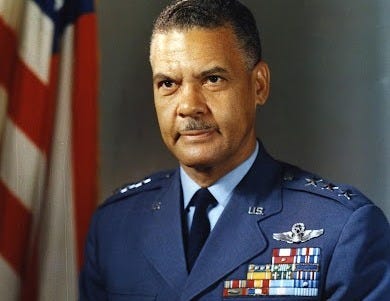
Before Benjamin O. Davis Jr. commanded the Tuskegee Airmen, before he became a general and before West Point placed his name on one of its barracks, he was a young Black cadet walking the halls of an institution where many of his classmates had already decided he did not belong.
Davis entered the United States Military Academy at West Point in 1932.
What followed was nearly four years of deliberate social isolation.
White cadets subjected Davis to a practice known as “silencing.” They spoke to him when military duty required it, but outside of official business, many refused to acknowledge him. He had no roommate and was largely excluded from the ordinary friendships, conversations and relationships that were part of cadet life.
The purpose was clear. The isolation was intended to make him quit.
He never did.
“It was designed to make me buckle, but I refused to buckle,” Davis later recalled.
The story is often told as a chapter in West Point history or the history of the Tuskegee Airmen. But Cleveland has a rightful place in it as well.
Cleveland Helped Shape Him
Davis was born in Washington, D.C., in 1912, the son of Benjamin O. Davis Sr., who would later become the first Black general in the U.S. Army.
Because of his father’s military assignments, the family moved several times. In the 1920s, they came to Cleveland, where the younger Davis spent important years of his childhood and adolescence.
He attended Cleveland’s Central High School and graduated in 1929. He later attended Western Reserve University before eventually entering West Point.
That makes Davis more than a distant national figure with a passing connection to the city. Cleveland was part of his development before the military knew his name and before history understood what he would become.
At West Point, Davis entered an environment already known for its extraordinary academic and military demands. Cadets trained together, studied together, ate together and relied heavily on one another.
Davis was expected to meet those same standards while being deliberately denied much of the camaraderie available to everyone else.
The isolation continued year after year.
It is an important distinction because Davis had not violated the academy’s honor code or committed an offense deserving punishment. His presence itself was the issue for those who believed a Black man did not belong there.
He had technically been admitted into the institution.
That did not mean the institution had fully accepted him.
He Graduated Anyway
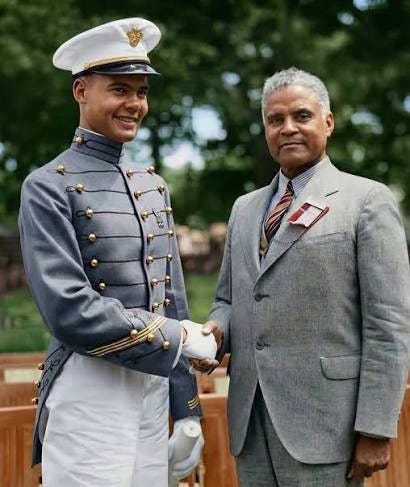
In 1936, Davis graduated from West Point, becoming only the fourth Black graduate in the academy’s history and the first in nearly half a century.
He also finished in the upper portion of his class.
His achievement exposed the failure of the campaign against him. Four years of isolation had not pushed him out. It had not prevented him from meeting the academy’s standards. It had not stopped him from becoming an officer.
The next barrier appeared almost immediately.
Davis wanted to become a military aviator, but the Army did not have a place for Black officers in its aviation units. He was instead assigned to the all-Black 24th Infantry Regiment.
Once again, his qualifications were not the issue.
Race was.
That changed as the United States slowly moved toward creating a program to train Black military pilots. Davis was selected for pilot training at Tuskegee, Alabama, and earned his wings in 1942.
He would soon become one of the most important figures in the history of Black military aviation.
From West Point Isolation to Combat Command
Davis commanded the 99th Fighter Squadron, the first operational Black military flying unit in the United States armed forces.
He later commanded the 332nd Fighter Group, remembered today as the legendary Red Tails.
The Tuskegee Airmen were fighting more than an overseas war. Their performance was being watched by military officials who still questioned whether Black pilots possessed the intelligence, discipline and ability required for combat aviation.
Davis understood the larger stakes.
When criticism threatened the future of the Black aviation program, he defended his pilots and challenged claims that they were incapable of performing at the required level.
Their combat record ultimately became part of the evidence that helped discredit longstanding arguments supporting military segregation.
There was also an unmistakable irony.
Only a few years earlier, cadets at West Point had refused to speak to Davis.
Now American pilots were depending on men under his command to protect bombers flying dangerous missions over Europe.
The Black cadet they had attempted to isolate had become a combat commander.
Rising Through the Air Force
Davis continued serving after World War II and remained in uniform when the U.S. Air Force became a separate military branch.
His career continued to break barriers.
In 1954, he became the first Black general officer in the United States Air Force. He eventually retired in 1970 as a lieutenant general after decades of military service.
Nearly three decades later, President Bill Clinton promoted the retired Davis to four-star general in 1998.
The rank placed him among the most senior military officers in American history.
His relationship with Cleveland also continued.
After leaving active military service, Davis briefly served as Cleveland’s public safety director under Mayor Carl B. Stokes, another historic Black figure whose rise helped reshape the city’s political landscape.
For Cleveland, Davis therefore represents something unusual. The city appears in both the early and later chapters of his public life.
West Point Eventually Put His Name on the Building
Perhaps no part of Davis’s story captures its historical reversal better than what happened decades after he graduated.
In 2015, West Point announced that a new cadet barracks would be named Davis Barracks in his honor.
The symbolism was difficult to miss.
A Black cadet who had once lived without a roommate because other cadets refused to live with him would now have generations of West Point cadets living in a building bearing his name.
The classmates who attempted to make him invisible are largely unknown today.
Benjamin O. Davis Jr. is not.
His life became part of the history of West Point, the United States Air Force, the Tuskegee Airmen and the broader struggle of Black Americans to force institutions to live up to the principles they claimed to represent.
Cleveland belongs in that story too.
Before the general’s stars, before the Red Tails and before West Point placed his name on a barracks, there was a young Benjamin Davis attending school in Cleveland and preparing for a future few people around him could have imagined.
West Point gave him four years of silence.
History gave Benjamin O. Davis Jr. the last word.
Great story!