

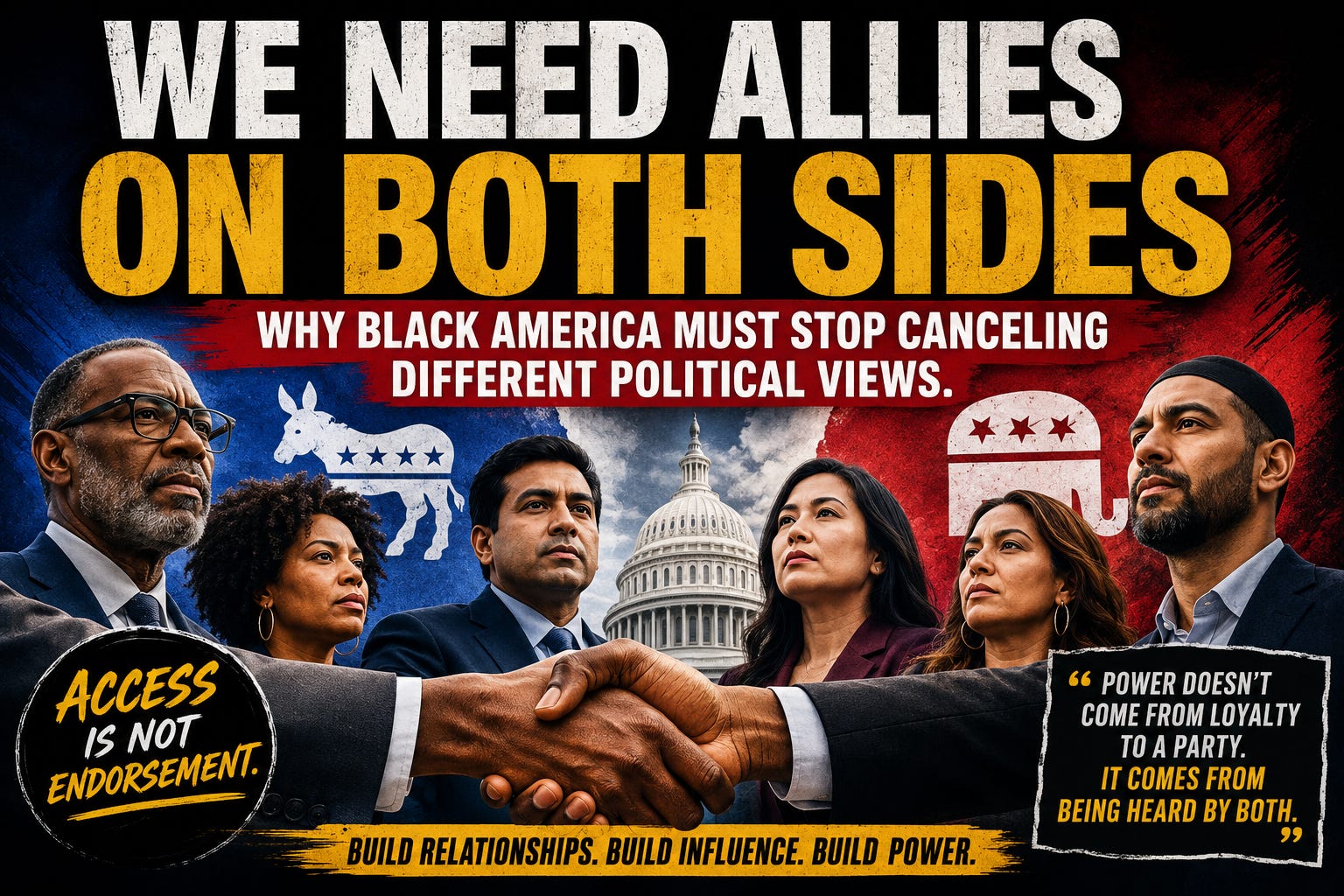
There is a difference between political loyalty and political power.
Loyalty asks, “Which party are you with?”
Power asks, “What can you deliver for our community?”
For too long, Black political participation has been discussed almost entirely through the language of party allegiance. A Black person who supports Democrats is generally accepted as operating within the community’s political mainstream. A Black person who votes Republican, supports a conservative candidate or even agrees with Republicans on a particular issue may be treated as though he or she has betrayed the race.
That reaction is not only excessive. It is strategically self-defeating.
Black people do not have to agree with every Black Republican. We do not have to excuse disrespectful language, defend harmful policies or pretend that every person claiming independence is acting in the community’s best interest.
But disagreement should not automatically lead to excommunication.
It is ridiculous to declare that every Black person must arrive at the same political conclusion simply because we share a racial identity. Black Americans do not have identical incomes, religious convictions, occupations, neighborhoods, family structures or experiences. We should not expect more than 40 million people to hold one political opinion on every issue.
Other communities appear to understand something that Black America must take more seriously: You need relationships wherever decisions are being made.
Indian Americans Organize Around Interests
The U.S.-India Political Action Committee offers one of the clearest examples.
USINPAC describes itself as a bipartisan political organization representing the interests of more than four million Indian Americans. It supports candidates and lawmakers who share the community’s concerns and works on issues including entrepreneurship, immigration, trade, hate-crime protections and appointments to executive and judicial positions. It does not define its mission as helping one party defeat the other. Its stated purpose is producing outcomes for Indian Americans at the federal, state and local levels.
That is a significant distinction.
The organization begins with the community’s interests and then evaluates political leaders. It does not begin with a political party and then ask the community to accept whatever that party offers.
Indian Americans certainly disagree among themselves. They are not a political monolith, and no single organization speaks for every Indian-American voter. The lesson is not that the community moves in perfect unity. The lesson is that it has built political infrastructure capable of communicating across party lines.
That gives Indian-American advocates access to people in government regardless of which party controls the White House, Congress, a governor’s office or a state legislature.
Arab Americans Have Built Independent Political Machinery
The Arab American Political Action Committee in Michigan provides another example.
AAPAC identifies itself as a nonpartisan and independent political committee whose primary concern is the Arab-American community. Its stated objectives include preparing Arab-American candidates for office, maintaining contact with non-Arab candidates, meeting with candidates to discuss their platforms and deciding whom to support.
Read that carefully.
The organization meets with candidates.
It discusses their platforms.
It introduces them to the community.
Then it decides whom to support.
That is negotiation.
It does not require every Arab American to vote the same way. It does not assume that one party is permanently entitled to the community’s support. It creates a process through which candidates can be questioned, evaluated and held accountable.
Arab-American voters have supported different parties at different times and on different issues. Their politics can be contentious, particularly when foreign policy, immigration, religious freedom and civil rights are involved. But that disagreement has not prevented Arab-American organizations from building relationships, interviewing candidates and attempting to turn their numbers into influence.
Latino Political Power Exists in Both Parties
Latino political organization also exists on both sides of the aisle.
The Congressional Hispanic Caucus historically became the organized voice of predominantly Democratic Latino members of Congress. Hispanic Republicans later established the Congressional Hispanic Conference, creating a center of Latino political influence within the Republican Party. The official historian of the U.S. House describes the development as making Hispanic organization in Congress more complex and dynamic.
That means Latino communities can have advocates inside Democratic rooms and Republican rooms.
Those advocates may disagree sharply. They may promote different policies on immigration, taxes, labor, education, policing and foreign affairs. But when either party controls Congress, Latino officials and organizations have people positioned within that governing structure.
Outside the parties, the NALEO Educational Fund works to mobilize Latino voters, train policymakers and strengthen a national network that now includes more than 8,000 Latino elected officials. Its work focuses on representation and participation rather than requiring one political identity from every Latino citizen.
The Latino community is not powerful because everyone agrees. It gains leverage because people are organizing, voting, running for office, developing leaders and operating in multiple political spaces.
Asian-American Organizations Build Political Pipelines
Asian-American and Pacific Islander organizations have also invested in nonpartisan civic infrastructure.
APIAVote describes itself as a nonpartisan nonprofit dedicated to engaging and empowering Asian-American and Pacific Islander communities. It partners with approximately 80 organizations in 29 states, conducts voter education and serves as a connection point between AAPI communities and local, state and federal policymakers.
The Asian Pacific American Institute for Congressional Studies is similarly nonpartisan. Its work includes preparing Asian Americans and Pacific Islanders to pursue public office and public-service careers at every level of government.
Again, the strategy is larger than a presidential election.
It involves building a bench.
It involves placing people in government.
It involves educating voters, training candidates, gathering data and maintaining communication with policymakers.
It is not simply about deciding which presidential candidate receives the most votes every four years. It is about ensuring that the community has influence before, during and after an election.
Voting Differently Is Not the Same as Betrayal
The 2024 presidential election demonstrated that several major racial and ethnic constituencies were politically divided.
Pew Research Center found that Hispanic voters split approximately 51% for Kamala Harris and 48% for Donald Trump. Asian voters supported Harris by 57% to 40%. Black voters remained much more concentrated, with 83% supporting Harris and 15% supporting Trump.
Those numbers should not be misused.
They do not prove that Hispanic and Asian voters sat together and consciously designed a coordinated strategy to divide their votes. These populations contain different nationalities, religions, economic interests, generations and political philosophies.
Nor does a close division automatically produce political power.
A community can divide its vote and still receive very little.
The real source of leverage is not simply voting for both parties. It is having organizations that can define priorities, question candidates, contribute resources, mobilize voters, recruit officeholders and measure what elected officials actually deliver.
That is the lesson Black America should consider.
Cancel Culture Can Destroy Our Own Access
When Black people attack, ridicule or ostracize every Black person who maintains a relationship with Republicans, we may be destroying our own access.
When Republicans control a state legislature, who can walk into those offices and speak credibly about Black communities?
When Republicans control Congress, who has established relationships with committee chairs, agency officials and legislative staff?
When Democrats control government, who is prepared to hold them accountable without being dismissed as someone who has nowhere else to go?
A politically mature community needs people positioned in multiple places.
Some should work within the Democratic Party.
Some should work within the Republican Party.
Some should remain independent.
Some should lead nonpartisan institutions that can communicate with whoever holds office.
The presence of Black Republicans does not require Black Democrats to abandon their principles. The presence of Black Democrats should not require Black conservatives to surrender their convictions. Political disagreement is not automatically racial betrayal.
We should judge people by what they advocate, what they accomplish, whom they serve and whether they remain accountable to the community—not simply by the letter beside their names.
Access Is Not Endorsement
Talking to both parties does not mean pretending that both parties are identical.
It does not mean ignoring racism.
It does not mean remaining silent when politicians attack Black interests.
It does not mean giving unconditional support to candidates whose policies harm Black families.
Communication is not capitulation.
Meeting with an elected official is not an endorsement.
Building a relationship does not require surrendering principles.
In business, community development and government relations, serious leaders communicate with every institution that possesses the authority to affect their work. They may oppose an institution’s position while still understanding that refusing all contact eliminates any possibility of negotiation.
Politics should be no different.
The Black community needs advocates who can enter Democratic spaces and demand measurable results. We also need advocates capable of entering Republican spaces and making the case for Black businesses, Black neighborhoods, historically Black institutions, criminal-justice reform, housing, education, access to capital and economic development.
We cannot influence rooms that none of us are willing—or permitted—to enter.
No Party Should Own the Black Vote
The objective should not be to move Black voters from one political plantation to another.
The objective should be political independence.
That does not require Black votes to be divided evenly between Democrats and Republicans. It means neither party should believe that Black support is automatic, unconditional or disconnected from performance.
Candidates should have to present plans.
They should have to answer questions.
They should have to make commitments.
Those commitments should be written down, tracked and evaluated.
Endorsements should be earned.
Continued support should depend on results.
And Black citizens should be allowed to examine those results and reach their own conclusions without being subjected to personal attacks or accusations that they are no longer authentically Black.
A community that punishes independent thought eventually produces fewer thinkers and more followers.
That is not unity.
That is conformity.
We Need Bridges, Not Political Purity Tests
Black America’s political history is too complex—and our present challenges are too serious—to reduce everything to a loyalty test.
We need allies in city halls, county governments, state legislatures, Congress, federal agencies and both major political parties.
We need Black people who can speak to progressives.
We need Black people who can speak to moderates.
We need Black people who can speak to conservatives.
Most importantly, we need people who can enter all of those spaces without forgetting who sent them there.
The standard should not be, “Did you vote exactly as I did?”
The standard should be, “Are you using your position to produce something meaningful for our people?”
Other communities have built political organizations, candidate pipelines and advocacy networks that operate across partisan boundaries. Black America should be capable of doing the same without treating disagreement as disloyalty.
We do not need fewer voices in positions of influence.
We need more.
We do not need to cancel every Black person who takes a different political path.
We need to hold them accountable, keep the lines of communication open and determine whether their access can produce meaningful results.
Because power does not come from being owned by a party.
Power comes from being organized enough that every party must listen.
Well stated!