

Walking into the Consumer Electronics Show is an experience that’s hard to describe until you’ve lived it.
It’s loud—not just in sound, but in ambition. Screens everywhere. Demos stacked on demos. Founders pitching futures that promise to be faster, smarter, cleaner, and more automated than anything we’ve known before. It is physically exhilarating and exhausting at the same time—the kind of experience that leaves your feet sore, your mind racing, and your sense of possibility stretched.
CES doesn’t whisper about what’s next—it announces it with confidence.
But as I moved through the exhibition halls, one question stayed with me:
Who is this future actually being built for—and who gets to shape it?
Innovation Everywhere—Access Still Uneven
CES is a masterclass in what’s possible. Artificial intelligence embedded in everyday tools. Smart infrastructure solutions. Health technology that can predict, personalize, and prevent. Energy innovations that could reshape how cities function.
Yet the more advanced the technology, the clearer the underlying assumptions became.
Much of what I saw presumes:
Reliable broadband and digital infrastructure
Significant purchasing power or institutional backing
Organizations ready to integrate new systems
Communities already connected to innovation pipelines
For someone who has spent over two decades working in community development and nonprofit leadership, those assumptions matter. Because many neighborhoods, small businesses, and place-based institutions are still working toward baseline access, not cutting-edge solutions.
Innovation often feels distant not because it’s inaccessible, but because many communities and organizations aren’t exposed to where it happens or how to engage with it. When those voices aren’t present in spaces like CES, it can create the impression that innovation lives somewhere else. In reality, much of it is closer, more open, and more navigable than people realize
The Missing Conversation at CES
What CES doesn’t center is implementation equity.
Not just:
Can this technology work?
But:
Where will it work?
Who controls it?
Who has the resources to deploy it responsibly?
The real opportunity isn’t just inventing new tools—it’s building pathways that allow communities to evaluate, adopt, govern, and benefit from those tools on their own terms.
The World Is Smaller Than I Thought—and That Matters
One of the most powerful realizations I had at CES had nothing to do with technology—it had to do with geography.
CES is profoundly international. I met innovators, entrepreneurs, and institutional leaders from across Africa, Europe, Asia, and Latin America, all converging in one place to exchange ideas and build global partnerships.
And I became acutely aware of how accessible this experience was for me.
For many attendees, being at CES required visas, long-haul flights, significant expense, and months of planning. For me, it was a four-hour direct flight.
That contrast was humbling—and instructive.
It underscored how being based in the United States still carries real weight in the global business ecosystem. Proximity to convenings like CES is not just about convenience; it’s about access to capital, visibility, and influence over which ideas gain traction.
What also became clear is that the value I bring to international business spaces isn’t only about expertise—it’s about position. Understanding U.S. systems, funding structures, and institutional norms creates immediate relevance in global conversations.
The question, then, is how that access gets used.
What This Means for Communities
If the world is smaller, communities should benefit from that closeness—not be bypassed by it.
Local organizations don’t need to invent new technology to participate in the future. What they need are:
Early exposure to emerging tools before they become cost-prohibitive
Capital pathways that align innovation with community priorities
Intermediaries and leaders who can translate global ideas into local implementation
Governance capacity to ensure technology serves people—not the other way around
Communities benefit when innovation is paired with:
Workforce development tied to real jobs
Small business adoption support, not just consumer products
Infrastructure investment that reaches neighborhood scale
Decision-making power that remains local
The future doesn’t need more pilots that never scale.
It needs systems that allow communities to be participants, partners, and owners in innovation.
Leaving CES With Clarity
I didn’t leave CES with a list of gadgets.
I left with sharper questions—and a clearer sense of responsibility.
If the future is already here, then equity can’t be an afterthought. It has to be built into how innovation is funded, governed, and deployed.
Because the true measure of progress isn’t what dazzles on a convention floor.
It’s whether communities that have historically been overlooked are finally positioned to shape—and benefit from—the future being built around them.
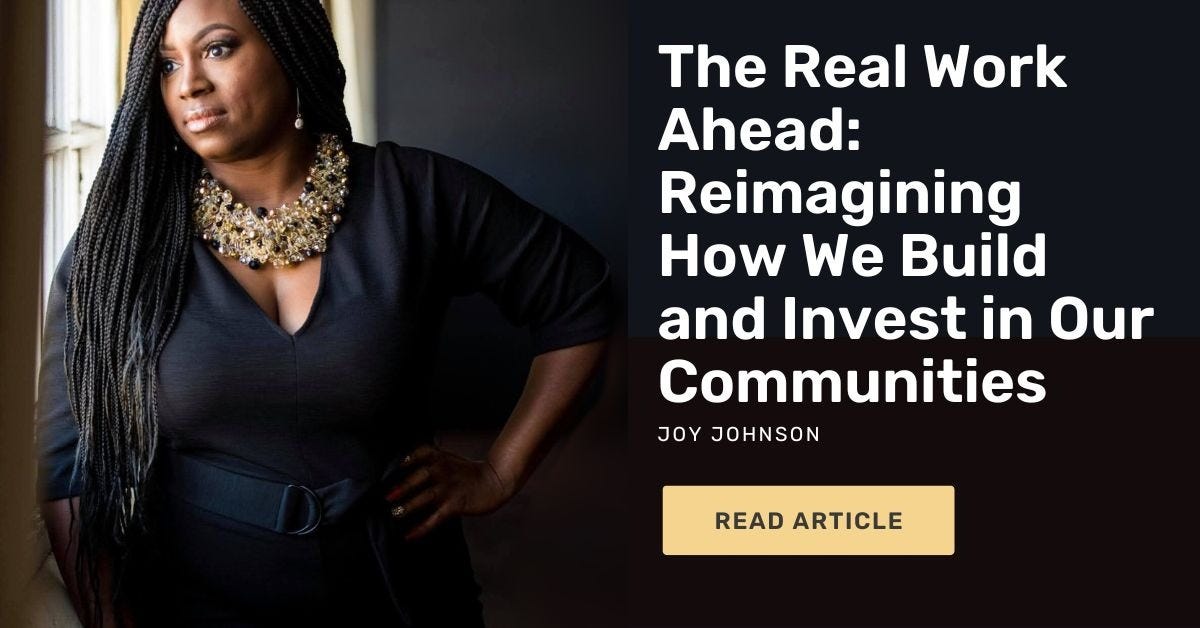
With more than two decades of experience in community development, real estate strategy, and organizational leadership, Joy Johnson brings a seasoned, solutions-focused voice to the field. She is committed to helping communities and institutions avoid systemic pitfalls and build models that truly work. To reach Joy call at (216) 238-2235