

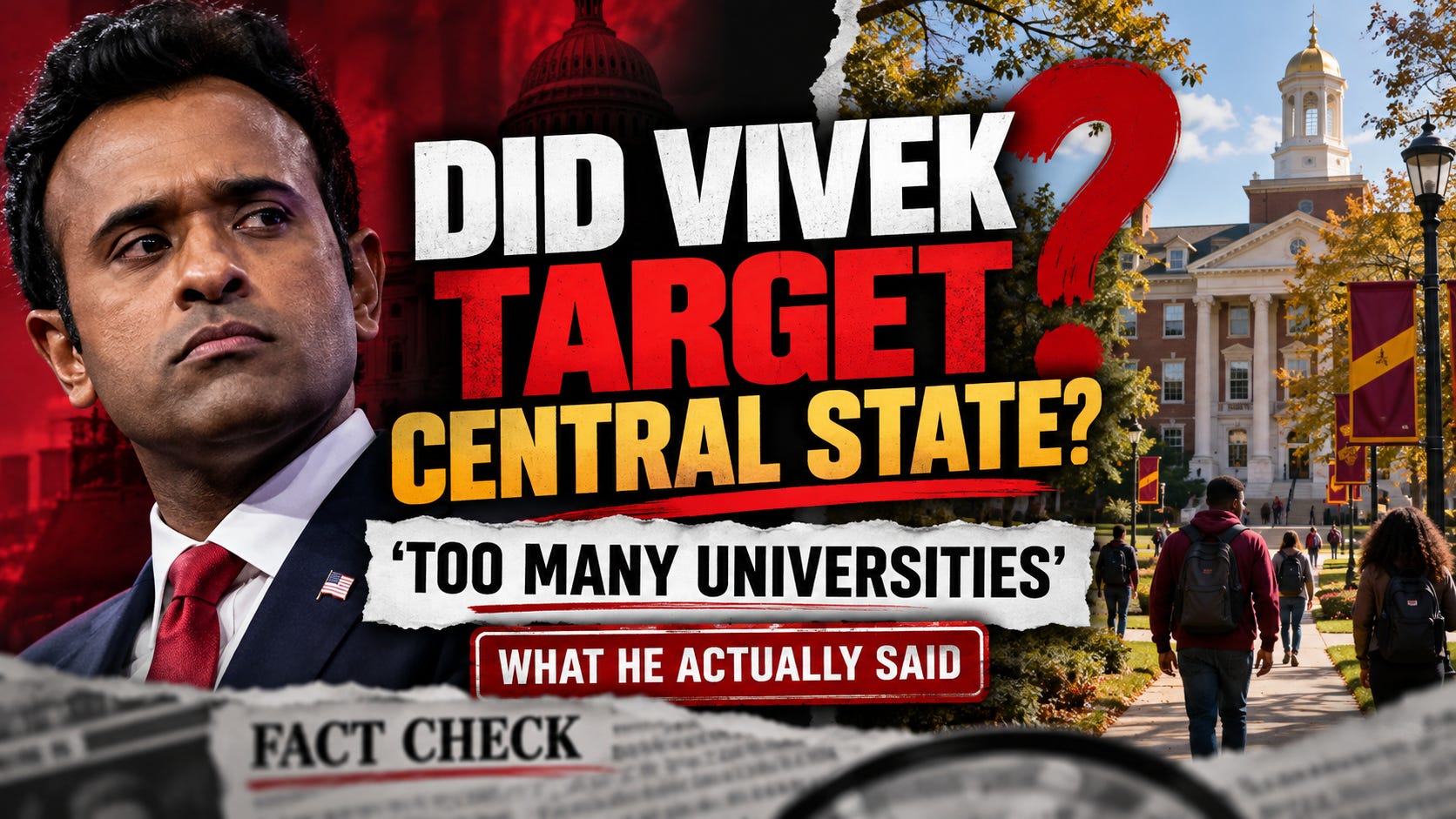
Publisher’s disclosure: I have a particular interest in the future of Historically Black Colleges and Universities. I am an advocate for HBCUs, I attended Central State University, and my daughter attended Spelman College. If someone proposes something that could threaten an HBCU, I want to know about it.
But that is also precisely why getting the facts right matters.
Political campaigns have a way of turning proposals into talking points, talking points into warnings and warnings into statements that the candidate may never have actually made.
The controversy surrounding Republican gubernatorial candidate Vivek Ramaswamy and Ohio’s public universities is a good example.
Ramaswamy has unquestionably proposed major changes to Ohio’s higher-education system.
In March, he said Ohio has too many universities.
“We have too many of them,” Ramaswamy said in a video discussing state spending. “They need to be consolidated.”
That is a significant statement and one that Ohio voters — particularly communities with universities in their regions — have every right to scrutinize.
But what Ramaswamy said next, what he wrote later and what he specifically said about Central State University are equally important.
What his plan actually says
In a March 27 opinion column outlining his higher-education proposal, Ramaswamy argued that declining enrollment and increasing costs require Ohio to rethink how its public universities operate.
He pointed to several universities experiencing financial or enrollment challenges. Among them was Central State University, which he noted remained under “fiscal watch.”
Central State was not alone. His discussion also referenced Cleveland State University, the University of Akron and Kent State University.
Ramaswamy proposed giving Ohio’s Chancellor of Higher Education authority to conduct a statewide review. According to his proposal, that review would examine where university missions overlap, where enrollment losses have made institutional independence difficult to sustain and where administrative operations could potentially be combined.
That proposal deserves serious examination.
It potentially could lead to significant changes in Ohio higher education.
But there is an important distinction.
Ramaswamy did not say in that proposal that Central State University should be closed.
He did not say Central State should be merged with another university.
And he did not identify another institution that Central State should be combined with.
He also did not specifically propose eliminating Central State’s state funding.
Where the concern comes from
The concern did not appear out of thin air.
Ramaswamy’s own language created questions.
In addition to saying Ohio had too many universities and that they should be consolidated, he later said during an April event, “I don’t think you should be funding subpar universities.”
That is a legitimate statement for voters to examine.
But there is another distinction that matters: the available evidence does not show Ramaswamy making that statement and specifically identifying Central State University as one of the “subpar universities” he was talking about.
Connecting those two things may be a political interpretation. It is not the same thing as quoting him saying it.
That distinction gets lost quickly during campaigns.
Ramaswamy later clarified his position
By July, Ramaswamy was being directly questioned about reports that he wanted to shut down Ohio universities.
He denied that characterization.
At a Strongsville event, Ramaswamy said his focus was on eliminating duplication between university programs rather than eliminating universities themselves.
“I think that we have too many duplicative programs in our universities,” he said.
When an attendee asked whether he wanted to “shut some schools,” Ramaswamy repeatedly said that interpretation was incorrect. He said he supported consolidating programs so every university would not necessarily offer the same academic programs.
That clarification does not erase his earlier comments.
Voters can reasonably ask whether his March statement that universities “need to be consolidated” went further than his later explanation.
They can question whether his proposal could eventually lead to mergers.
They can question whether an HBCU such as Central State could be disproportionately affected by a statewide restructuring.
Those are legitimate questions.
But they are questions.
They should not automatically be converted into a quotation or declaration that Ramaswamy said, “I am closing Central State University.”
The available evidence does not establish that.
You can oppose a proposal without changing what was said
This is where political discourse often breaks down.
People sometimes believe that accurately stating an opponent’s position somehow helps that opponent.
It doesn’t.
You can disagree strongly with Ramaswamy’s higher-education proposal.
You can believe consolidating programs would damage universities.
You can believe Central State deserves additional investment rather than restructuring.
You can argue that Ohio should protect the state’s only public HBCU.
You can even believe Ramaswamy’s proposal creates a future risk for Central State.
But none of those arguments requires claiming he said something that cannot be documented.
The strongest political argument is usually the one that can survive a fact check.
This is bigger than Central State or Vivek Ramaswamy
Earlier, Black Vanguard Media examined other political claims and reached the same basic conclusion: voters should not allow campaign advertisements, social-media posts, political parties or commentators to do all of their thinking for them.
That standard has to apply regardless of which candidate benefits from the facts.
If someone tells you a candidate said something, look for the video.
Look for the transcript.
Look for the candidate’s written proposal.
Read beyond the headline.
And distinguish between these three very different statements:
What the candidate actually said.
What the proposal could potentially lead to.
What the candidate’s opponents say the proposal means.
Sometimes all three point in the same direction.
Sometimes they don’t.
In this case, there is ample evidence that Vivek Ramaswamy wants significant restructuring of Ohio’s public higher-education system. He has talked about consolidation, reducing duplication and reconsidering the way struggling institutions operate.
That should be debated.
There is also reason for Central State supporters to pay attention.
But based on the publicly available statements reviewed by BVM, there is not evidence that Ramaswamy specifically announced a plan to close Central State University, eliminate its funding or merge it with a named institution.
That’s the difference between reporting what someone said and reporting what someone believes it might mean.
During an election season, voters deserve to know the difference.
Do your own research. Read the source material. And don’t let anybody’s political narrative — including one you agree with — substitute for the facts.