

As our nation approaches its 250th anniversary, many people are asking an important question: What does a repaired future look like?
For those of us who work in community development, the answer is not theoretical.
We see it every day.
I recently learned about the Week of Repair, a national effort inviting Americans to reflect on how we repair harm and build a thriving future together. The initiative challenges us to think beyond commemoration and consider what it would take to create communities where everyone has the opportunity to flourish.
As I reflected on that question, I realized something.
Community development has always been an act of repair.
For more than twenty years, I have worked alongside residents, nonprofit organizations, public agencies, and community leaders to strengthen neighborhoods. The language we use is often economic development, affordable housing, neighborhood revitalization, or capacity building.
But beneath all of those terms is a simple idea: helping communities recover from the consequences of disinvestment and creating the conditions for future prosperity.
Repair is restoring a vacant property so that it becomes a home again.
Repair is helping a nonprofit build the capacity to serve more families.
Repair is connecting communities to capital that has historically flowed elsewhere.
Repair is creating opportunities for residents to shape the future of their own neighborhoods.
Repair is not simply fixing what is broken. It is investing in what is possible.
Throughout my career, I have worked in communities that were often described by their challenges. Yet what I found was something entirely different. I found neighborhoods rich with talent, creativity, leadership, and resilience.
What many communities lacked was not potential.
They lacked investment.
They lacked access.
They lacked the resources necessary to transform vision into reality.
A repaired future is one where those barriers no longer determine outcomes.
A repaired future is one where a child’s ZIP code does not dictate their opportunities.
A repaired future is one where historically disinvested neighborhoods have access to the same capital, infrastructure, and economic opportunity as any other community.
A repaired future is one where residents are not merely consulted but are trusted as co-creators of change.
A repaired future is one where community voice guides investment rather than follows it.
Most importantly, a repaired future is built through relationships.
No grant, policy, or program can create repair on its own.
Repair happens when people choose collaboration over division.
When institutions listen.
When communities are trusted.
When resources align with local priorities.
When we recognize that strengthening one neighborhood strengthens all of us.
As we celebrate America’s 250th year, we should certainly honor our history. But we should also honor the countless nonprofit leaders, community builders, volunteers, organizers, and residents who have spent generations repairing what others ignored.
They are the connective tissue of our democracy.
They are the reason communities endure.
And they are showing us what a repaired future can look like.
The good news is that we do not have to imagine that future from scratch.
Across the country, communities are already building it.
One neighborhood, one partnership, and one act of repair at a time.
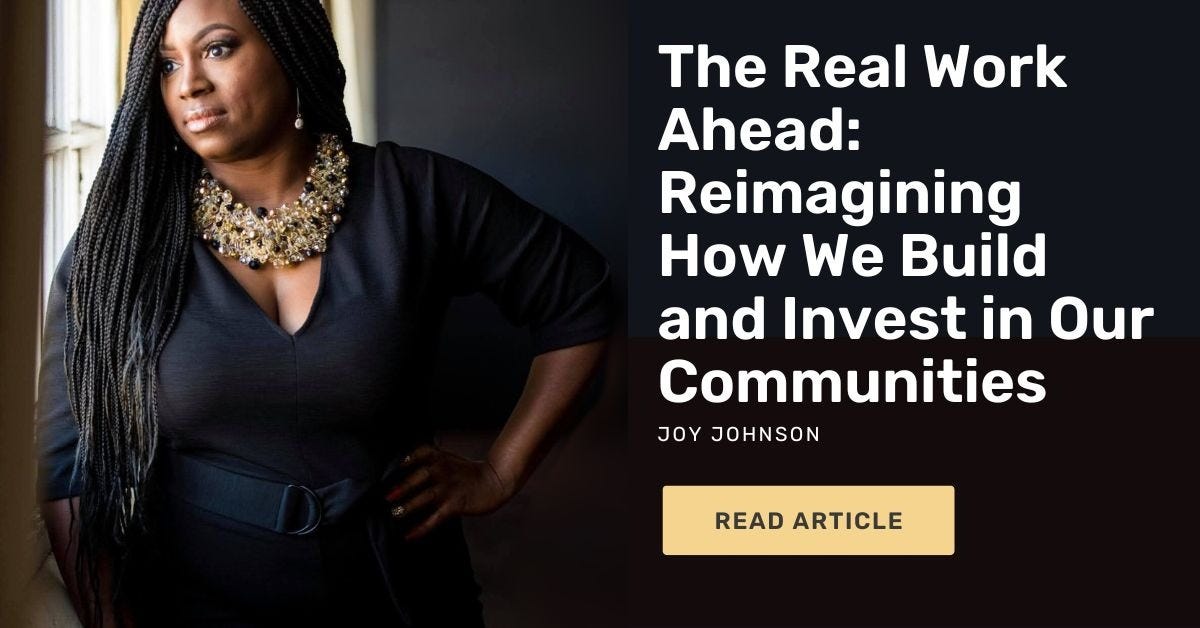
With more than two decades of experience in community development, real estate strategy, and organizational leadership, Joy Johnson brings a seasoned, solutions-focused voice to the field. She is committed to helping communities and institutions avoid systemic pitfalls and build models that truly work. To reach Joy call (216) 238-2235.