

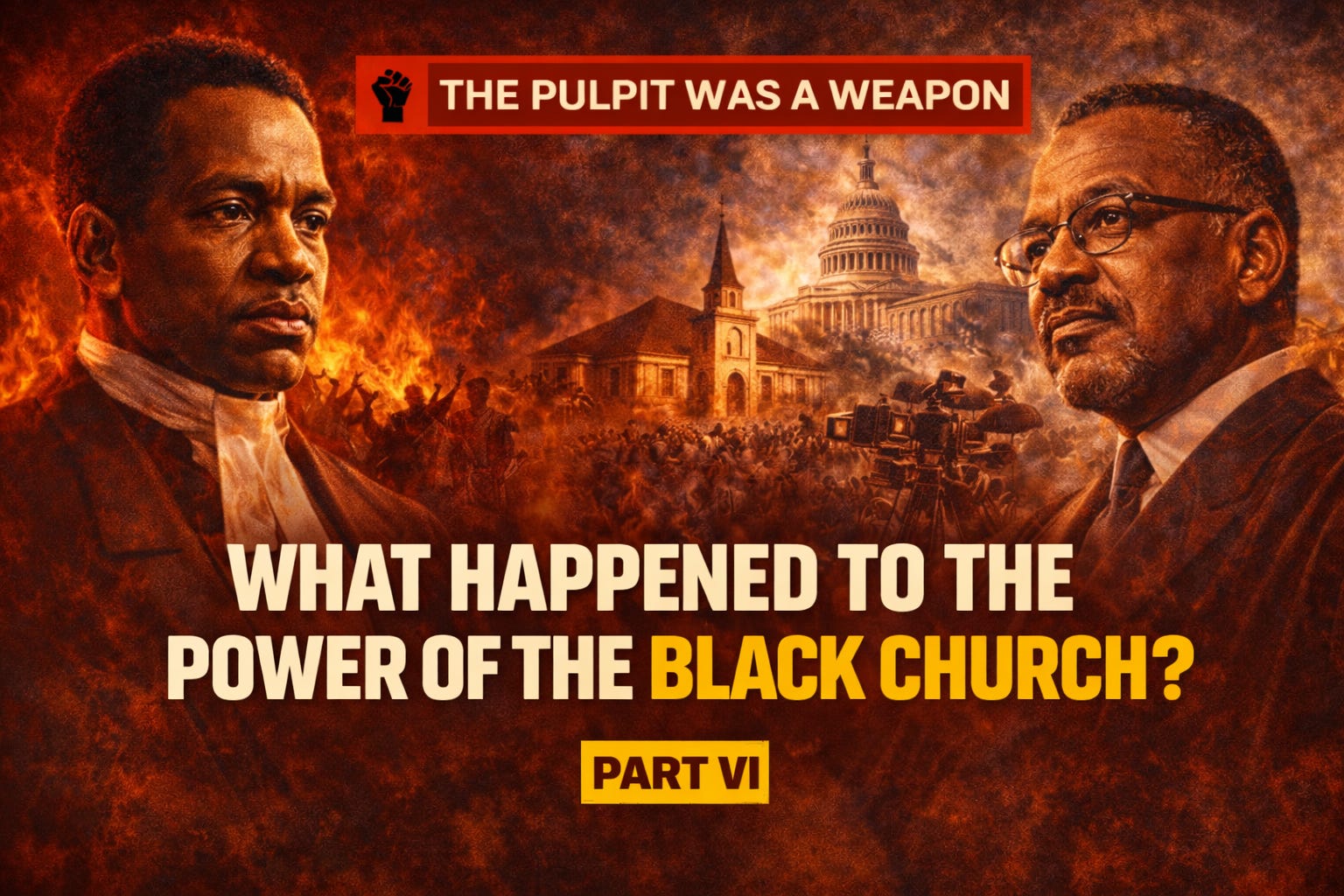
The Black church didn’t lose power overnight.
It didn’t collapse.
It didn’t disappear.
It didn’t stop existing.
It shifted.
Quietly. Incrementally. Respectably.
And that’s what makes this question so uncomfortable—because the loss wasn’t imposed. Much of it was negotiated.
From Liberation Engine to Accepted Institution
At its height, the Black church was feared because it was independent.
Independent of white oversight
Independent of donor approval
Independent of political permission
It could disrupt because it owed nothing to the systems it challenged.
But over time, a new reality emerged.
Survival began to require:
Funding
Access
Partnerships
Legitimacy in white-controlled spaces
None of these are inherently wrong.
But each came with conditions.
And conditions reshape behavior.
When Dependence Replaced Autonomy
As civil rights victories opened doors, the Black church gained proximity to power—but lost something else in the process.
Funding streams replaced congregational self-reliance.
Foundations replaced grassroots accountability.
Nonprofit language replaced prophetic language.
The church learned how to manage programs instead of confront systems.
What once threatened power began to interface with it.
And power prefers partners to prophets.
The Cost of “A Seat at the Table”
A seat at the table sounds like progress—until you notice who built the table, who sets the agenda, and who decides when you’ve overstayed your welcome.
Gradually:
Radical demands were softened
Economic critiques were postponed
Institutional loyalty replaced community risk
The pulpit still spoke about justice—but often without consequences.
Because consequences threaten funding.
And funding had become survival.
The Question Beneath the Question
People often ask:
“Why doesn’t the Black church lead movements like it used to?”
That’s the wrong question.
The better one is:
> What happens to an institution when its survival depends on not making anyone too uncomfortable?
Because liberation has never been comfortable.
The Myth of Neutrality
Some argue the church simply became “apolitical.”
History tells us that’s impossible.
Silence in the face of injustice is not neutrality.
It’s alignment—with whoever benefits from the status quo.
The early Black church understood this.
That’s why it was dangerous.
The modern version often pretends otherwise.
Can the Pulpit Be a Weapon Again?
That’s the question this entire series has been building toward.
Not:
Should the church be political?
Should pastors speak out?
But:
> Can an institution built to liberate operate effectively while dependent on the systems it once opposed?
Because you cannot weaponize what you do not control.
What History Actually Teaches Us
The lesson of Samuel Sharpe, Richard Allen, Nat Turner, Henry McNeal Turner, Martin Luther King Jr., James Cone, and others is not that faith saves.
It’s that faith organized independently disrupts empires.
Whenever the church:
Controlled its own resources
Answered directly to its people
Refused to dilute its moral clarity
It changed history.
Whenever it didn’t—history changed it.
The Final Mirror
This series was never about nostalgia.
It was about inheritance.
Every generation of Black leadership inherits institutions built through sacrifice. The question is not whether those institutions still exist.
The question is:
> What are we willing to risk to make them matter again?
Because the pulpit was never dangerous because of the Bible.
It was dangerous because of who controlled it—and what they were willing to say when power pushed back.
Covid took a lot of Black churches across the country out, and the majority of the ones remaining are trying to pose as politically correct amidst a politically incorrect regime.