

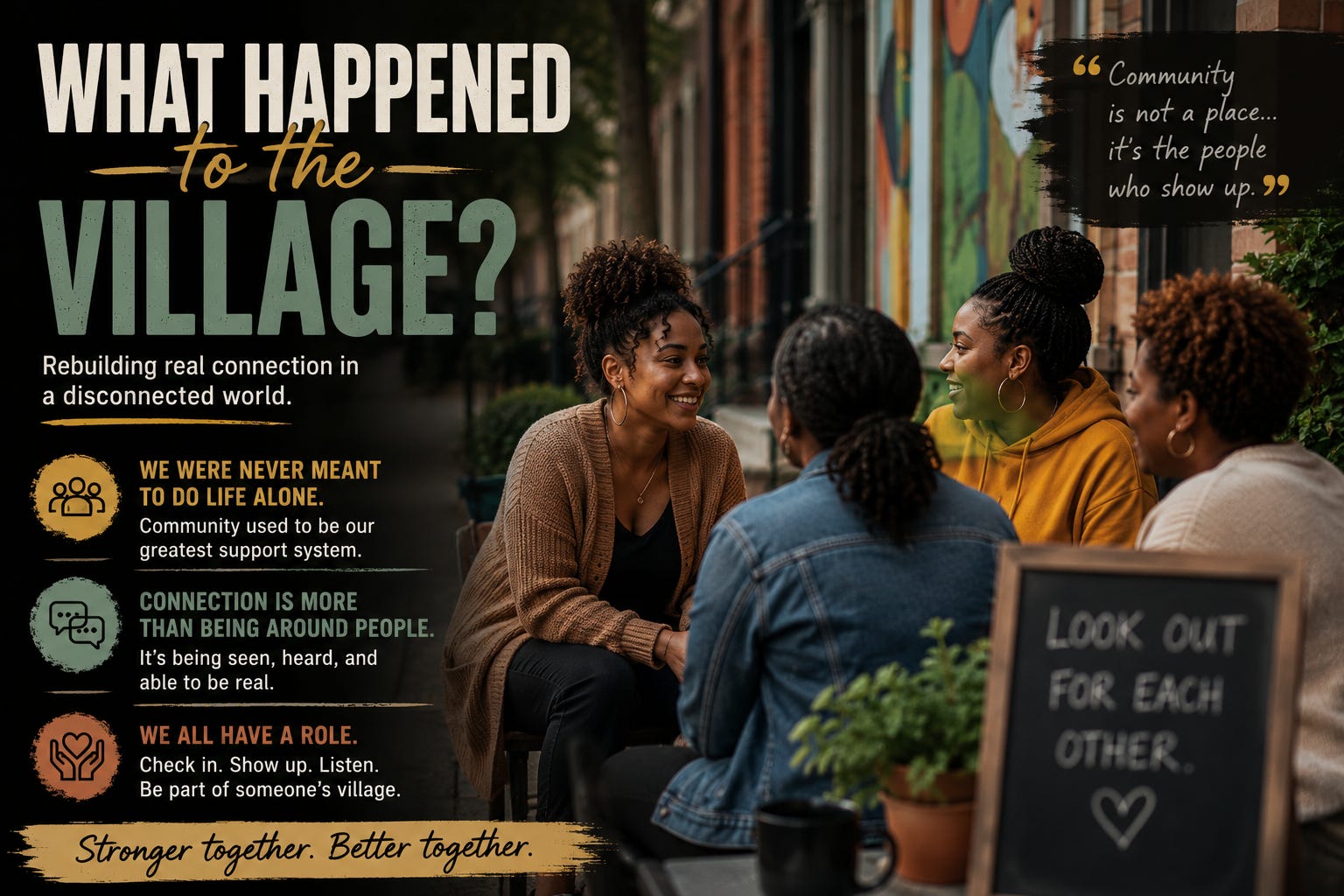
There was a time when the community felt closer.
People knew their neighbors. Parents looked out for each other’s children. Churches, barbershops, beauty salons, front porches, and community centers were more than just places people passed through — they were places where relationships were built. People checked in on one another. Conversations happened naturally. Advice, support, accountability, and encouragement were woven into everyday life.
That did not mean communities were perfect. They were not. People still struggled. Families still faced hardship. But there was often a stronger sense that nobody was supposed to carry life entirely on their own.
Somewhere along the way, that feeling started to fade.
Today, many people live surrounded by others while still feeling deeply disconnected. Neighbors can live next door to each other for years without speaking. Families communicate less. People spend more time interacting online than they do sitting together in real conversation. Even when people are physically present, many are mentally distracted, emotionally unavailable, or simply exhausted.
And the effects of that disconnection are showing up everywhere.
People are lonelier. Trust feels weaker. Patience feels shorter. Many people no longer feel like they have spaces where they can be fully honest about what they are carrying. Instead, people often feel pressure to appear successful, strong, busy, or unbothered — even when they are struggling underneath the surface.
Social media has intensified some of this. We are constantly connected to everybody’s opinions, achievements, arguments, lifestyles, and personal moments. But being exposed to people all day is not the same thing as feeling genuinely supported by them.
In many ways, we have replaced community with visibility.
And those are not the same thing.
A real community creates support. Accountability. Presence. A sense of belonging. It gives people somewhere to turn during difficult moments instead of forcing them to navigate everything alone.
That matters because people are not built to function in isolation for long periods of time.
When people feel disconnected long enough, it affects more than emotions. It affects relationships, mental health, conflict resolution, and even how people see the world around them. Isolation can slowly make people more hopeless, more defensive, and less trusting of others.
You can feel some of that tension today. People are quicker to argue, quicker to withdraw, and slower to listen. Conversations often feel performative instead of genuine. Many people no longer feel heard — they feel reacted to.
And maybe part of the reason is because we have lost some of the spaces where honest, human connection used to happen naturally.
That is why rebuilding community matters.
Not in a nostalgic way where we pretend the past was perfect, but in a real and practical way. People need spaces where they can talk honestly. They need mentors, friendships, community organizations, faith communities, families, and local spaces that remind them they are not navigating life alone.
A real “check up from the neck up” is not only personal — it is communal too.
It is about paying attention to the emotional condition of the people around us. It is about checking in on friends who suddenly become distant. It is about creating environments where vulnerability is not treated like weakness. It is about rebuilding the habits of community that help people feel grounded and supported.
Because the truth is, many people do not just need resources.
They need people.
And maybe one of the biggest challenges communities face right now is learning how to reconnect with each other in a world that constantly pulls people apart.