

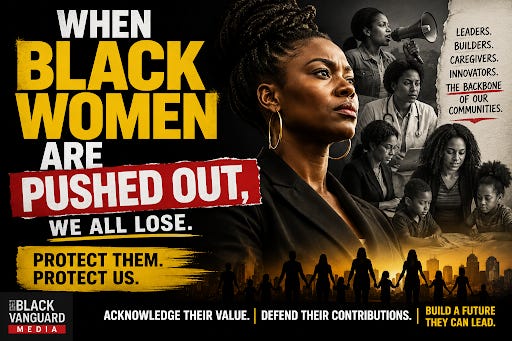
Black women have long been called the backbone of the community. The phrase is usually offered as praise, but it also carries an uncomfortable truth: backbones bear weight. They absorb pressure. They keep bodies standing even when the rest of the structure is weak.
In families, churches, schools, nonprofits, public agencies, small businesses and civic movements, Black women are often asked to hold together what others have neglected. They manage crisis, preserve institutional memory, calm conflict, build relationships and keep services moving when resources are thin.
Yet the public gratitude rarely matches the institutional protection.
A growing body of labor data and workplace research shows that Black women have faced disproportionate employment disruption in recent years. That disruption is not only about layoffs. It includes reduced hours, labor-force exits, public-sector losses, leadership instability and a recurring pattern in which Black women are expected to repair broken systems without being given the support, resources or grace required to survive them.
BY THE NUMBERS
16.6%: Black women’s unemployment rate in May 2020, according to NWLC analysis of BLS data.
606,000: Approximate number of Black women who had left the labor force by February 2021, according to NWLC.
1.4 points: Drop in Black women’s employment-to-population ratio in 2025, according to EPI.
3.5 points: Employment-to-population drop among Black women with bachelor’s degrees in 2025, according to EPI.
During the pandemic recession, the damage was immediate. National Women’s Law Center analysis of federal labor data found that Black women’s unemployment rate reached 16.6 percent in May 2020. Months later, many had not recovered. NWLC reported that Black women remained unemployed at nearly twice their pre-pandemic rate in early 2021, while hundreds of thousands had left the labor force entirely.
Those losses were not random. A peer-reviewed study in Feminist Economics by Michelle Holder, Janelle Jones and Thomas Masterson found that Black women’s work was heavily concentrated in sectors and occupations hit hard by COVID-related shutdowns and disruption. The study described how occupational segregation, low-wage work and the structure of the labor market made Black women particularly vulnerable when the economy buckled.
Even as the broader economy recovered, Black women’s return to stable work remained uneven. Brookings Institution researchers reported that Black women were leaving the labor force during parts of the recovery while other groups were regaining ground. The numbers revealed something Black women had already been saying in workplaces and households: recovery does not reach everyone at the same time, and it does not reach everyone with the same protection.
The concern did not end with the pandemic. In 2025, the Economic Policy Institute reported that Black women suffered one of the sharpest one-year employment declines seen in the last quarter century. EPI found that Black women’s employment-to-population ratio fell to 55.7 percent, with the steepest losses among Black women with bachelor’s degrees. In other words, education alone did not shield Black women from the downturn.
That finding should trouble anyone who believes the solution is simply for Black women to work harder, credential up or prove themselves again. Many already have. They have done what America told them to do. They earned degrees, built resumes, led departments, served communities, raised families and carried institutions through fragile periods. Still, the data shows they remain exposed when systems decide who is protected and who is expendable.
The public sector is especially important to this story. For generations, government and nonprofit employment provided a pathway to relative stability for Black workers, particularly Black women. But EPI’s 2025 analysis concluded that public-sector losses played a major role in the decline in Black women’s employment. When those jobs disappear, the impact is not limited to one worker. It reverberates through households, neighborhoods and institutions that depend on Black women’s income, expertise and leadership.
There is also a leadership pattern that rarely appears in a monthly jobs report. Workplace equity researchers have described the “glass cliff,” a term used when women or people of color are placed in leadership during moments of crisis, instability or heightened risk. They are handed the hardest assignments, often with limited resources and shrinking room for error. If the institution falters, they become the face of failure. If they survive it, the system often claims the credit.
“The question is not whether Black women are strong. The question is whether communities will finally build systems that do not depend on their strength while refusing to protect them.”
Many Black women recognize this pattern before it is ever named. They are brought in after the budget is already strained. They are asked to restore trust after others damaged it. They inherit old conflicts, inadequate systems, political pressure and public expectations that were created long before they arrived. Then, when the strain becomes visible, scrutiny narrows. The woman who carried the burden becomes easier to question than the structure that created it.
This is where communities must be careful. Accountability is necessary. No leader, employee or institution should be above honest review. But accountability becomes something else when it isolates one Black woman from the full environment around her. It becomes something else when it ignores who controlled the resources, who set the policies, who delayed decisions, who benefited from silence and who was protected when blame was being assigned.
A fair review asks more than whether a Black woman was strong enough to withstand pressure. It asks whether she was properly supported. It asks whether the expectations were realistic. It asks whether others were held to the same standard. It asks whether the institution used her labor, credibility and relationships until they became inconvenient.
That distinction matters because job loss and leadership removal are not private events in the Black community. When a Black woman is pushed out of work, a family may lose its primary source of stability. When she is forced out of leadership, an institution may lose memory, trust and community connection. When she is publicly undermined after years of service, younger Black women are watching and calculating the cost of stepping forward.
Silence teaches a lesson, too. It tells employers, boards, agencies and civic organizations that Black women can be praised in public and abandoned in practice. It tells the next generation that loyalty may not be returned, competence may not be enough and service may not protect them from being treated as disposable.
Protecting Black women does not mean shielding anyone from legitimate questions. It means demanding full context before accepting a convenient narrative. It means asking who else had responsibility. It means reviewing the system, not only the person standing closest to the fire. It means refusing to turn the language of accountability into a weapon used most forcefully against those who had the least margin for error.
The response must be practical. Institutions should track employment and leadership outcomes by race and gender. Boards and executive teams should document the resources given to leaders during periods of crisis. Departures from key roles should be handled with transparency and care, especially when public trust or community service is involved. Communities should ask for facts before joining public takedowns. Black men, in particular, must do more than call Black women queens, backbones and pillars. They must stand beside them when institutional power turns cold.
There is no serious conversation about Black progress that does not include the protection of Black women. They are not merely participants in our survival. They are often the infrastructure of it.
The question now is whether communities will keep celebrating Black women after the damage is done, or whether we will build the habits, policies and courage to defend them while they are still standing.
If Black women are the backbone, then protecting Black women is not charity. It is self-preservation.
Protect them, and we protect families. Protect them, and we protect institutions. Protect them, and we protect the future we keep asking them to carry.
Selected sources
• U.S. Bureau of Labor Statistics, Current Population Survey, Table A-2: Employment status by race, sex, and age — source link
• National Women’s Law Center analysis of Black women’s pandemic job loss and labor-force disruption — source link
• Michelle Holder, Janelle Jones and Thomas Masterson, ‘The Early Impact of COVID-19 on Job Losses among Black Women in the United States,’ Feminist Economics — source link
• Brookings Institution, analysis of Black women leaving the labor force during the recovery — source link
• Economic Policy Institute, analysis of 2025 employment losses among Black women — source link
• Joint Center for Political
and Economic Studies, 2025 jobs analysis — source link
• Catalyst, research explainer on the glass cliff and women of color — source link
• National Employment Law Project, analysis of occupational segregation among Black women workers — source link