

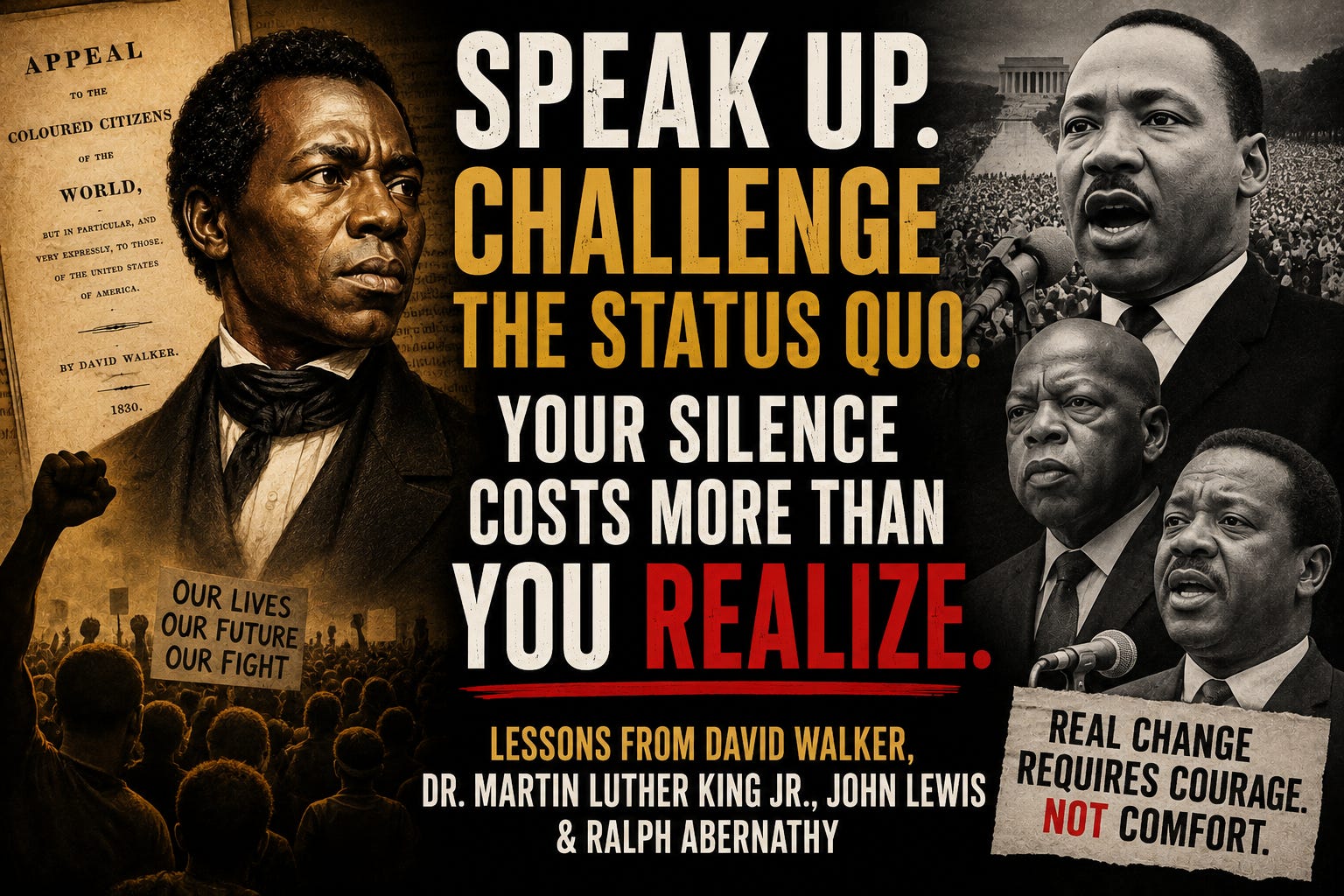
David Walker, Martin Luther King Jr., John Lewis and Ralph Abernathy are easy to honor now. Following their example when speaking up threatens a paycheck, a relationship, a grant or a career is something else entirely.
David Walker did not write Appeal to the Coloured Citizens of the World because challenging America was good for his career.
There was no foundation grant waiting for him because he confronted Thomas Jefferson’s assertions about Black inferiority. There was no corporate sponsor underwriting his criticism of slavery. There was no comfortable institutional consensus protecting him when copies of his Appeal made their way into Southern states.
Walker spoke when speaking carried consequences.
That is precisely what makes his example worth remembering.
Nearly two centuries later, America has become very good at celebrating people who challenged injustice after the challenge is over.
We quote Martin Luther King Jr. We invoke John Lewis and “good trouble.” We remember Ralph Abernathy. We celebrate Rosa Parks. We teach children about abolitionists and freedom fighters.
But there is an uncomfortable question underneath all of that celebration:
Would we have followed them when following them could have cost us something?
That question matters because there is an enormous difference between admiring courage and practicing it.
Everybody Loves a Revolutionary After the Revolution
History has a way of sanitizing courageous people.
Their confrontations become inspirational quotations. Their arrests become photographs in textbooks. Their unpopular positions become commemorative speeches. Institutions that once would have considered their demands disruptive can eventually sponsor luncheons honoring their memory.
What disappears is the risk.
Martin Luther King Jr. was not universally admired while he was alive. Gallup polling from the period shows that by 1966, a majority of Americans viewed him unfavorably. He was arrested, threatened, surveilled by the federal government and ultimately assassinated.
John Lewis was beaten during the Freedom Rides and suffered a fractured skull on Bloody Sunday in Selma.
Ralph Abernathy was arrested repeatedly and saw his home and church bombed during the Montgomery Bus Boycott.
David Walker circulated an argument so threatening to the slaveholding order that Southern authorities attempted to suppress it and responded with increased restrictions on Black people and abolitionist literature.
These men were not practicing ceremonial civil rights.
They were confronting power.
And confronting power is rarely comfortable.
Civil Rights Was Never a Job Description
One of the great distortions of the modern civil-rights conversation is the assumption that advocacy belongs primarily to people who are employed to do it.
History says otherwise.
Movements have certainly required organizations, professional leadership, fundraising and infrastructure. But much of the actual work of freedom was performed by ordinary people who did not receive salaries for marching, organizing, boycotting, registering voters, housing organizers or challenging injustice.
They participated because something needed to be done.
The Montgomery Bus Boycott depended upon thousands of Black residents making daily sacrifices.
The sit-in movement was driven substantially by students.
Freedom Summer relied heavily on volunteers.
Local churches, families, teachers, business owners and ordinary citizens provided food, transportation, meeting space, money and protection.
They did not ask whether civil rights was included in their job description.
They understood citizenship differently.
There was work that belonged to the community simply because they were members of the community.
That distinction deserves to be recovered.
Being paid to administer a civil-rights organization and possessing civil-rights convictions are not the same thing.
A salary can support advocacy.
It cannot manufacture courage.
The Paycheck Problem
There is another sentence heard constantly in workplaces and communities:
“I agree with you, but I can’t say anything. I could lose my job.”
That fear is not imaginary.
People have mortgages. Children need food. Careers can be damaged. Powerful institutions can retaliate. Contracts can disappear. Relationships can change. Speaking recklessly without understanding the consequences is not necessarily courage.
But acknowledging those realities cannot end the conversation.
Because silence also has a price.
If every generation refuses to challenge injustice because challenging it might threaten employment, then the institutions providing those jobs effectively determine the boundaries of acceptable Black advocacy.
Think about what that means.
The employer becomes more powerful than the principle.
The funder becomes more powerful than the mission.
The political relationship becomes more important than the community.
The invitation to the room becomes more important than what happens inside the room.
Eventually, people become experts at describing injustice privately while remaining remarkably quiet publicly.
That is not neutrality.
Silence can preserve the conditions we claim to oppose.
Your Children Inherit What You Refuse to Confront
This is where the issue becomes generational.
When people say, “I have to protect my job because I have children,” the motivation is understandable.
But there is another responsibility to those same children.
What kind of community will they inherit?
A parent can protect today’s paycheck while leaving tomorrow’s problem untouched.
A professional can preserve a career while allowing a discriminatory system to become more deeply entrenched.
A community leader can protect institutional relationships while another generation inherits the consequences of those relationships.
That does not mean everyone must become a martyr.
It means we should stop pretending that silence is free.
Sometimes we pay for speaking.
Sometimes our children pay for our silence.
David Walker understood that distinction.
He was writing not simply about the condition of Black people in 1829, but about what Black people were willing to accept as the definition of themselves.
That was a generational question.
When Funding Begins Defining the Movement
Modern advocacy faces a complication earlier movements experienced differently: a substantial professional ecosystem now exists around social justice.
There are nonprofit organizations, foundations, corporate partnerships, government contracts, consultants, conferences and professional advocacy positions.
Much of that infrastructure does valuable work.
But infrastructure creates a danger when preserving the institution becomes more important than confronting the condition the institution was created to address.
An organization can gradually learn which subjects threaten funding.
It learns which officials should not be challenged.
It learns which corporate partners should not be embarrassed.
It learns which community grievances can be discussed safely and which ones might jeopardize relationships.
Nobody necessarily issues an order to remain silent.
The incentives can accomplish that themselves.
Soon advocacy becomes strongest where opposition is weakest.
Statements arrive after the public consensus has formed.
Courage is demonstrated on subjects where courage is no longer particularly necessary.
The language remains radical.
The behavior becomes institutional.
That is how a movement can retain the vocabulary of civil rights while losing some of its willingness to confront power.
Civil Rights Cannot Mean Only Safe Rights
There is something fundamentally contradictory about practicing civil rights only when everyone important agrees with you.
The people we celebrate did not have that luxury.
King’s opposition to the Vietnam War placed him at odds with President Lyndon Johnson and some allies within the civil-rights movement.
Lewis and the Student Nonviolent Coordinating Committee pushed against the caution of established leaders.
Abernathy endured jail, threats and violence.
Walker challenged one of America’s most revered founding fathers and the racial assumptions of the society around him.
They did not wait for universal approval.
That is why their examples matter.
Civil rights, properly understood, means asserting the dignity, citizenship and rights of human beings precisely when those rights are being denied.
If everyone already agrees, little courage is required.
The test comes when your position costs access.
When the donor disagrees.
When your employer would prefer silence.
When political allies become uncomfortable.
When friends tell you that you are going too far.
When there is no applause yet.
That is where conviction becomes visible.
Quoting John Lewis Is Easier Than Making Good Trouble
“Good trouble” has become one of the most beloved phrases in American civic life.
But good trouble was never supposed to mean comfortable trouble.
John Lewis was talking about disrupting injustice.
Real disruption inconveniences somebody.
It challenges somebody.
It threatens an arrangement somebody benefits from.
That is why trouble becomes necessary in the first place.
If our version of “good trouble” never threatens a relationship, never challenges a powerful institution, never risks access and never creates discomfort, we should at least ask whether it is trouble at all.
The same applies to King.
It is easy to quote the dream.
It is harder to follow the man who wrote from a Birmingham jail because religious leaders told him his demonstrations were “unwise and untimely.”
King’s response to those moderate critics remains one of the great lessons of the movement: people suffering injustice are continually told to wait for a more convenient time.
History usually remembers the person who refused to wait.
It rarely erects monuments to the people who advised him to remain quiet.
Courage Does Not Require Recklessness
None of this means everyone should walk into work tomorrow and deliberately get fired.
Strategy matters.
Movements need lawyers, researchers, business owners, donors, organizers, elected officials, journalists, clergy, professionals and people working inside institutions.
Different people can take different risks.
Courage is not measured by how quickly someone can destroy his own livelihood.
The lesson is more demanding than that.
Fear of consequences cannot become a permanent excuse for surrendering one’s conscience.
Sometimes courage means speaking publicly.
Sometimes it means documenting what is happening.
Sometimes it means organizing coworkers.
Sometimes it means supporting someone else who can speak.
Sometimes it means providing money.
Sometimes it means voting differently.
Sometimes it means refusing to participate.
Sometimes it means building an alternative institution so that the community no longer depends upon the institution creating the problem.
Everyone does not have to stand in the same place.
But everybody can do something.
Stop Admiring Courage You Are Unwilling to Practice
Perhaps that is the uncomfortable lesson David Walker leaves us.
We should stop reducing courageous people to quotations.
Walker is not important because his words sound powerful almost 200 years later.
He is important because he said them when saying them was dangerous.
King is not important merely because his speeches sound beautiful today.
Lewis is not important because “good trouble” fits neatly on a T-shirt.
Abernathy is not important because his name belongs in a history book.
Their significance lies partly in the fact that they acted before history had guaranteed that history would vindicate them.
They put skin in the game.
That is the standard worth remembering.
The next great civil-rights question may not arrive with a universally recognized villain. It may involve an employer we like, a political party we support, a corporation that funds our organization, a foundation that writes our checks, a leader we consider a friend or an institution whose invitation list we enjoy being on.
That is when we will discover whether civil rights is something we believe or simply something we commemorate.
David Walker confronted Thomas Jefferson when Jefferson’s intellectual authority towered over the country.
The generations that followed confronted slavery, segregation, disenfranchisement and state-sanctioned discrimination when doing so carried enormous personal consequences.
They did not know that streets would someday bear their names.
They only knew something was wrong.
And they decided that silence would cost too much.
The question for our generation is not whether we honor their courage.
The question is whether, when our own moment comes, we are willing to practice it.