

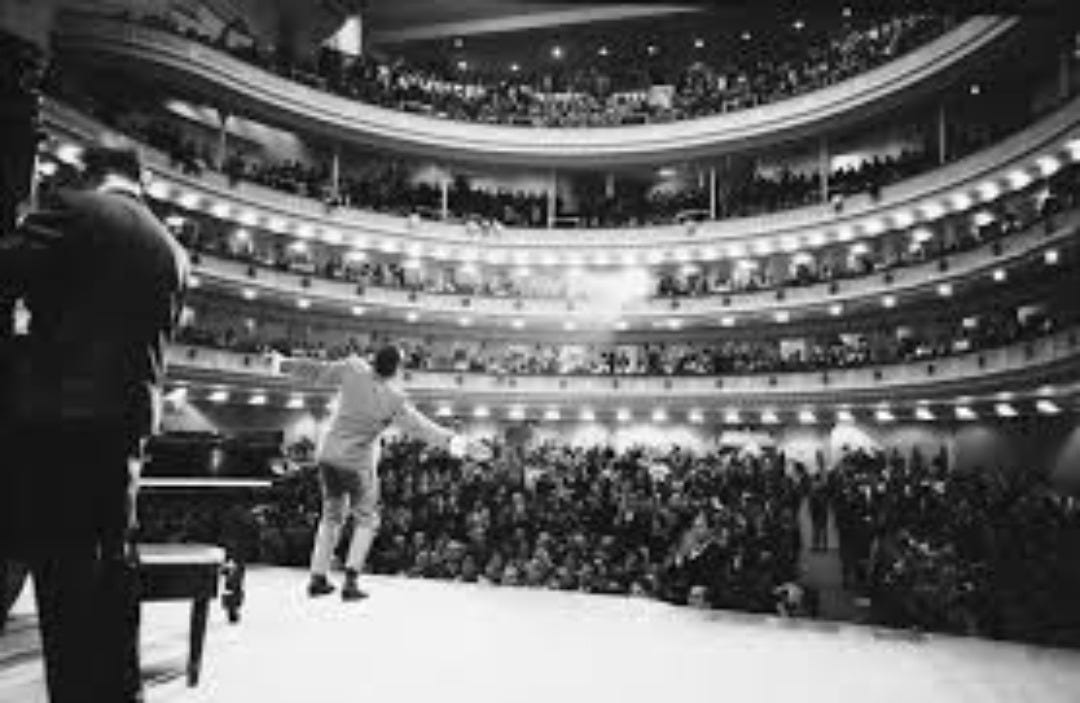
In 1961, Ray Charles walked out of a segregated auditorium in Augusta, Georgia—and canceled his own sold-out show.
Not because the tickets hadn’t sold.
Not because the crowd wasn’t waiting.
But because Black fans were being forced into the balcony.
The promoters threatened lawsuits.
The city threatened retaliation.
Ray Charles canceled anyway.
And then he didn’t play Georgia again for fourteen years.
That decision cost him real money.
At the time, Ray Charles was not a legacy act insulated by nostalgia. He was at the height of his commercial power. “What’d I Say” had crossed him over to white audiences. His deal with ABC-Paramount gave him something almost no Black artist had in the 1950s: ownership. He controlled his masters.
That control made the choice possible—and dangerous.
Promoters couldn’t blackball him quietly.
They could only punish him loudly.
Georgia did.
The state banned his music from radio stations. Concert bookings vanished. Local officials labeled him ungrateful. Industry insiders urged compromise. Ray Charles ignored them all. He understood something many still refuse to grasp:
Integration without dignity is just a new stage for humiliation.
Ray Charles had learned that lesson long before Augusta.
He went blind at seven years old, watching his younger brother drown in a washtub he couldn’t reach in time. Poverty followed. Independence followed faster. At the Florida School for the Deaf and the Blind, he learned music as survival—not decoration. By the time he entered the industry, he trusted his ears more than contracts and his instincts more than approval.
That instinct reshaped American music.
When Ray Charles fused gospel with blues and country in the 1950s, churches called it blasphemy. Labels called it unmarketable. White audiences were not supposed to hear Black sacred emotion repurposed as joy, lust, or grief.
Ray Charles did it anyway.
The backlash only confirmed the power. He had found the fault line—and he kept pressing it.
The Georgia boycott held until 1979.
That year, the state finally adopted Georgia On My Mind as its official song. Ray Charles returned to perform it publicly for the first time since the ban. The moment was framed as reconciliation. Ray Charles treated it as closure.
The state changed.
He did not.
Ray Charles was never defiant for symbolism.
He was defiant because control without conscience is useless. He owned his music so he could walk away from money when dignity demanded it. Long before activism became branding, Ray Charles lived by a rule that never wavered:
If the room required him to shrink, the music stopped.
That rule still echoes—louder than any encore.