

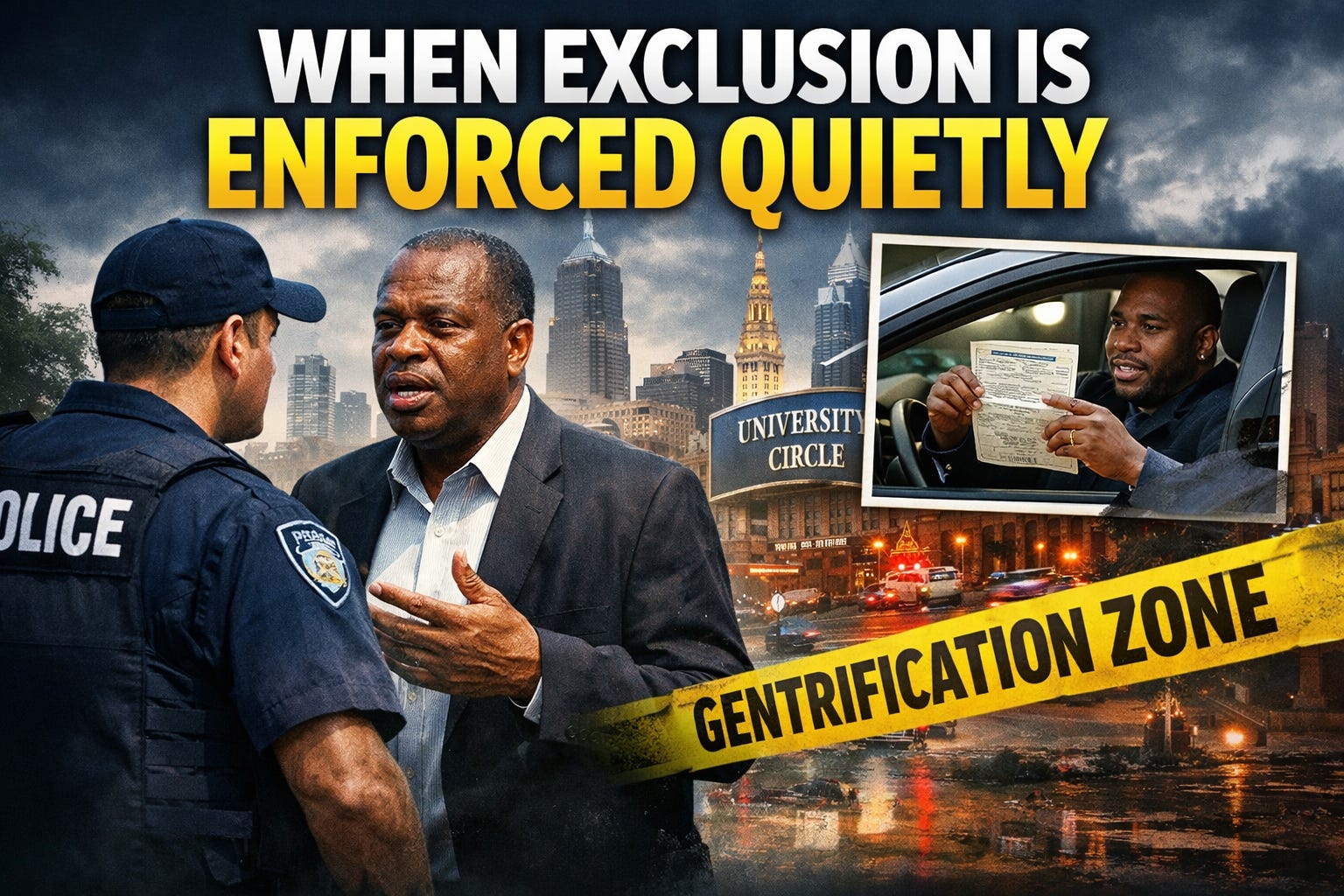
A recent civil rights lawsuit filed by the State of New Jersey alleges that local officials directed police to keep Black people out of a suburban town. The allegation is notable not because discrimination is new, but because it is unusually explicit. According to the complaint, routine law-enforcement tools—traffic stops, minor citations, and heightened scrutiny—were used to regulate who belonged in the community.
That case has drawn national attention. But its broader significance lies in what it helps illuminate elsewhere: how exclusion can be produced without explicit orders, through ordinary policing practices embedded in redevelopment strategies.
Cleveland’s University Circle provides an important local context for understanding how this can happen.
Disparities in Plain Sight
An analysis of Cleveland Municipal Court citation records reported by ProPublica found that, since 2015, approximately 88 percent of traffic citations issued by the University Circle Police Department (UCPD) were issued to Black drivers. This figure far exceeds the Black share of the driving population in the surrounding ZIP codes and substantially exceeds Cleveland-wide averages for traffic enforcement.
To understand whether a disparity is merely reflective of broader city patterns—or something more—researchers look to established benchmarks. One of the most authoritative benchmarks in Northeast Ohio comes from Dr. Ronnie A. Dunn, an urban sociologist whose peer-reviewed research examined racial profiling and traffic enforcement across Cleveland and Cuyahoga County.
In Racial Profiling: A Persistent Civil Rights Challenge Even in the Twenty-First Century, Dr. Dunn documented that Black motorists in Cleveland were cited at rates disproportionate to their presence in the driving population, particularly for low-level and administrative offenses. Importantly, even in those findings—already considered problematic by civil-rights standards—Black drivers typically accounted for roughly half of citations citywide, with higher concentrations for certain violations.
Against that backdrop, a figure approaching nine out of ten citations concentrated on Black drivers within a specific district is not a marginal deviation. It is a structural outlier.
Dr. Dunn has noted that such patterns—especially when concentrated geographically and tied to discretionary offenses—are consistent with what scholars describe as spatial profiling: heightened scrutiny of certain racial groups based on where they are, not what they have done.
A Public Example of “Out-of-Place” Policing
Concerns about spatial profiling in University Circle are not abstract. Kevin Conwell, a sitting member of Cleveland City Council, publicly stated that he was questioned by police while walking in University Circle.
Councilman Conwell was not suspected of a crime, nor engaged in disruptive behavior. His account was widely reported and became part of a broader public conversation about who is presumed to belong in the district—and who is subject to scrutiny simply for being present.
Incidents like this matter because they illustrate a core civil-rights principle: if presence alone triggers police attention, enforcement has moved beyond crime control and into social regulation.
Policing and Gentrification: What the Research Shows
A substantial body of peer-reviewed research shows that intensified policing often accompanies gentrification—not as a response to rising crime, but as a tool for reshaping public space.
Urban scholars have documented this pattern across U.S. cities:
Katherine Beckett and Steve Herbert, in Banished: The New Social Control in Urban America, show how low-level enforcement is used to remove “undesirable” populations from redeveloping areas.
Forrest Stuart, in Down, Out, and Under Arrest, documents how aggressive, discretionary policing stabilizes gentrifying neighborhoods by regulating who may occupy public space.
Hwang and Sampson (Urban Studies) found that police stops increase in neighborhoods undergoing gentrification, even when crime does not—disproportionately affecting Black residents.
These studies converge on a single conclusion: policing becomes an infrastructure of redevelopment, enforcing social boundaries without the need for explicit exclusionary policies.
University Circle’s Institutional Role
University Circle is not an ordinary neighborhood. It is a high-value district managed and branded by University Circle Inc., supported by major hospitals, universities, and cultural institutions, and policed by a department with delegated public authority.
This governance structure matters. When redevelopment, branding, and policing are closely aligned, enforcement patterns cannot be separated from development outcomes. Even absent discriminatory intent, consistent racial disparities in enforcement functionally determine who feels welcome, who feels watched, and who bears the cost of “safety.”
The Erasure Beneath the Redevelopment
The question of who belongs in University Circle is not new. Long before its modern transformation, the area was shaped by Winston Willis, a prominent Black businessman who owned significant land, hotels, and entertainment venues in and around what is now University Circle.
Willis’s properties were systematically targeted by law enforcement and regulatory actions in the 1970s, leading to his eventual removal from the area. While the circumstances of that era differ from today, the throughline is difficult to ignore: Black ownership and presence diminished as institutional control and redevelopment expanded.
Gentrification is often narrated as progress without context. But history shows that redevelopment frequently coincides with the displacement of Black residents, visitors, and business owners—through legal, regulatory, and policing mechanisms.
From New Jersey to Cleveland: Intent Versus Impact
The New Jersey lawsuit alleges explicit intent. Cleveland’s experience raises questions of impact.
Civil-rights law increasingly recognizes that discriminatory outcomes do not require discriminatory language. When enforcement patterns are persistent, measurable, and geographically concentrated, the effect—not the rhetoric—becomes the issue.
In both cases, policing operates at the boundary of race and place. One case makes the directive explicit. The other reveals how the same result can be achieved through routine practice.
Why This Matters
This is not a claim of conspiracy, nor an indictment of individual officers. It is a data-driven observation about systems.
When a district undergoing sustained redevelopment produces citation patterns that far exceed even already-disparate city norms—when elected officials can be questioned for walking, and when history shows the removal of Black ownership alongside rising institutional control—it is reasonable, and necessary, to ask whether policing has become a tool of exclusion.
That question is not about sour grapes. It is about accountability.
Because exclusion today rarely announces itself. It enforces itself—quietly, routinely, and with paperwork.