

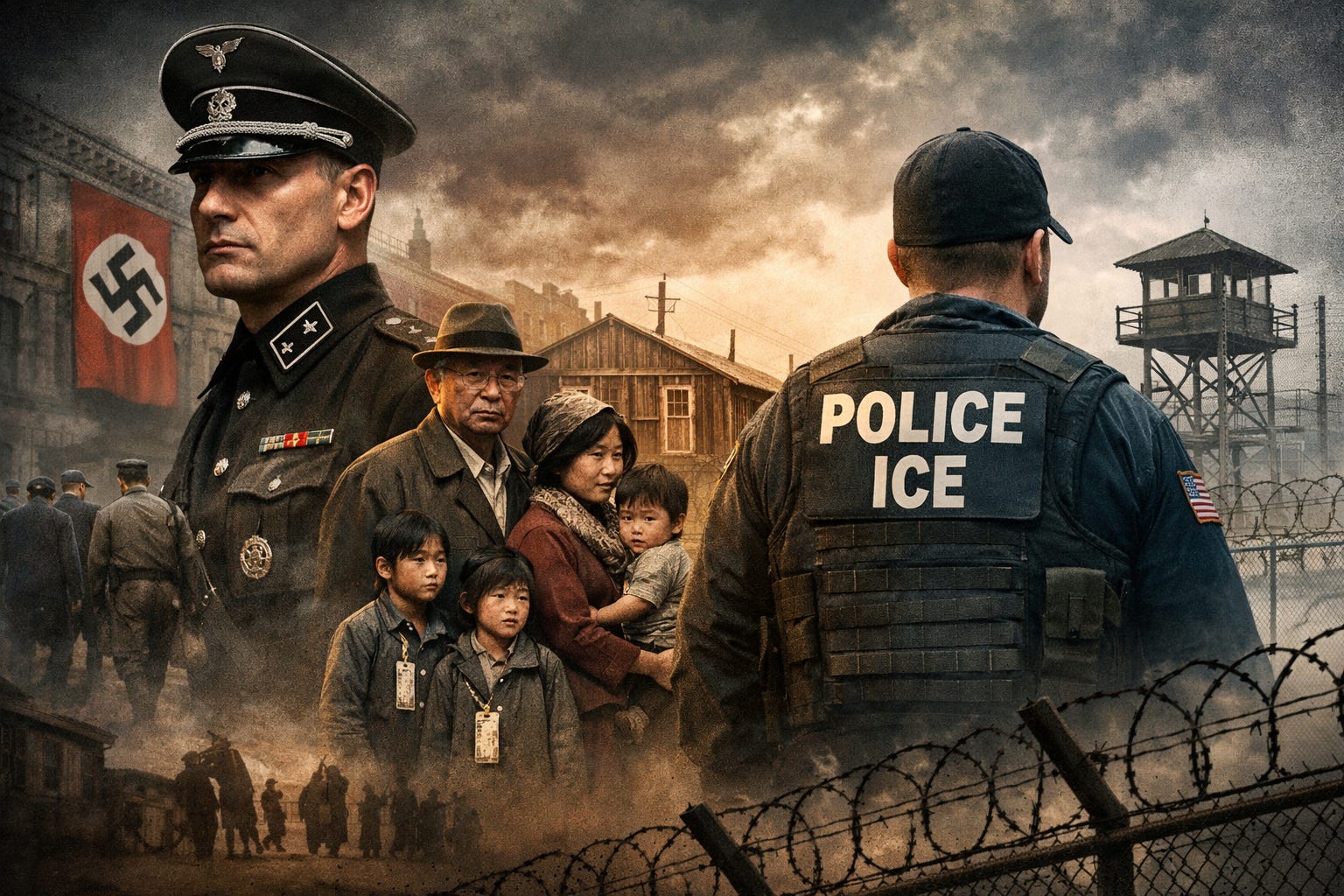
History rarely announces itself as tyranny. More often, it arrives dressed as law, order, and security—administered by courts, paperwork, and uniformed professionals doing their jobs.
When people compare U.S. Immigration and Customs Enforcement (ICE) to Nazi Germany, the reaction is often immediate dismissal. When they compare ICE to Japanese American internment, the conversation becomes more comfortable—because it is American, acknowledged, and already apologized for.
But history demands intellectual honesty.
ICE resembles elements of both—not in outcome, but in structure, logic, and escalation pathways.
Understanding that distinction is not inflammatory.
It is preventive.
The Mistake People Make About Nazi Comparisons
The common rebuttal is simple:
“ICE isn’t committing genocide, so the comparison is offensive.”
That argument misunderstands how authoritarian systems actually form.
Nazi Germany did not begin with extermination camps. It began with legal classifications, administrative detention, identity-based targeting, bureaucratic enforcement, and courts that validated emergency powers.
By the time the most visible atrocities emerged, the machinery was already normalized—and opposition had been isolated, one group at a time.
This pattern was later captured with haunting clarity by Martin Niemöller, a Protestant pastor imprisoned by the Nazis, who reflected afterward:
“First they came for the socialists, and I did not speak out—
Because I was not a socialist…”
His words were not poetry for effect.
They were confession.
The Nazi Germany Parallel: Early-Stage Authoritarian Enforcement
ICE most closely resembles the early internal enforcement mechanisms of Nazi Germany—not its final genocidal stage.
Specifically, it mirrors the logic used by institutions like the Gestapo before mass extermination began.
1. Status-Based Suspicion
In Nazi Germany, Jewish identity itself was treated as a threat. Guilt was presumed by classification, and rights depended on belonging.
With ICE, legal immigration status becomes a proxy for danger. Civil violations justify detention, and individual conduct matters less than category.
This is not an ideological comparison—it is a structural one.
Niemöller’s warning explains why this matters:
“Then they came for me—and there was no one left to speak for me.”
Authoritarian systems do not expand all at once. They expand after silence is normalized.
2. Detention Without Criminal Conviction
Early Nazi enforcement relied on “protective custody,” administrative detention, and confinement without criminal trial.
ICE detention today is civil, not criminal. It allows prolonged confinement without conviction, often limits access to counsel, and shifts the burden of proof onto detainees.
The shared mechanism is unmistakable: the state restrains liberty without proving guilt.
This is not the end stage Niemöller warned about.
It is the beginning.
3. Bureaucracy as Moral Insulation
Nazi enforcement relied on paperwork, role compartmentalization, lawful orders, and the logic of “I was just following policy.”
ICE operates through detention quotas, federal contracts, bed counts, and inter-agency referrals.
This is what Hannah Arendt later described as the banality of evil—harm carried out by ordinary systems, not extraordinary villains.
Niemöller’s poem exists because law alone did not stop injustice.
The Japanese American Internment Parallel: America’s Own Warning
The second mirror is closer—and harder to deny.
Japanese American internment was legal, court-approved, framed as temporary, popular with much of the public, and later acknowledged as unjust.
It was authorized by Executive Order 9066 and upheld in Korematsu v. United States. Decades later, the U.S. government admitted the policy was driven by fear—not evidence—and passed the Civil Liberties Act of 1988.
Internment shows how democracy can fail without abandoning its legal form.
4. Collective Punishment
Internment involved no individualized suspicion. Families were detained, and entire communities were uprooted.
ICE similarly targets communities rather than isolated offenders, separates families, detains long-term residents, and disrupts economic and social stability.
This is not racial ideology—it is administrative logic, the same logic Niemöller described unfolding step by step.
5. National Security Without Evidence
Internment occurred despite intelligence agencies concluding Japanese Americans posed no threat.
Modern immigration enforcement persists despite data showing immigrants commit fewer crimes and evidence that mass detention does not improve safety.
Fear, once institutionalized, does not require proof—only repetition.
Why These Comparisons Must Be Held Together
Comparing ICE only to internment risks sanitizing the danger as a past mistake already resolved. Comparing ICE only to Nazi Germany invites dismissal as exaggeration.
Together, they reveal the full warning:
Nazi Germany shows where unchecked systems can go.
Japanese internment shows how America gets there legally.
Niemöller explains how people allow it to happen.
Early Warning Signs Democracies Must Watch
History does not hide its patterns:
Civil detention becomes routine.
Status replaces individual guilt.
Emergency powers never sunset.
Oversight is framed as disloyalty.
Economic incentives attach to enforcement.
Apologies are promised to the future.
These are not accusations.
They are signals.
Why This Matters for Black Communities
Black Americans understand Niemöller’s lesson viscerally.
Surveillance is framed as safety.
Policing is framed as protection.
Rights are narrowed for “exceptional” cases.
History shows the net always widens.
Silence is not neutrality.
It is participation.
The Bottom Line
ICE is not Nazi Germany.
But it does resemble the early enforcement architecture that made Nazi atrocities possible, the legal failure of Japanese American internment, and the pattern Niemöller warned about—where people wait too long to speak.
History does not repeat exactly—but it remembers what it is allowed to do.
The question is not whether we are already there.
The question is whether we still believe someone else will speak—so we don’t have to.