

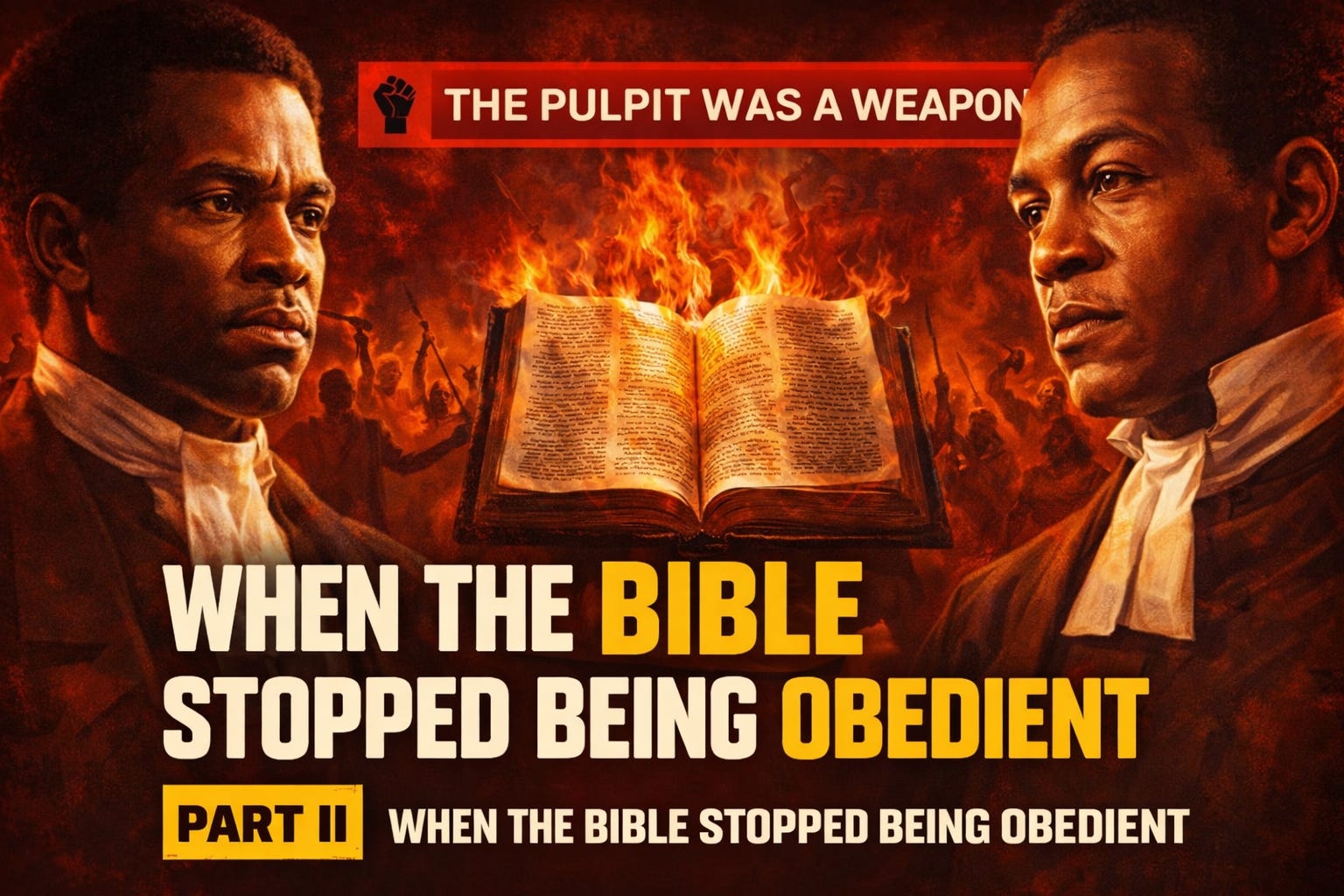
The Bible was never neutral.
From the moment enslaved Africans were forced to hear it read aloud, scripture became a battleground. Slaveholders treated it like a leash—selecting verses about obedience, silence, and patience while stripping away everything else.
But something dangerous happened when Black people learned to read it for themselves.
The Bible stopped behaving.
---
The Bible They Didn’t Want Read
Slaveholders loved Paul’s instruction for servants to obey their masters.
They loved sermons about heaven after death.
They loved faith that required no resistance.
What they didn’t love were stories like:
Moses confronting Pharaoh
God hardening the heart of an oppressor
Captives walking out of bondage
Empires collapsing under divine judgment
Those stories were explosive.
Because once enslaved people encountered them, the question became unavoidable:
> If God freed them… why not us?
---
Nat Turner: When Scripture Became a Summons
Nat Turner was not illiterate.
He was not confused.
And he was not passive.
Turner was a preacher who believed the Bible was alive—and that God spoke through it directly. He read scripture not as metaphor, but as instruction.
Where slaveholders saw control, Turner saw condemnation.
He believed slavery was not just unjust—it was sinful. And sin, in biblical tradition, is not negotiated with. It is confronted.
Turner’s revolt in 1831 terrified the American South not just because of its violence, but because of its theological clarity.
This was not chaos.
This was conviction.
The response was swift:
Turner was executed
Laws against Black preaching tightened
Literacy restrictions intensified
Not because rebellion was new—but because biblical rebellion was harder to discredit.
---
Samuel Sharpe: The Strategy of Righteousness
If Nat Turner represents prophetic fire, Samuel Sharpe represents disciplined faith.
Sharpe, an enslaved Baptist preacher in Jamaica, believed Britain had already outlawed slavery—and that plantation owners were illegally defying God and law alike.
His solution was deliberate:
A coordinated labor strike
Minimal violence
Moral legitimacy grounded in scripture
This wasn’t emotional revolt.
It was ethical resistance.
And when plantation owners responded with force, the rebellion escalated—not because Sharpe sought bloodshed, but because oppression always reveals itself when challenged.
Sharpe was hanged.
But slavery in the British Empire followed him to the grave.
---
Why Faith-Fueled Revolt Was So Dangerous
Rebellions could be crushed.
Weapons could be confiscated.
Leaders could be executed.
But belief was harder to kill.
When enslaved people framed resistance as:
God-ordained
Morally justified
Biblically consistent
Oppression lost its spiritual cover.
That’s what made these movements terrifying.
They didn’t just challenge power.
They delegitimized it.
---
The Lie of “Peaceful Faith”
We are often told that Christianity brought peace to enslaved people.
History tells a different story.
Christianity brought:
Language for justice
Moral frameworks for resistance
Networks for organizing
Courage rooted in something larger than survival
It didn’t calm people down.
It woke them up.
---
The Question That Still Lingers
If scripture once inspired revolt…
If the Bible once challenged empires…
If faith once produced resistance instead of compliance…
> What version of Christianity are we practicing now?
Because the Bible didn’t change.
But how it’s taught did.