

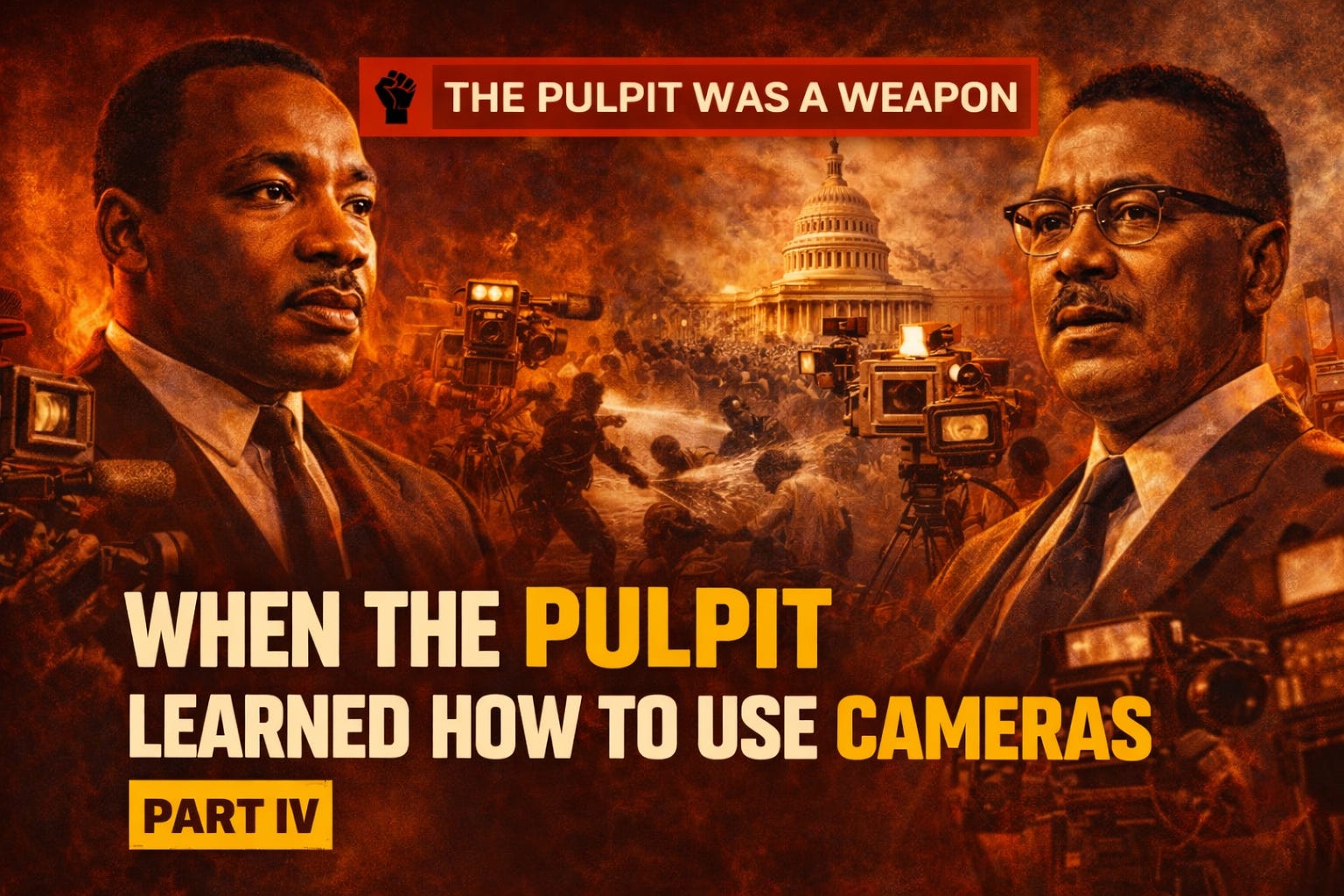
Power changes when it’s seen.
Before television, the Black church organized quietly. Strategy moved through sermons, back rooms, kitchens, and pews. Authority flowed locally. Risk was shared. The work was intimate—and dangerous.
Then cameras arrived.
And the pulpit became national.
---
Visibility: The New Battlefield
Media did something radical to Black liberation movements:
It amplified them—and boxed them in at the same time.
Television brought:
Sympathy from distant audiences
Pressure on politicians
Moral clarity for the undecided
It also brought:
Surveillance
Simplification
A demand for palatable leadership
From that moment on, pastors weren’t just speaking to congregations. They were speaking to the country—and eventually, to history.
---
Martin Luther King Jr.: Moral Power, Broadcast Nationwide
Martin Luther King Jr. didn’t invent the Black church’s political role. He scaled it.
King understood optics. He understood timing. He understood that nonviolence, when televised, became a weapon the state struggled to counter without exposing itself.
Dogs.
Firehoses.
Jails.
These images forced the nation to choose a side.
But here’s what’s often missed:
King’s power didn’t come from the camera.
The camera came because he already had power.
That power was built through:
Church networks
Trained organizers
Coordinated strategy
Economic pressure (boycotts)
Media didn’t replace organizing.
It revealed it.
And when King later turned the camera toward economic injustice and war—toward things donors and politicians preferred ignored—the protection faded.
Visibility has conditions.
---
Adam Clayton Powell Jr.: When the Camera Didn’t Control the Message
If King represents moral suasion, Adam Clayton Powell Jr. represents political leverage.
Pastor of Harlem’s Abyssinian Baptist Church and a U.S. Congressman, Powell operated comfortably in both spaces. He didn’t ask to be liked. He asked to be obeyed.
Powell used the pulpit to:
Mobilize votes
Apply economic pressure
Enforce consequences
His message wasn’t softened for television.
And the backlash was swift.
Powell was investigated, censured, and targeted—not because he broke the rules, but because he understood them too well.
Media visibility didn’t empower Powell.
It exposed how threatening unapologetic power really was.
---
The Trade-Off No One Admitted
The media age introduced an unspoken bargain:
> You can have the microphone—if you don’t say certain things.
Leaders who stayed within acceptable boundaries were elevated.
Those who crossed into economic power, international critique, or institutional autonomy were isolated.
The pulpit became louder.
But narrower.
---
From Mass Movement to Manageable Leadership
Television favored:
Singular leaders over collective structures
Moments over systems
Emotion over logistics
This didn’t kill the movement—but it reshaped it.
Power slowly shifted from:
Churches to nonprofits
Congregations to foundations
Accountability to optics
The pulpit still spoke—but often within limits it didn’t set.
---
The Question We Have to Ask
If visibility expanded the reach of liberation—
but constrained its demands—
> Did the camera make the movement stronger… or safer for power to manage?
Because not everything that’s seen is allowed to win.
---
What Comes Next
In Part V, we confront the theological line that media could never fully absorb—the rise of Black Liberation Theology, why it terrified institutions, and how certain pastors were punished not for being wrong, but for being uncontainable.