

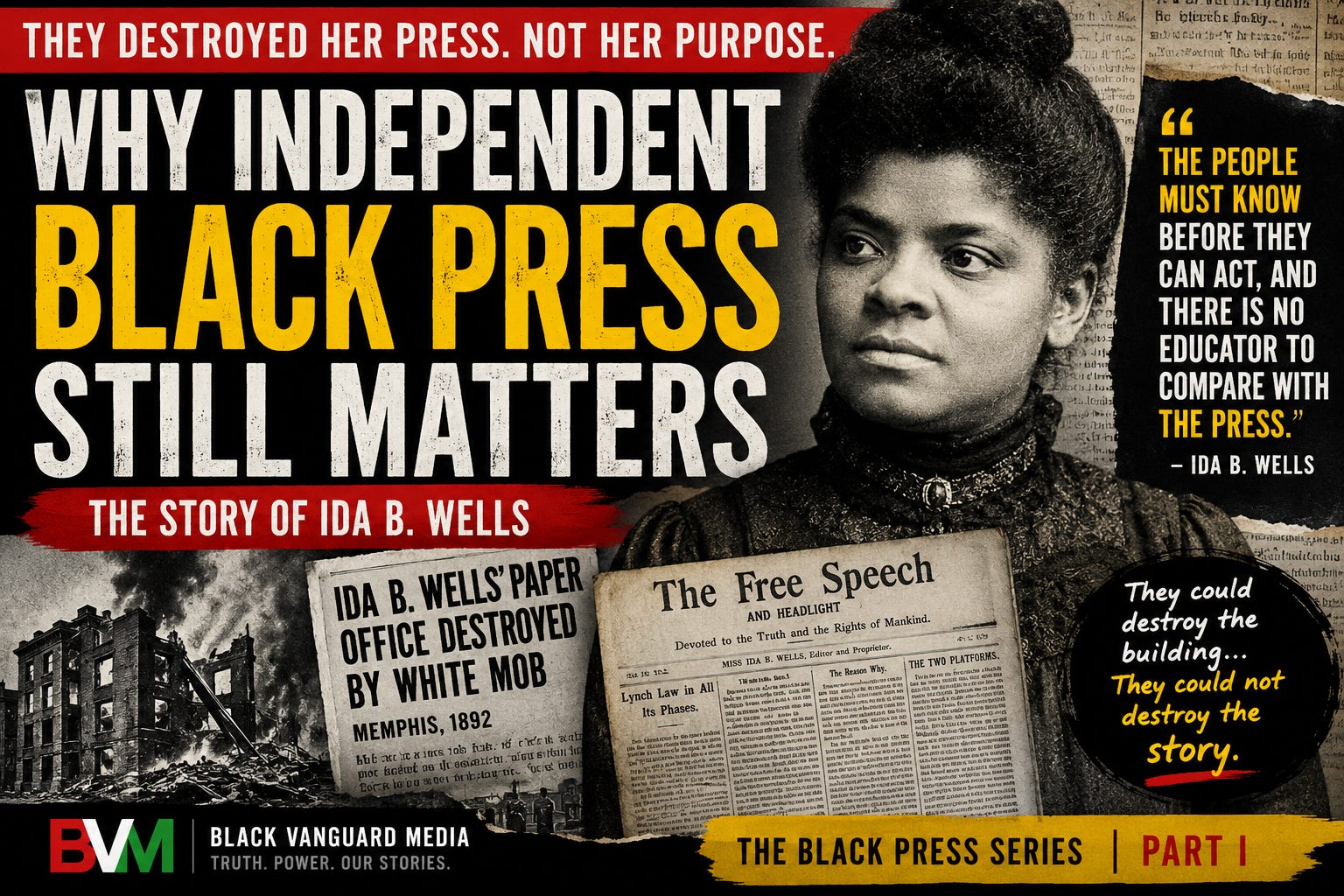
Part I in a continuing Black Vanguard Media series examining the historical role of independent Black press, narrative control, and why community-owned journalism still matters today.
“The people must know before they can act, and there is no educator to compare with the press.” — Ida B. Wells
There are moments in history when communities realize that simply being represented inside existing systems is not the same as owning the ability to tell their own story.
That realization helped give birth to the Black press.
Long before social media, before podcasts, before livestreams, Black newspapers became one of the only places where uncomfortable truths about the Black experience could be documented without waiting for approval from institutions that often had incentives to minimize, soften, delay, or ignore them altogether.
Ida B. Wells Refused Permission-Based Journalism
Ida B. Wells understood this better than almost anyone.
When white newspapers justified lynchings or ignored them, Wells used the Black press to investigate what others would not. She challenged accepted narratives. She documented names, stories, motives, and patterns.
And for doing so, her newspaper office in Memphis was destroyed by a mob after she exposed the truth behind lynchings tied to economic competition and racial terror.
But because she owned her voice — and because Black press existed — they could destroy the building without destroying the story.
“They destroyed the building. They could not destroy the story.”
The Difference Between Representation and Ownership
That distinction matters.
There is a difference between Black journalists and a truly independent Black press.
A Black journalist working inside a larger structure may still have editors, advertisers, institutional pressures, legal concerns, political relationships, or professional limitations that shape what can be pursued, how far it can go, and whether it can be sustained.
That does not make those journalists bad people. Many do important work under difficult realities.
But historically, independent Black newspapers, newsletters, and publications often existed because Black communities understood something deeper:
If nobody owns the platform to investigate wrongs affecting the community objectively, some stories may never fully be told.
“If nobody owns the platform to investigate wrongs affecting the community objectively, some stories may never fully be told.”
Why Black Organizations Created Their Own Press
That is part of why many of the most influential Black organizations during the Civil Rights Movement created their own publications, newsletters, newspapers, and communications arms.
They understood that controlling distribution of information meant controlling whether abuses were exposed, whether strategies were understood, and whether communities stayed informed enough to act.
The Black press was not simply about news.
It was about survival. Documentation. Strategy. Memory. Protection. Coordination. Accountability.
And perhaps that concern still exists today.
When the Press Threatens Power
One reason certain injustices may receive limited sustained examination is because modern media ecosystems are complicated.
Stories involving power, relationships, institutions, advertisers, politics, legal risk, or access can become difficult to pursue deeply and consistently.
For example, many people in Northeast Ohio still remember the disturbing image of a Black defendant having his mouth duct-taped shut in open court by a sitting judge.
Yet despite national attention at moments, there are legitimate questions about whether the broader implications, community impact, humiliation, historical parallels, and institutional accountability surrounding that incident were explored with the depth and persistence they might have been if an aggressive independent Black press ecosystem still existed at scale.
That is not an accusation against every journalist.
It is an observation about systems.
And it raises a larger question:
Who documents uncomfortable truths when institutions become uncomfortable with the documentation?
Why Ida B. Wells Still Matters
Why do we still speak the name Ida B. Wells more than a century later?
Because she did not merely report events.
She demonstrated what happens when independent journalism refuses to wait for permission to pursue truth.
She used Black press to influence national conversations, reshape international understanding about racial violence in America, and force issues into public view that many powerful people preferred remain hidden.
That legacy still matters.
“The way to right wrongs is to turn the light of truth upon them.” — Ida B. Wells
Black Vanguard Media (www.blackvanguardmedia.com ) hopes to continue in that spirit — thoughtfully, responsibly, and beyond reproach.
This article is Part I of a continuing series examining the historical role of the Black press, the difference between representation and independence in journalism, and why independent community-centered media may still matter today.
Next Week in This Series
How Black newspapers during the Civil Rights era bypassed traditional gatekeepers, organized communities, documented injustices, and helped build movements that changed America.