

Every parent wants to protect their child.
From the moment children are born, parents learn how to care for scraped knees, fevers, and broken bones. They know when to call the pediatrician, when to keep their child home from school, and how to respond when something seems physically wrong.
Mental health can be different.
What happens when a child becomes withdrawn? When anxiety begins interfering with school? When anger seems constant? When depression, trauma, self-harm, or emotional distress become part of everyday life?
Many parents find themselves asking questions they never expected to face.
Is this normal?
Should I be worried?
How do I talk to my child?
Who do I call?
What happens next?
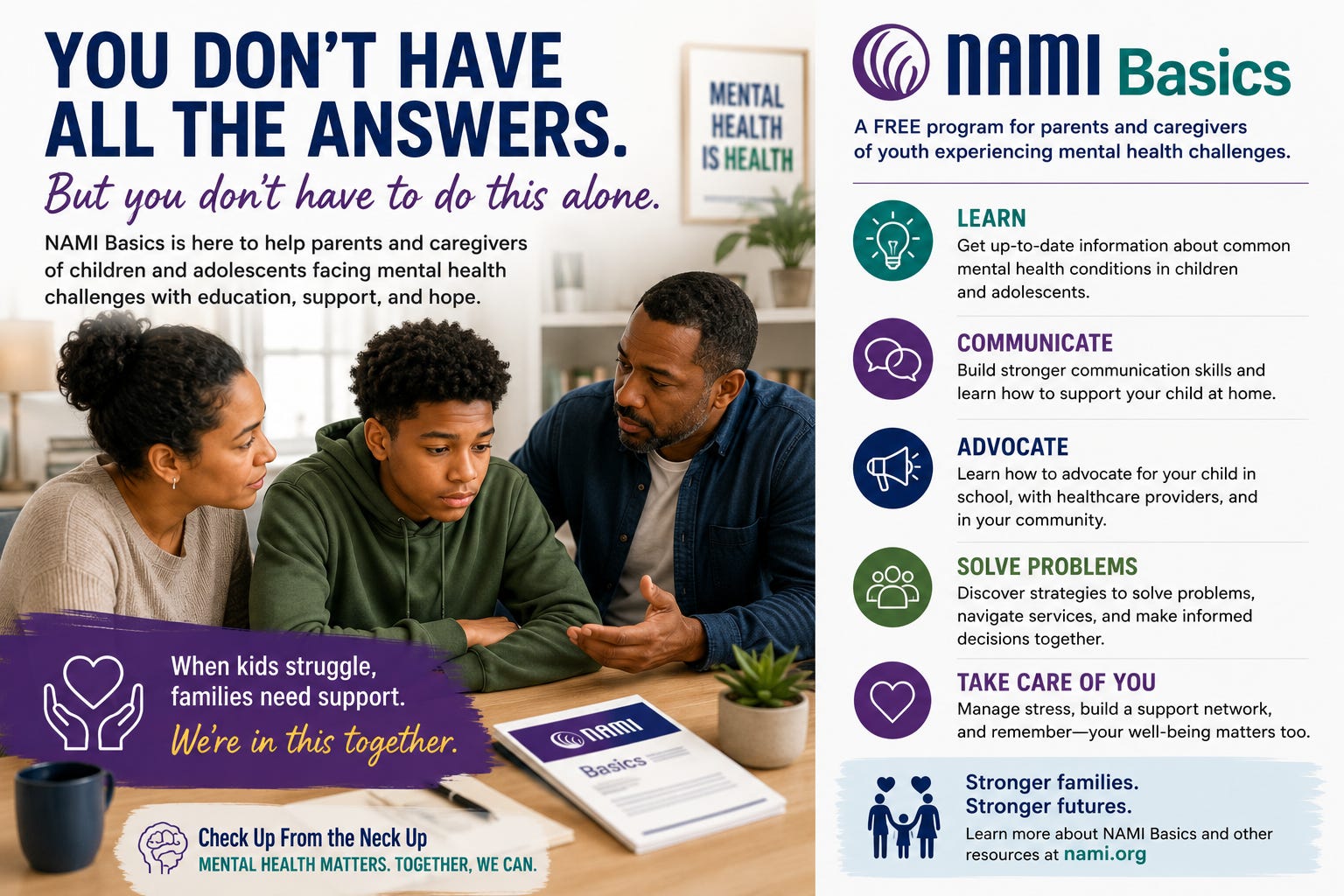
At Check Up From the Neck Up, we believe no parent should have to answer these questions alone. One resource designed specifically to help families navigate these challenges is the National Alliance on Mental Illness (NAMI) Basics program.
What Is NAMI Basics?
NAMI Basics is a free educational program created for parents, grandparents, guardians, and other caregivers of children and adolescents experiencing mental health challenges.
The program provides families with practical information about youth mental health conditions while helping caregivers understand how to advocate for their child, communicate more effectively, and navigate school systems, healthcare providers, and community resources.
Unlike many programs that focus primarily on the child, NAMI Basics recognizes that parents also need knowledge, support, and confidence to help their children succeed.
Understanding Youth Mental Health
Childhood and adolescence are periods of tremendous growth and change. While mood swings and emotional ups and downs can be a normal part of development, some children experience mental health conditions that require additional support.
Learning to recognize the difference can be difficult.
NAMI Basics helps caregivers better understand common youth mental health conditions, what symptoms may look like, and why early recognition and intervention matter.
The goal is not to encourage parents to diagnose their children. Instead, it is to provide families with reliable information so they can make informed decisions and seek appropriate professional support when needed.
Becoming Your Child’s Best Advocate
Parents quickly discover that helping a child with mental health challenges often involves more than medical appointments.
Families may find themselves communicating with teachers, school counselors, psychologists, pediatricians, therapists, insurance providers, and community organizations—all while trying to support their child’s emotional well-being at home.
This can feel overwhelming.
NAMI Basics helps caregivers understand how to advocate effectively within both educational and healthcare systems. Participants learn strategies for asking questions, understanding available services, collaborating with professionals, and ensuring their child receives appropriate support.
Knowledge empowers parents to become stronger advocates for their children.
Strengthening Communication at Home
Mental health challenges can affect the entire family.
Conversations become more difficult. Misunderstandings increase. Parents may worry about saying the wrong thing, while children may struggle to explain what they are feeling.
NAMI Basics introduces practical communication and problem-solving strategies that help families build stronger relationships during difficult times.
Rather than relying on fear, frustration, or uncertainty, families learn approaches that foster trust, understanding, and collaboration.
These skills often benefit the entire household—not just the child experiencing mental health challenges.
Parents Need Support Too
One of the most important messages within NAMI Basics is that caring for a child with mental health needs can be emotionally demanding.
Parents often carry feelings of guilt, fear, exhaustion, or isolation. They may wonder whether they have done something wrong or whether they are doing enough.
The reality is that parenting has never come with a manual, and supporting a child through mental health challenges can be especially complex.
Programs like NAMI Basics remind caregivers that seeking education and support is not a sign of failure. It is an investment in both their child’s well-being and their own ability to provide consistent, informed care.
Why This Matters for Our Community
At Check Up From the Neck Up, we believe that improving youth mental health begins long before a crisis occurs.
It begins with equipping parents and caregivers with knowledge, confidence, and resources.
Families are often the first to notice changes in a child’s behavior. When caregivers understand mental health, know where to seek help, and feel empowered to advocate for their children, young people are more likely to receive timely support and experience better long-term outcomes.
Programs like NAMI Basics strengthen not only individual families but entire communities by helping parents become informed partners in their children’s mental health journey.
Looking Forward
Every child deserves to grow up knowing that their mental health matters.
Every parent deserves access to reliable information, practical guidance, and a supportive community.
NAMI Basics helps make that possible by giving caregivers the tools they need to better understand youth mental health, navigate complex systems, and advocate for the children they love.
At Check Up From the Neck Up, we believe informed parents build stronger families, stronger schools, and stronger communities. Investing in caregivers today helps create healthier futures for the next generation.