

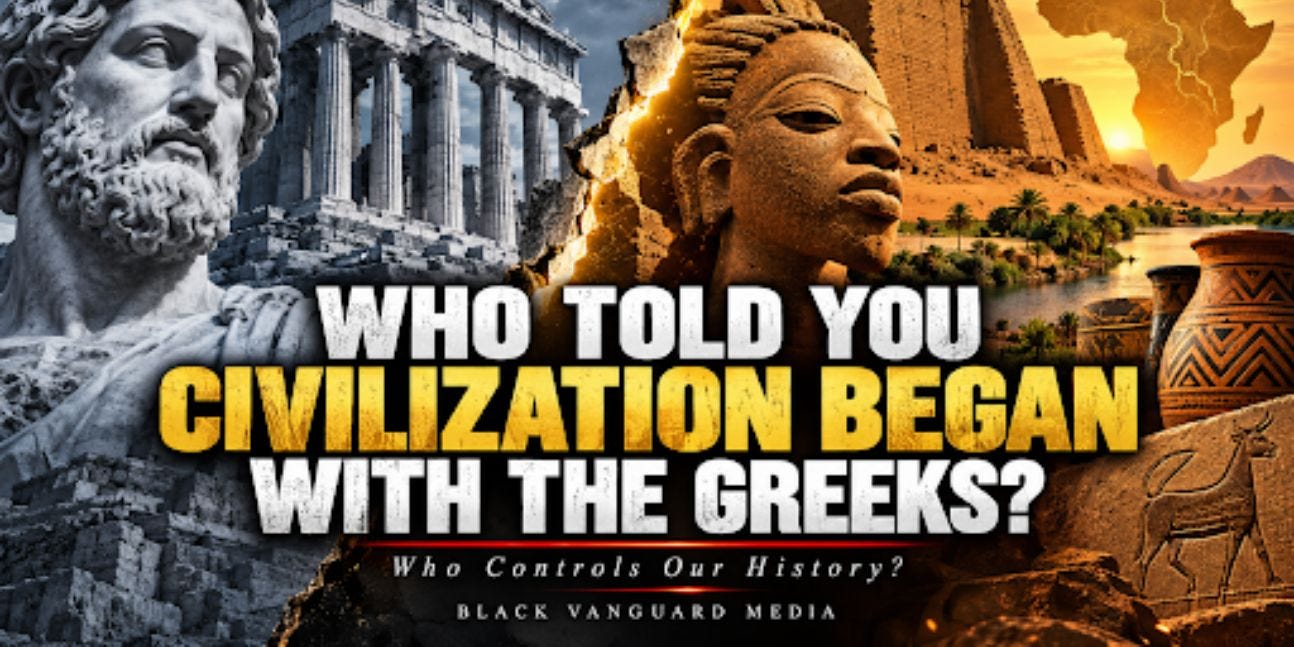
For generations, Western history has celebrated ancient Greece as the birthplace of civilization. But the archaeological record tells a much older story. And it raises an important question: Who gets to decide how our history is told?
For generations, Americans have been taught that ancient Greece gave the world philosophy, democracy, mathematics, science and the intellectual foundations of modern civilization.
The Greeks made extraordinary contributions to human knowledge. That much is undeniable.
But somewhere along the way, the idea that Greece helped establish Western civilization became confused with the belief that Greece was the beginning of civilization itself.
There’s just one problem. Civilization existed thousands of years before classical Greece. And some of the earliest and most remarkable examples were in Africa.
That is not an opinion or an attempt to diminish Greek achievements. It is supported by archaeological evidence.
So why have so many people grown up knowing about Socrates, Plato and Aristotle while knowing almost nothing about the ancient African societies that preceded them?
The answer tells us something important about who writes history, who controls its interpretation and why Black people must invest in credible scholars, authors and independent media to tell our own stories.
Before Greece, there was Africa
Civilization generally refers to a complex, organized human society with developed systems of government, agriculture, economic activity, trade, cultural traditions and social institutions. Not every civilization possessed every characteristic, and writing or monumental buildings are not absolute requirements for a sophisticated society.
By approximately 3100 BCE, ancient Egypt had developed into a unified kingdom.
But Egypt was far from Africa’s only early complex society.
In what is now Sudan and southern Egypt, the Nubian A-Group culture emerged around 3700 BCE. Archaeological discoveries reveal sophisticated pottery, extensive trade relationships and evidence of emerging political leadership.
The Kingdom of Kerma, in present-day Sudan, developed around 2500 BCE and became a powerful Nubian state known for monumental architecture, royal burial complexes and extensive trade networks.
In present-day Mauritania, the Dhar Tichitt region preserves evidence of complex communities, stone-built settlements, agriculture and livestock management beginning in the second millennium BCE.
And in present-day Nigeria, the Nok culture, whose beginnings are commonly dated to around 1500 BCE, developed a distinctive artistic tradition, particularly its extraordinary terracotta sculptures.
These were not all identical political entities. Kerma was an established kingdom, while the Nubian A-Group, Dhar Tichitt and Nok are archaeological cultures or traditions whose political structures are less fully understood.
But each demonstrates that sophisticated African societies developed long before classical Greece.
For perspective, the earliest Greek-speaking palace civilization, Mycenaean Greece, emerged around 1600 BCE. Classical Greece, associated with Socrates, Plato and Aristotle, came much later, primarily during the fifth and fourth centuries BCE.
The dates alone challenge the notion that human civilization began with the Greeks.
How did Europe become the center of the story?
During the eighteenth and nineteenth centuries, European scholars increasingly presented ancient Greece and Rome as the foundations of Western intellectual and political traditions.
Within the history of Europe, those civilizations were enormously influential.
The problem emerged when the story of Western civilization was presented as though it were the story of civilization itself.
African and Asian societies, including civilizations that predated Greece and contributed to the ancient Mediterranean world, often received considerably less attention.
Historian Martin Bernal examined this issue in his controversial 1987 book, Black Athena: The Afroasiatic Roots of Classical Civilization. He argued that European nationalism and racial thinking influenced how scholars interpreted ancient Greece’s relationships with Egypt and the Near East.
Scholars have disputed important parts of Bernal’s historical reconstruction, but his work helped provoke serious debate about how modern assumptions influence interpretations of the ancient world.
That debate also has implications for American education.
The American Historical Association’s 1898 recommendations for history instruction emphasized Greek and Roman history while giving earlier civilizations a more limited introductory role. Western Civilization courses later became prominent features of American education.
There is nothing wrong with studying Greece and Rome.
The problem is teaching their accomplishments without adequately explaining the civilizations that came before them.
When generations of students learn extensively about Greek philosophy but rarely encounter Kerma, Nubia or the early societies of West Africa, an incomplete historical picture can begin to feel like the whole truth.
And sometimes history is distorted as much by what is omitted as by what is written.
When someone else writes your history
For Black Americans, this issue reaches well beyond ancient civilizations.
Much of what Americans learn about Black history begins with slavery, continues through segregation and eventually reaches the civil rights movement.
Those subjects are essential. But they are not the beginning of African history.
Long before the transatlantic slave trade, African societies were governing communities, developing agriculture, producing remarkable art, constructing monumental buildings and establishing international trade relationships.
When that history is neglected, the Black experience becomes disproportionately defined by what others did to Black people rather than also recognizing what African people built, discovered and accomplished.
Black Vanguard Media has previously expressed a provocative principle:
When the colonizer tells your story, you are often portrayed as the savage. But when you investigate and tell your own story, you can expose who actually committed acts of savagery and inhumanity.
History provides ample reason to examine that statement.
European colonial powers frequently justified conquest by describing African societies as uncivilized. Yet those same colonial systems participated in land dispossession, forced labor, racial oppression and extraordinary violence.
That contradiction deserves examination.
It does not mean every European historian deliberately falsified history, nor does it mean African societies were without conflict, exploitation or wrongdoing.
It means historical narratives must be examined critically, particularly when those who exercise power also possess disproportionate influence over how events are recorded and remembered.
Civilization is not the same as morality. And possessing the power to write history does not automatically make someone’s version of events truthful.
Why credible Black scholarship matters
More than a century ago, historian Carter G. Woodson understood the importance of Black people documenting their own experiences.
In 1915, he helped establish the Association for the Study of Negro Life and History. The following year, he launched The Journal of Negro History, creating a scholarly platform dedicated to researching and preserving Black historical contributions.
Woodson understood that Black history could not depend entirely on whether established institutions considered it worthy of attention.
That lesson remains relevant.
But credibility is essential.
Being Black does not automatically make someone’s historical interpretation correct, just as being white does not automatically make someone’s scholarship unreliable.
Black historians and journalists must document their claims, examine evidence, acknowledge uncertainty and correct errors.
We cannot challenge distorted European-centered accounts while accepting unsupported claims simply because they make us feel proud.
Our history does not need to be exaggerated to be extraordinary. It needs to be researched, documented and accurately told.
The evidence of ancient African achievement is substantial enough to stand on its own.
Black media matters. But readers have a responsibility, too.
This is precisely why independent Black media, Black authors, historians and research institutions remain important.
They help determine which stories are investigated, which questions are asked and which overlooked contributions receive public attention.
But serious journalism does not sustain itself.
Research requires time. Publishing requires resources. Investigations require evidence. And credibility requires the willingness to challenge popular assumptions, even when those assumptions are embraced by our own communities.
That is why supporting Black intellectual thought must mean more than applauding an article’s headline or agreeing with its message.
It means reading the entire article. Examining the sources. Studying unfamiliar history. Asking questions. Sharing credible information with others.
It also means supporting responsible Black-owned publications financially when possible.
Too often, people share headlines without reading the articles. They repeat historical claims without examining the evidence. They consume information created by Black journalists without considering what it takes to sustain those journalists and their institutions.
If we want Black media to remain independent, credible and capable of challenging incomplete historical narratives, we must actively engage with it.
Read the articles. Study the evidence. Share the reporting. Support the institutions doing the work.
And do not confuse support with unquestioning agreement. The purpose of independent journalism is not to tell us only what we want to hear. It is to help us understand what the evidence establishes.
The real question is who will tell our story
The issue is not whether Greece deserves recognition. It does.
The issue is why so many earlier African accomplishments remain unfamiliar while Greek achievements are treated as common knowledge.
That imbalance should concern anyone interested in accurate history.
And the responsibility for changing it cannot rest exclusively with schools, universities, mainstream publishers or television networks.
Black people must help build, sustain and hold accountable the institutions capable of researching and telling these stories.
That is the purpose of this Black Vanguard Media series.
We will examine ancient African civilizations, the documented exchange of knowledge between African and Greek societies, the influence of colonialism on historical narratives and the work of Black scholars who challenged incomplete accounts of our past.
Some findings may challenge what readers learned in school. Others may challenge popular claims circulating within our own communities.
Both are necessary because our objective must be truth, not simply a more flattering narrative.
If we do not research, document, preserve and tell our own history, we cannot expect others to tell it completely for us.
But telling our own story is only half the responsibility.
The other half belongs to those who read it.
Read. Study. Question. Share. Support.
Because independent Black media cannot survive on applause alone. And our history is too important to leave unread.
Coming Next — Part Two: Before Greece, Africa Was Already Building Civilizations
From the monumental structures of Kerma to the ancient communities of Nubia, Dhar Tichitt and Nok, we examine the archaeological evidence of African achievement that rarely receives the attention it deserves.
Part of Black Vanguard Media’s seven-part series, “Who Controls Our History?”
Selected historical sources
American Historical Association, The Study of History in Schools (1898); Association for the Study of African American Life and History, Carter G. Woodson Timeline; The Journal of African American History, Building upon a Century-Long Tradition of Excellence; Martin Bernal, Black Athena: The Afroasiatic Roots of Classical Civilization (1987).