

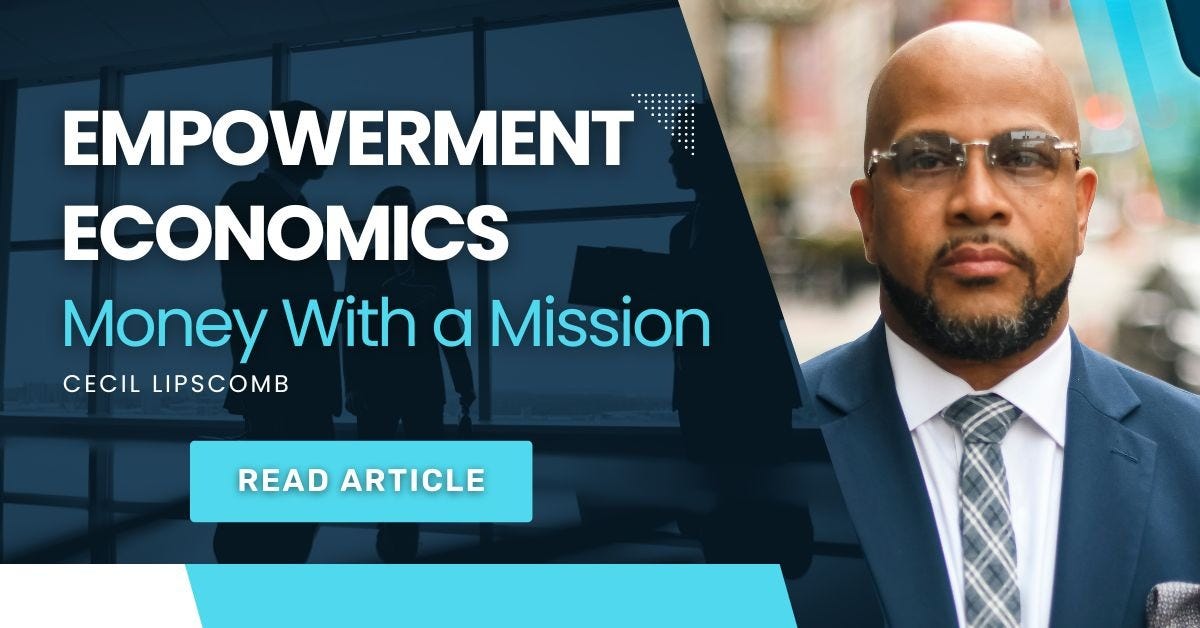
“Purpose without profit is philanthropy. Profit without purpose is exploitation.
The future lies in the space between.”
We’ve Led the Culture. Now We Need to Lead the Contracts.
Communities that have been on the margins of economic power—Black communities, working‑class neighborhoods, rural towns, immigrant corridors—have never had a creativity problem.
We start the movements, shape the culture, build the mutual aid networks, and hold neighborhoods together when larger systems pull back. Our ideas, organizing power, and hustle have moved this country forward more times than history books admit.
But when it comes to monetizing those ideas and leveraging our intellect at scale, we are too often left watching others capitalize on what we created.
We lead the trends; others lead the IPOs.
We launch the grassroots pilots; others land the national contracts.
We build local trust; outsiders buy local assets.
This gap is not about talent or effort. It’s about how we’ve been positioned in the economy—and how the systems of capital, procurement, philanthropy, and policy have been structured.
Empowerment Economics is about changing how we show up to those systems. It’s about moving from inspiration to infrastructure.
And as we head toward our March 11 working session at MidTown Tech Hive, this column is an invitation to every emerging leader and community:
To think bigger than consumer goods and basic services, and
To get more creative—and more disciplined—about how we turn community innovation into community infrastructure, ownership, and revenue.
Beyond Consumer Goods: We Are More Than “Sell It to Our People”
When many people hear “local business” or “minority‑owned business,” their mind goes first to:
Hair, beauty, and apparel
Food and hospitality
Entertainment and events
These sectors matter. They employ people and anchor culture. But if most of our enterprises—especially in historically marginalized communities—are only selling to each other as end consumers, we cap our economic power at the bottom of the value chain.
The deepest wealth and control in a modern economy sit in:
Infrastructure: real estate, energy, broadband, logistics
Business‑to‑business (B2B) services: technology, finance, consulting, supply chain, health systems support
Contracts with institutions: hospitals, universities, school districts, local governments, large employers
Intellectual property: curriculum, software, frameworks, media, licensing
Look at the numbers:
Black Americans are roughly 13–14% of the U.S. population but own only about 2–3% of employer firms (Brookings, 2020).
Firms owned by people of color are heavily concentrated in retail and personal services, and under‑represented in sectors like manufacturing, tech, and professional services where margins and valuations are higher.
The average revenue of a Black‑owned employer firm is less than one‑third that of a white‑owned firm (U.S. Census, 2018).
You see similar patterns in many Latino, Native, and rural communities as well.
This is not because our communities lack capacity. It’s because we’ve been boxed into the last mile of the value chain—where competition is fiercest and margins are thinnest.
If emerging leaders in communities want different outcomes, we have to change where we sit in the economic stack.
Nonprofits Are Not “Less Than Business”
They’re Strategic Infrastructure—If We Design Them That Way
Too often, nonprofits are seen as:
“Nice to have”
“Soft”
A consolation prize for people who “couldn’t make it in business”
That’s not reality.
Nonprofits, especially in under‑resourced communities, often control or influence:
Significant public and philanthropic contracts in health, housing, youth services, and workforce
Real estate, facilities, and networks of trust
Program design and curriculum that shape how children and adults learn and engage
In many neighborhoods the most stable institutions are:
Faith communities
Community Development Entities (CDEs)
Youth and family service organizations
Cultural and arts institutions
When public systems struggle or pull back, nonprofits are frequently the front line.
So, the real question is:
Are we using nonprofits as serious economic infrastructure—or just as underfunded emergency rooms?
Consider:
If our education systems are struggling to prepare children to compete globally, then our before‑school and after‑school nonprofits must not be babysitters—they must be running world‑class curriculum.
If local businesses can’t match big‑box prices, then our nonprofits and business associations should be organizing buying collaboratives and shared services, not leaving every shop to fight Amazon alone.
The nonprofit sector should be where we engineer solutions to the gaps:
in schools
in local economies
in health outcomes
in access to capital
And those solutions must be designed with financial sustainability, not perpetual scarcity, at their core.
What Comes Next
In the next part of this series, I’ll share specific examples of how communities have turned these ideas into real strategies:
Cooperatives and buying power
Anchor institution contracts
Nonprofits as earned‑income engines
Practical collaboration models that protect “the category” for all of us
We’ll move from “why this matters” to what it looks like in practice.
And if you’re ready to move from reading to doing, I want to invite you into a room where we’ll be working these ideas against your actual numbers.
Join the Working Session – March 11
On March 11 from 4:00–5:30 p.m. at the MidTown Tech Hive in Cleveland, I’ll be leading an Empowerment Economics Working Session designed for:
Nonprofit leaders
Small and medium‑sized business owners
Corporate intrapreneurs
Community builders who want more than survival
In 90 minutes, you will:
Set a 12‑month financial target
Start a backward plan from that target
Identify potential contracts, collaboratives, and capital partners that fit your model
If this article speaks to you, don’t just nod and scroll.
REGISTER TODAY for the March 11 working session at the MidTown Tech Hive.
Because moving from ideas to infrastructure doesn’t happen by accident—it happens by design.
Where do we register for the briefing at Midtown?