

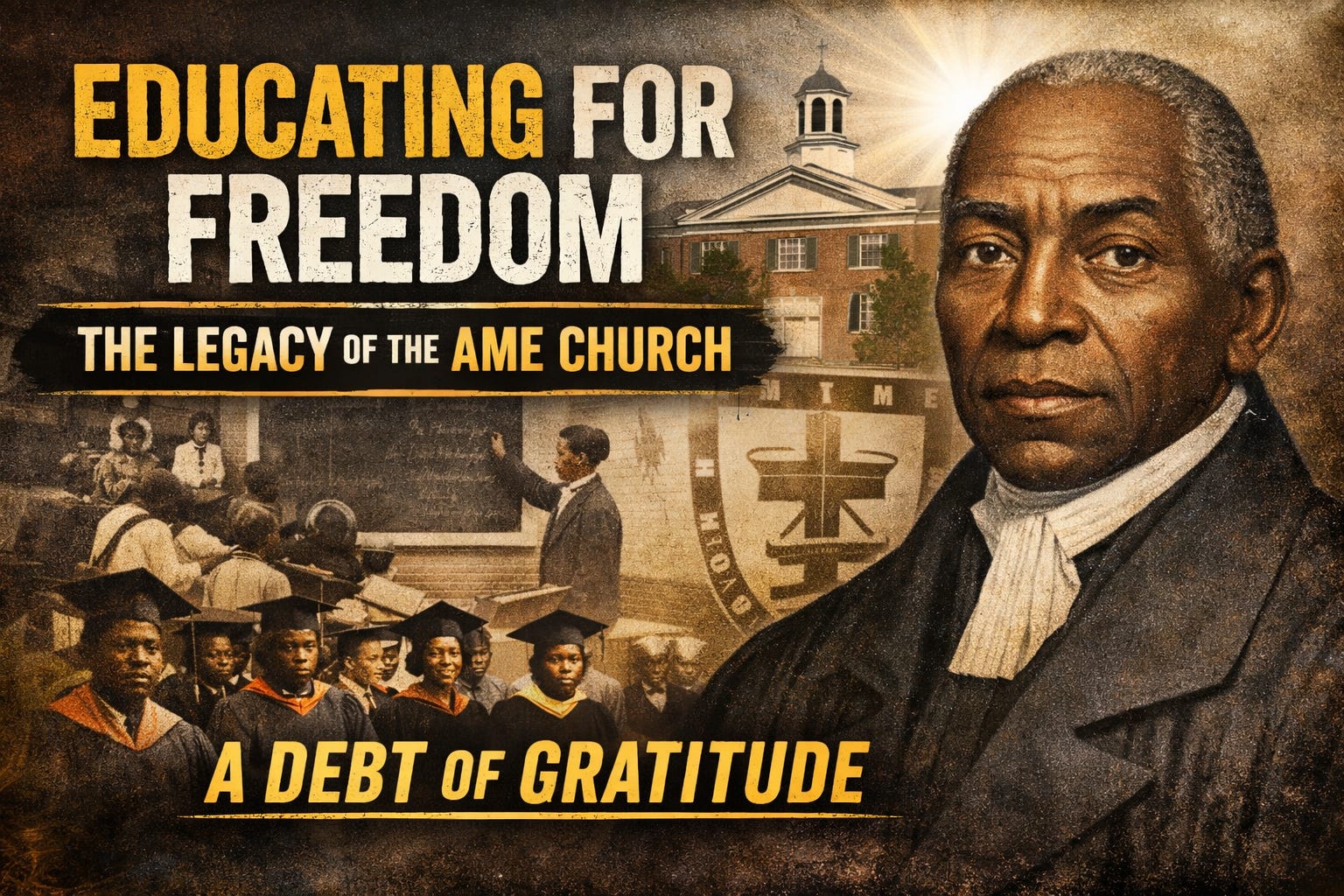
In American history, freedom has rarely been handed to Black people fully formed. It has been built—brick by brick, book by book, institution by institution. Few organizations understood this earlier, or acted on it more deliberately, than the African Methodist Episcopal (AME) Church.
The AME Church did not merely preach liberation. It engineered it—and education was the cornerstone.
This is why, among all Black denominations, the AME Church holds the strongest, most direct connection to the founding of Black colleges and universities. And it is why the AME Church deserves not just recognition, but collective gratitude.
Born from exclusion, committed to self-determination
The AME Church was founded in 1816 after Black worshippers were forcibly removed from prayer at a white Methodist church. That moment of humiliation became a moment of clarity.
Led by Richard Allen, the AME Church understood something foundational:
spiritual freedom without institutional power would never last.
From its earliest days, the AME Church rejected dependence. It chose ownership. It chose governance. And critically, it chose education as the one form of freedom that could not easily be revoked.
Literacy as survival, education as resistance
For much of American history, Black literacy was considered dangerous. In many Southern states, teaching Black people to read was illegal. Literacy meant access—to contracts, to courts, to scripture without mediation, to political organizing.
The AME Church responded by turning churches into:
Schools
Teacher-training centers
Political education hubs
Education was not enrichment. It was self-defense.
A theology that demanded educated leadership
The AME Church rejected the idea that Black people should be offered passion without preparation or faith without critical thought. It insisted on an educated ministry and an informed laity.
This conviction led to the creation of:
Theological seminaries
Liberal arts colleges
Professional training institutions
Clergy were expected to be literate, civically aware, and economically competent. That expectation was radical in a society designed to keep Black people untrained and uncredentialed.
Building a Black higher-education system—on purpose
The AME Church did something few institutions in American history have done: it built a coordinated, Black-governed system of higher education.
Institutions such as Wilberforce University—the first Black-owned and operated university in U.S. history—were not symbolic achievements. They were strategic ones.
Alongside Wilberforce, the AME Church founded and sustained colleges including:
Morris Brown College
Edward Waters University
Allen University
Paul Quinn College
Shorter College
When theological seminaries, normal schools, and training institutes are included, the AME Church’s educational footprint reaches roughly twenty institutions—more than any other Black denomination.
This was not accidental growth. It was nation-building.
Education as legacy, not moment
The AME Church understood a truth many movements learn too late:
Protest without institutions fades.
Institutions without education collapse.
By investing in education, the AME Church created leverage that survived:
Political backlash
Economic repression
Generational change
Its colleges produced teachers, lawyers, ministers, journalists, and civic leaders who carried Black progress forward long after individual protests ended.
Why this matters now
At a moment when many Black institutions are under-resourced and public trust is strained, the AME Church’s legacy offers a sober reminder:
Freedom is not sustained by outrage alone. It is sustained by institutions.
The AME Church did not wait for permission. It built anyway. It educated anyway. It governed anyway.
Giving credit where it is due
Black America stands on foundations laid by people who understood that liberation required more than faith—it required infrastructure.
The African Methodist Episcopal Church deserves recognition not just as a religious institution, but as one of the most effective builders of Black intellectual, civic, and institutional power in U.S. history.
That legacy is not merely historical. It is instructional.
The question before us now is simple—and demanding:
What institutions are we building today that will still matter a century from now?
Black Vanguard Media exists to surface these histories—not to romanticize them, but to learn from them.