

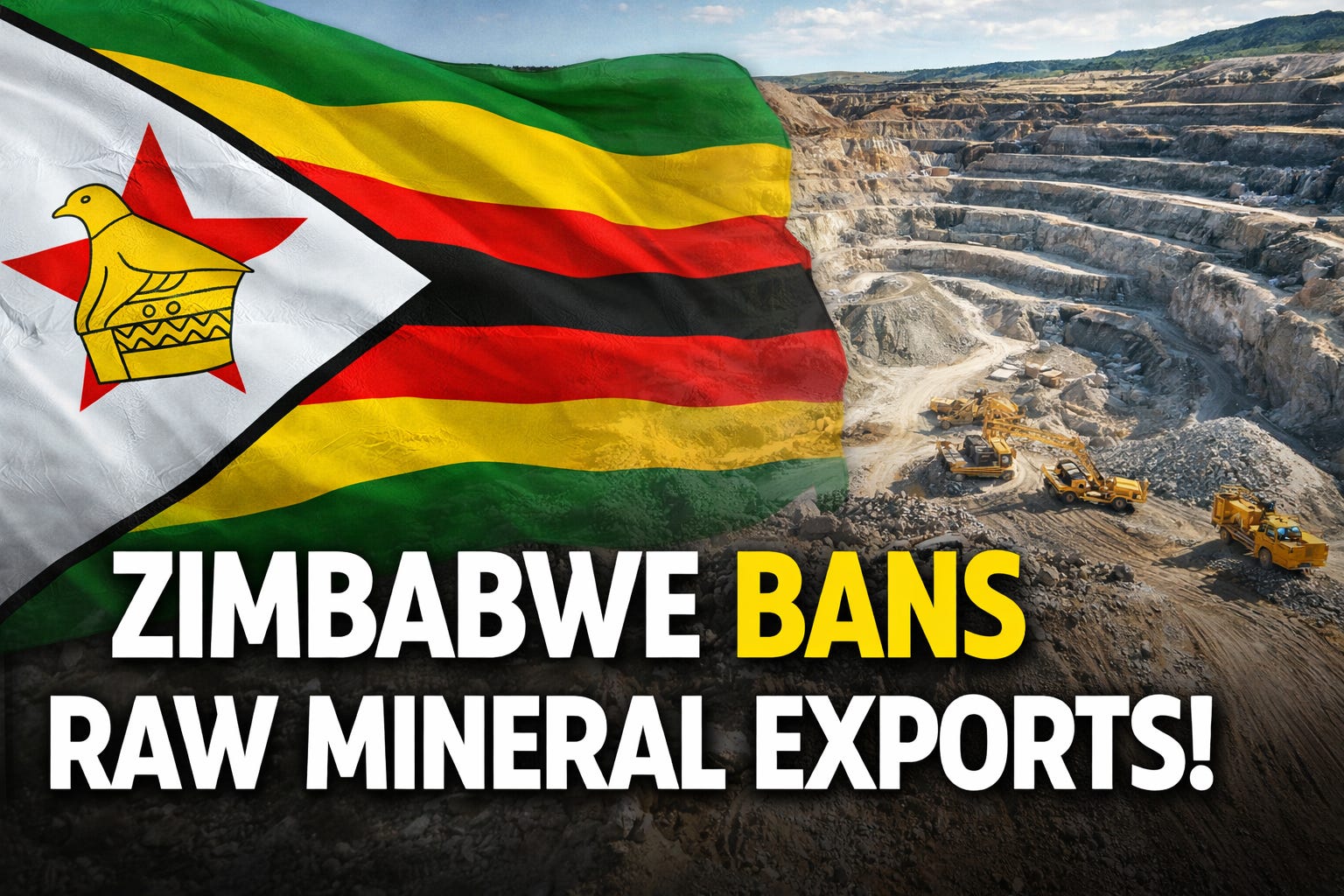
No More Shipping Out the Future
Zimbabwe has made a bold move that many resource-rich nations have talked about for decades — but few have executed at this scale.
The government has announced an immediate suspension of exports of raw minerals and lithium concentrates. In simple terms, Zimbabwe no longer wants to be a pit stop for extraction. It wants to be a destination for production.
That shift is not small. It’s structural.
And if implemented effectively, it could redefine Zimbabwe’s economic trajectory for a generation.
What This Decision Really Means
Zimbabwe is one of the most mineral-rich countries in Africa. It holds significant deposits of:
Lithium (critical for EV batteries)
Platinum group metals
Gold
Chrome
Diamonds
Nickel
For decades, much of this wealth has been exported in raw or semi-processed form — meaning the highest profits, manufacturing jobs, and industrial growth happened somewhere else.
Now Zimbabwe is saying:
If you want our minerals, you will help build the factories here.
This is what economists call beneficiation — adding value to raw materials before export. Instead of exporting ore, you export refined lithium. Instead of raw platinum, you export catalytic converter components. Instead of gold concentrate, you export refined bullion or manufactured goods.
That changes everything.
The Strategic Logic: Control the Value Chain
There are three core economic implications:
1. More Jobs at Home
Processing minerals requires refineries, engineers, technicians, logistics systems, financial services, and compliance infrastructure. That means skilled and semi-skilled employment.
Raw extraction creates jobs.
Industrialization multiplies them.
2. Greater Revenue Retention
When a country exports raw materials, it captures only a fraction of the value. The highest margins sit in:
Refining
Manufacturing
Branding
Distribution
If Zimbabwe builds those layers domestically, it keeps more capital circulating inside its economy.
3. Increased Negotiating Power
In a world racing toward electrification, lithium and battery minerals are geopolitical assets. Countries that process critical minerals hold leverage.
This is not just an economic decision. It’s a power decision.
The Risk: Can the Infrastructure Keep Up?
Bold policies only work if the ecosystem supports them.
Zimbabwe now faces major implementation questions:
Does it have sufficient refining capacity?
Is the power grid stable enough to support industrial expansion?
Will foreign investors adapt or exit?
Can regulatory consistency be maintained?
Industrial policy requires capital, energy reliability, technical expertise, and strong governance. Without those, bans can unintentionally shrink exports rather than grow value.
The world is watching to see if this becomes transformation — or turbulence.
A Broader African Signal
Zimbabwe is not alone in this thinking.
Across Africa, nations are reassessing the old extraction model:
Ghana is pushing for more local gold refining.
The Democratic Republic of Congo is exploring domestic cobalt processing.
The message across the Global South is increasingly clear:
We will not remain warehouses for someone else’s industrial revolution.
Zimbabwe’s move fits that pattern.
What This Means for Zimbabwe’s Future
If successful, this policy could:
Increase GDP through industrial output
Strengthen the currency through higher-value exports
Reduce dependency on commodity price volatility
Build technical capacity for the next generation
If poorly executed, it could:
Reduce export revenue in the short term
Create smuggling pressures
Scare off investment
Expose infrastructure gaps
The outcome will depend less on the announcement — and more on execution.
The Deeper Question for Black Economies
Zimbabwe’s move forces a larger conversation:
Who owns the value chain?
Who captures the margins?
Who controls the processing layer?
Across the diaspora, we often talk about ownership — but ownership without value-addition still leaves power on the table.
Industrial strategy is not just about pride.
It’s about positioning.
Zimbabwe just made a positioning decision.
Now the world will see if it can build the machinery to match the ambition.
Final Thought
For decades, Africa’s wealth has moved outward in its most basic form. Zimbabwe is attempting to reverse that flow.
It’s a high-risk move.
It’s also a high-reward one.
The question is no longer whether the minerals are valuable.
The question is whether Zimbabwe can convert raw potential into refined power.
And that’s the story worth watching.