

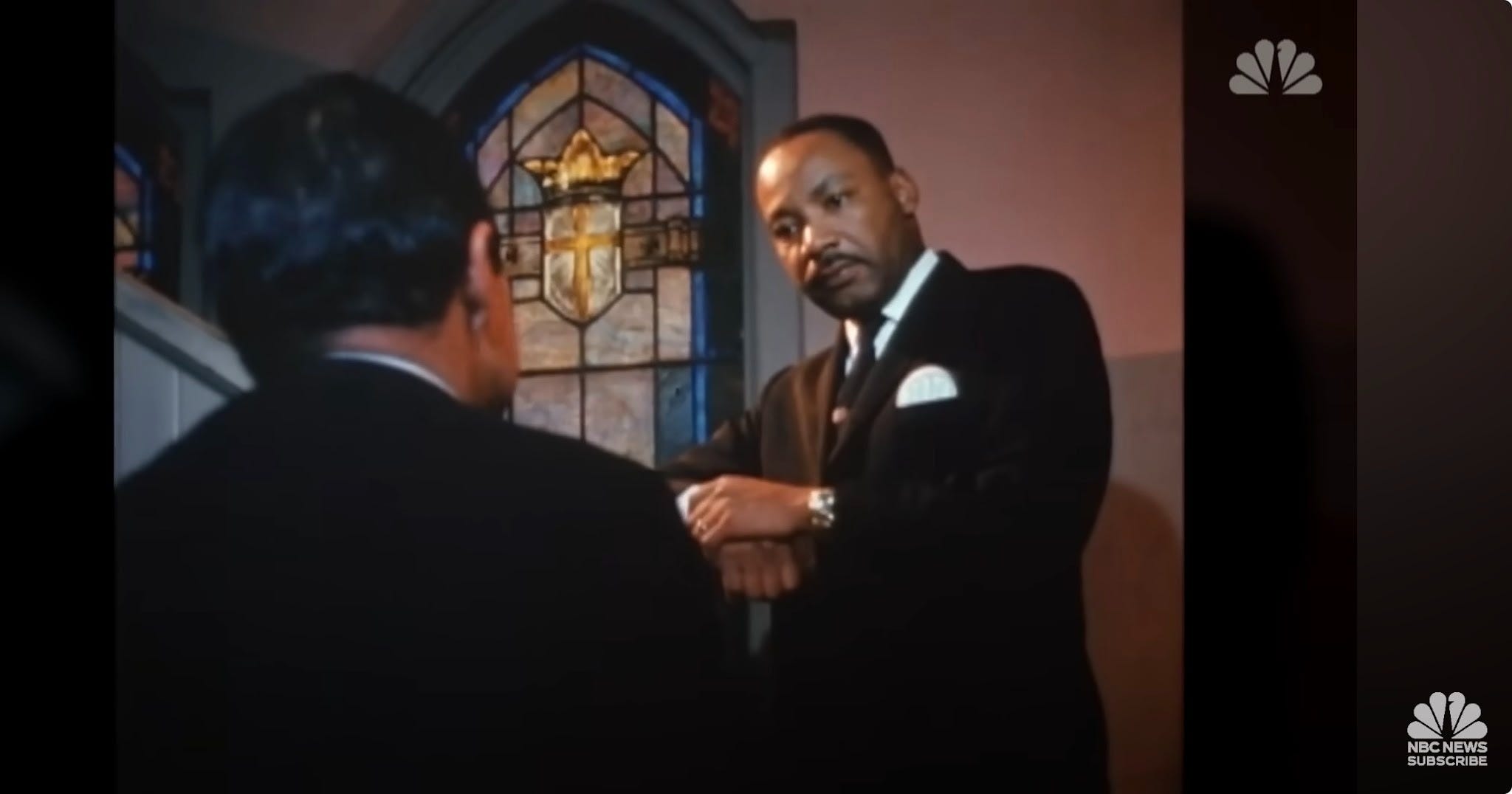
CLEVELAND, Ohio — In May 1967, Dr. Martin Luther King Jr. sat inside Ebenezer Baptist Church in Atlanta for an interview with NBC News correspondent Sander Vanocur. Less than a year before his assassination, King offered an assessment of the civil rights movement that was considerably more unsettling than the vision he had presented four years earlier at the March on Washington.
America had made progress, King acknowledged. But the movement had reached a point where its greatest challenges were no longer simply about gaining access to public accommodations or securing the right to vote.
The next battle was about economic equality.
And King understood something that many Americans were reluctant to acknowledge: Some of the very people who had supported the civil rights movement were unwilling to support the economic changes necessary to achieve genuine equality.
Nearly 60 years later, his observations deserve renewed attention, particularly here in Cuyahoga County.
In our recent article, Keep Your Eyes on the Money: Political Loyalty Must Produce Economic Results, Black Vanguard Media raised a fundamental question about the relationship between Black political participation and economic opportunity.
After decades of voting, organizing and supporting elected officials, where are the economic results?
King was asking a remarkably similar question in 1967.
What King Said About Northern Liberals
One of the most revealing moments in the interview comes when Vanocur asks King about the hypocrisy of Northern Americans who had condemned segregation in the South.
King did not hesitate.
He pointed to members of Congress from the North and West who had supported the Civil Rights Act of 1964 and the Voting Rights Act of 1965 but refused to support civil rights legislation in 1966 when the issue was housing discrimination.
The distinction was important.
It was relatively easy for Northern politicians to condemn segregation in Alabama or Mississippi. But fair housing legislation challenged practices in their own communities, affecting their own constituents, neighborhoods and property interests.
Suddenly, some of the people who had been allies were no longer willing to go as far.
King described this limited commitment as an “installment plan for equality.”
His criticism was not directed exclusively at Southern segregationists. It extended to white Americans who considered themselves progressive, sympathetic or supportive of civil rights but were unwilling to accept the consequences of genuine racial equality.
King explained that many people who supported the movement in Birmingham and Selma had been outraged by the brutality of officials such as Bull Connor and Jim Clark. Their opposition to that brutality, however, did not necessarily mean they were committed to economic equality for Black Americans.
King was making a distinction that remains relevant today. There is a difference between supporting Black people in their struggle against obvious injustice and supporting changes that expand their access to wealth, property and economic power.
Watch Dr. Martin Luther King Jr.’s original 1967 NBC News interview here.
The Fight Became More Difficult When It Required Money
King explained that integrating a lunch counter was considerably easier than eliminating poverty. Integrating a bus was easier than providing quality education. Opening a public park to Black residents was easier than eliminating deteriorating housing conditions.
The previous phase of the civil rights movement, he argued, had produced major victories without requiring enormous financial commitments from the nation.
Genuine economic equality would be different.
“Now we are confronting issues that cannot be solved without costing the nation billions of dollars,” King said. “Now I think this is where we are getting our greatest resistance.”
That observation may be the most important statement in the entire interview.
King also challenged the idea that Black Americans could overcome their economic circumstances simply through personal responsibility. He reminded the interviewer that the nation had emancipated enslaved Black people without providing them an economic foundation, even as the federal government distributed millions of acres of land to settlers in the West and Midwest.
He believed in self-determination and personal responsibility. But he also understood that the ability to build wealth depends in part on access to resources and opportunity.
For Black Americans, the absence of that economic foundation was not accidental.
The question King presented to America was whether the nation was prepared to address the consequences of its own history.
Cuyahoga County: Three Studies and Fourteen Years of Evidence
We do not have to look to Alabama, Mississippi or Washington, D.C., to understand the importance of King’s argument.
We can examine the evidence right here in Cuyahoga County.
The county has commissioned three major disparity studies examining government contracting. Together, those studies cover 14 years of contracting activity between 2009 and 2024.
The findings deserve the attention of every elected official, business leader and resident who claims to be committed to economic equality.
The 2014 Cuyahoga County Disparity Study, which examined contracting activity from 2009 through 2012, found that minority-owned businesses received approximately $9.3 million in combined prime and subcontracting awards, representing just 1.4% of the total. Black-owned businesses received approximately $7.8 million, or 1.2%.
The 2020 Cuyahoga County Disparity Study, examining contracting activity from 2014 through 2018, found that the county spent more than $1.1 billion on prime contracts in the major procurement categories studied. Minority-owned businesses received just 0.59% of those dollars, while white woman-owned businesses received 4.03%. The study also identified statistically significant underutilization of Black-owned firms in all five major prime contracting categories.
The 2025 Cuyahoga County Disparity Study, examining contracting activity from 2020 through 2024, found that Black-owned businesses received 7.01% of the county’s analyzed prime and subcontracting dollars, compared with an estimated availability of 15.92%.
In other words, Black-owned businesses received less than half the share of contracting dollars that their availability would suggest.
The studies employ different methodologies, so these percentages should not be treated as a direct measurement of year-by-year progress. Nevertheless, each study provides evidence of substantial barriers to equitable contracting.
And these are not studies commissioned by political opponents seeking to embarrass county leadership.
They were commissioned by Cuyahoga County itself.
When the County Used Its Tools, the Results Were Different
Perhaps the most compelling finding in the 2025 study concerns construction contracts.
Where the county applied elements of its contracting equity programs, Black-owned businesses received 16.59% of construction contracting dollars, compared with an estimated availability of 17.89%.
Where those program elements were not applied, Black-owned businesses received just 3.73%, compared with an estimated availability of 16.31%.
The differences are substantial.
Although these comparisons do not establish that the programs alone caused the improved outcomes, they provide a compelling reason to examine which measures have worked, where they have been applied and how effective approaches can be expanded within applicable law.
This is where the conversation must become more specific.
What policies have been implemented? What recommendations from the previous studies remain outstanding? What barriers prevent qualified Black-owned businesses from competing successfully? What changes can county leadership make now?
We should not have to commission another disparity study before asking those questions.
Political Loyalty Cannot Replace Accountability
King’s criticism of Northern liberals deserves particular attention in Cuyahoga County, where Democratic leadership has long dominated local government.
For generations, Black voters have been an important part of the Democratic Party’s political strength in this community. Those relationships have produced meaningful political victories and increased representation.
But political representation and economic opportunity are not the same thing.
The disparity studies compel us to examine whether the economic outcomes for Black businesses have been consistent with the political support Black residents have provided.
That is not an argument for abandoning one political party in favor of another. It is an argument for holding the people who exercise political authority accountable for the results produced under their leadership.
Federal and state policies matter, and county officials must operate within the law. But the disparities identified in the county’s first study existed long before the current national political environment.
They cannot simply be explained away by recent federal policy changes.
King understood in 1967 that America’s commitment to equality would be tested when the conversation moved from political principles to economic consequences.
The same standard should apply here.
Who receives the contracts? Who has access to capital? Who is building businesses and accumulating wealth through public investment? What measurable progress is being made?
These are questions that should be asked of every political institution, regardless of party.
Three Years of Organizing. Now We Are Moving Into the Next Phase.
For the past three years, a group of concerned individuals in Greater Cleveland has been meeting, examining these issues and working toward solutions.
The effort did not begin with the publication of the 2025 disparity study. Nor did it begin with the recent election.
It is an ongoing effort grounded in the belief that Black political participation must be accompanied by meaningful economic opportunity.
On Tuesday, November 17, that work will move into its next phase.
An organized planning session will bring together individuals prepared to examine the county’s three disparity studies in greater detail and contribute to the development of a coordinated corrective action plan.
The objective is straightforward.
We will divide the studies into manageable sections, assign those sections to individuals and working groups, establish deadlines for completing the analysis and set a date to reconvene.
When the groups come back together, their findings will be consolidated into a comprehensive set of recommendations.
Those recommendations will address the documented disparities, identify practical and legally supportable solutions, establish measurable objectives and provide a foundation for engaging county officials and other stakeholders.
Each recommendation should identify what needs to change, who has the authority to make the change and how progress will be measured.
We are particularly interested in identifying individuals with experience in business, government procurement, law, finance, economic development, research and public policy. But professional credentials are not a prerequisite for contributing.
What matters most is a willingness to do the work.
We need people who are prepared to read the reports, examine the evidence, complete assignments and follow through. People who understand that meaningful change requires more than attending a meeting, expressing outrage or agreeing that disparities exist.
This is not an invitation to start another conversation. It is an invitation to help carry forward three years of work.
Join Us: Disparities Report Planning Session
If you are genuinely interested in changing the economic conditions of Black businesses and communities in Cuyahoga County, we invite you to participate.
Tuesday, November 17, 2026
6:00 PM Eastern Time
CLICK HERE TO JOIN THE ZOOM MEETING
Participants are encouraged to review the three disparity studies before the meeting. The full reports are available through the links below.
Come prepared to contribute. Come prepared to accept an assignment. And come prepared to help develop solutions that can be measured by actual results.
The Real Measure of Our Progress
Nearly 60 years ago, Dr. Martin Luther King Jr. warned that America’s commitment to racial equality would be tested when it required a genuine financial investment.
More than a decade of contracting evidence in Cuyahoga County gives us an opportunity to examine that commitment in our own community.
We have spent three years organizing around these issues. We have three disparity studies. We have evidence of policies and programs that warrant further examination. And we have elected officials with the authority and responsibility to address these problems.
The next step is to turn that knowledge into coordinated action.
We should not be satisfied with another study, another meeting or another promise if it does not ultimately lead to more qualified Black-owned businesses participating in government contracting, more opportunities to build sustainable companies and more wealth being created within our communities.
That is the economic foundation King was talking about in 1967.
That is the standard by which we should measure our political relationships today.
And that is the work we are inviting people to help us accomplish.
Keep your eyes on the money. It’s time to get to work.
Read the Evidence. Watch the Interview. Participate in the Work.
Dr. Martin Luther King Jr.’s 1967 NBC News Interview
Keep Your Eyes on the Money: Political Loyalty Must Produce Economic Results
2014 Cuyahoga County Disparity Study — 2009–2012
2020 Cuyahoga County Disparity Study — 2014–2018