

When institutions fail, they often face a choice.
They can tell the truth.
Or they can find someone to blame.
Telling the truth requires courage. It requires board members to look inward. It requires leaders to admit what they knew, when they knew it, what they failed to do, and how long they allowed problems to continue without meaningful correction.
Blame is easier.
Blame gives a struggling institution a villain.
Blame gives funders a simplified explanation.
Blame gives board members distance from their own decisions.
Blame gives new leadership a way to explain why things got worse after they took control.
And when the person being blamed is no longer in the room, the strategy becomes even easier.
That is what appears to be happening to Joy Johnson.
Burten, Bell, Carr Development, Inc. now wants the public, the court, funders, and community stakeholders to believe that Joy Johnson is the source of BBC’s problems. But the record tells a far more complicated story — and one far less convenient for BBC’s board.
BBC was not operating in a vacuum. A June 2026 Cleveland.com report found that fewer than half of Cleveland’s community development corporations had satisfactory capacity to handle real-estate development, while only 56 percent had adequate capacity to operate home-repair programs. The report documented staffing shortages, limited administrative funding, weakened internal operations and difficulty retaining experienced professionals across Cleveland’s CDC network. That broader evidence makes it difficult to credibly portray one former executive as the sole cause of problems rooted in a strained and under-resourced system.
Joy Johnson did not hide the problems.
She documented them.
She pushed for solutions.
She raised concerns about the broken CDC system, delayed funding, cash-flow strain, operational pressure, reimbursement delays, staffing stress, and the need for a more sustainable path forward.
That is not the profile of someone pretending there was no problem.
That is the record of someone trying to get people to face one.
Joy Johnson Saw the Crisis Before It Became Convenient to Blame Her
The central falsehood in BBC’s current narrative is not simply that Joy Johnson made mistakes.
Every executive leader can be questioned. Every organization has problems. Every board has a right to evaluate performance.
The falsehood is the attempt to make Joy the cause of problems she had already identified.
That distinction matters.
Because there is a major difference between a leader causing a crisis and a leader warning others that a crisis exists.
Joy Johnson was operating inside a community development system that had become increasingly unstable. The funding environment was shifting. City reimbursement processes were delayed. CDCs were being asked to do more with less. The administrative burden on local organizations was growing. Staffing challenges were not isolated to BBC. Cash-flow pressure was not unique to BBC. The entire ecosystem was under strain.
Joy was not silent about that.
She warned her board.
She raised concerns with Cleveland Neighborhood Progress.
She engaged foundations and other relevant stakeholders.
She understood that BBC’s challenges were not merely about one organization, one executive, or one department. They were part of a broader system that had become difficult to sustain.
That is what responsible leadership looks like.
But after Joy was removed, BBC’s narrative shifted. Suddenly, the problems she had warned about became evidence against her. The same conditions that existed across the CDC landscape were rebranded as personal failure. The same funding pressures other organizations were facing were turned into a story about Joy. The same board that had a fiduciary duty to understand BBC’s finances now appears to want the public to believe that the executive director alone owned the crisis.
That is not accountability.
That is scapegoating.
A Broken System Cannot Be Pinned on One Woman
The local CDC system did not become broken because of Joy Johnson.
That point should not be difficult to understand.
Public officials, CDC leaders, media reports, and civic stakeholders have all acknowledged that Cleveland’s community development system has been under serious strain. Funding delays, reimbursement problems, staff shortages, inconsistent capacity, changing city processes, and uncertainty around public dollars have created instability across the sector.
That reality matters because it destroys the simplicity of BBC’s blame narrative.
If the CDC system itself was in crisis, then BBC’s board cannot credibly claim that every problem inside BBC was caused by Joy Johnson.
If other CDCs were also facing financial pressure, staffing pressure, and funding uncertainty, then BBC’s problems cannot honestly be discussed as if they existed in isolation.
If Joy was publicly and privately warning that the system was broken, then blaming her later for operating inside that broken system is intellectually dishonest.
Joy did not create the city’s reimbursement delays.
Joy did not create the broader CDC funding crisis.
Joy did not create a system where nonprofits were forced to carry expenses while waiting on delayed public funds.
Joy did not create a landscape where organizations were expected to expand service areas and programming without comparable resources.
Joy did not create the structural weakness of Cleveland’s CDC ecosystem.
She called attention to it.
That is why BBC’s current framing deserves scrutiny.
Because an organization that blames one woman for a system-wide crisis is not telling the full truth.
It is protecting itself.
The Board Knew — Or Should Have Known
The most important question in this story is not simply what Joy knew.
It is what the board knew.
A nonprofit board is not decorative. It is not symbolic. It is not there to appear on letterhead, attend meetings, and disappear when things get difficult.
A board has fiduciary duties. It is responsible for oversight. It is responsible for understanding the organization’s financial condition. It is responsible for asking hard questions. It is responsible for ensuring that leadership has the resources, authority, and support needed to carry out the mission.
So when BBC now points at Joy, the public should ask:
Where was the board?
Where was the treasurer?
Where was the executive committee?
Where were the documented corrective actions?
Where were the demands for better financial systems?
Where was the board’s response when Joy raised concerns?
Where was the accountability before the termination?
And perhaps most importantly:
Why did the board wait until after Joy was gone to act as though it had discovered a crisis?
If BBC’s financial condition was serious, the board had a responsibility to know that.
If WOVU was creating a financial burden, the board had a responsibility to know that.
If city funding delays were affecting cash flow, the board had a responsibility to know that.
If staffing and systems needed improvement, the board had a responsibility to know that.
If BBC’s operations required modernization, the board had a responsibility to support that work.
A board cannot ignore warnings, fail to solve problems, remove the executive, and then use the existence of those same problems as proof that the executive was the problem.
That is not governance.
That is revision.

The Treasurer Problem Cannot Be Ignored
BBC’s blame narrative becomes even weaker when viewed through the role of financial oversight.
David Roney was not merely a later figure in the story. He was connected to BBC board leadership and financial oversight before becoming part of the post-Joy leadership structure.
That matters.
Because if BBC now claims that finances were poorly understood, poorly tracked, or poorly managed, then the role of the treasurer and board finance oversight becomes central.
The treasurer’s job is not to be surprised by the organization’s financial condition.
The treasurer’s job is to help understand it.
If BBC had problems with accounting, reporting, revenue, reimbursement, contracts, cash flow, or internal controls, those were board-level issues. They were not invisible. They were not beyond oversight. They were not the exclusive burden of Joy Johnson.
A serious board would ask:
What did the treasurer know?
What reports did the treasurer review?
What warnings did Joy provide?
What support did the board offer?
What financial controls did the board require?
What outside accounting or management support did the board approve?
What specific corrective actions did the board take before removing Joy?
What changed after Joy was removed?
Those questions matter because BBC’s current narrative asks the public to believe that Joy alone carried responsibility for problems that board leadership had a duty to understand.
That is not how nonprofit governance works.
Joy’s Warning Became BBC’s Weapon
One of the most troubling parts of this story is how easily an executive’s warnings can be turned against her.
A leader says the system is broken.
Later, the institution says: “See, the organization was broken under her.”
A leader documents cash-flow strain.
Later, the institution says: “See, finances were strained under her.”
A leader raises concerns about reimbursement delays.
Later, the institution says: “See, there were funding problems under her.”
A leader tries to restructure an unsustainable operation.
Later, the institution says: “See, she changed things.”
That is how scapegoating works.
It takes the evidence of a leader trying to solve a problem and rebrands it as evidence that the leader caused the problem.
But the public should not fall for that.
Joy Johnson’s documentation of problems is not proof that she created them. It is proof that she was paying attention.
Her warnings are not an admission of incompetence. They are evidence of awareness.
Her push for change is not evidence of misconduct. It is evidence that the old model was not working.
Her effort to find a sustainable future for WOVU is not evidence that she was trying to harm BBC. It is evidence that she was trying to stop WOVU from continuing to drain BBC’s resources.
BBC wants to turn Joy’s foresight into guilt.
That is unfair.
And the record deserves better.
WOVU Was Part of the Solution, Not the Smear
The Board Asked for a Solution — Then Blamed Her for Finding One
BBC’s attempt to blame Joy Johnson for the WOVU-FCB relationship becomes even weaker when one fact is placed at the center of the story:
The board had asked Joy to find a way for WOVU to stop draining BBC’s resources.
That changes everything.
Joy was not freelancing.
Joy was not hiding a problem.
Joy was not creating a crisis.
She was responding to a problem the board already knew existed.
WOVU had community value, cultural importance, and public meaning. But it also carried a financial burden that BBC could not continue to ignore. The station required programming, technical support, underwriting strategy, digital expansion, operational structure, and professional media management. BBC’s limited nonprofit resources were being stretched, and the board wanted a sustainable path forward.
The FCB relationship was Joy’s answer to that board-recognized problem.
That is why BBC’s later attempt to frame the relationship as suspicious deserves scrutiny. If the board asked Joy to solve WOVU’s financial drain, then the real question is not why Joy pursued a new model. The real question is why BBC later tried to punish her for finding one.
A board cannot ask an executive to solve a problem, accept the benefit of the solution, and then turn around and use that solution as evidence against her once the politics change.
That is not oversight.
That is scapegoating.
WOVU is central to this story because it exposes the difference between responsible problem-solving and after-the-fact blame.
BBC now attempts to frame the FCB relationship as suspicious. But the real question is why the relationship existed in the first place.
The answer is straightforward: WOVU needed help.
The station had cultural value, community significance, and public voice. But it also required resources, strategy, programming support, digital expansion, underwriting development, and operational expertise. Maintaining WOVU under BBC’s existing structure was a burden the organization could not ignore forever.
Joy Johnson faced that reality.
Rather than allow WOVU to continue operating under strain, she pursued a solution that connected the station with First Class Broadcasting, led by Darvio Morrow. FCB brought media experience, programming capacity, relationships, strategy, and digital growth potential.
That is not scandalous.
That is exactly what a leader should do when a program has value but needs a more sustainable model.
The problem for BBC’s current narrative is that FCB’s involvement produced real momentum. WOVU’s reach grew. Its digital presence expanded. Its programming strengthened. Its visibility increased.
Those facts make the smear campaign harder to sustain.
Because if Joy’s decision helped improve WOVU, then BBC must explain why it is now trying to make that decision look corrupt.
The Attempt to Rewrite Joy’s Record
Joy Johnson’s record cannot be reduced to BBC’s counterclaim.
That document is one side of a legal dispute. It is not the full history of her service.
Joy spent more than two decades connected to BBC’s work. She helped carry the organization through difficult periods. She maintained relationships with public officials, community partners, funders, residents, and sector leaders. She was not a disposable employee whose record can be erased because the board now needs a target.
She was a community development professional with institutional knowledge and public credibility.
That is why the attempt to tarnish her name should concern anyone who cares about Black leadership, nonprofit governance, and community institutions.
Too often, Black women in leadership are asked to carry impossible systems, absorb institutional dysfunction, shield organizations from collapse, and then become the face of failure when boards refuse to own their part.
They are asked to fix what they did not break.
They are blamed for warnings they gave.
They are judged for conditions they inherited.
They are punished for telling uncomfortable truths.
And when they are removed, their names become convenient cover for those who remain.
That pattern should not be ignored here.
The Separation Narrative Raises Its Own Questions
BBC’s later treatment of Joy also raises questions.
If Joy was truly the source of BBC’s problems, why did BBC prepare a severance justification recognizing her long service, institutional knowledge, donor relationships, public credibility, and the importance of a smooth transition?
Why describe her contributions respectfully in one context, then turn around and depict her as a central wrongdoer in another?
That inconsistency matters.
It suggests that BBC’s view of Joy may have shifted not because the facts changed, but because the litigation posture changed.
When the organization needed a clean transition, Joy’s service mattered.
When the organization needed someone to blame, Joy became the target.
That is the scapegoat strategy.
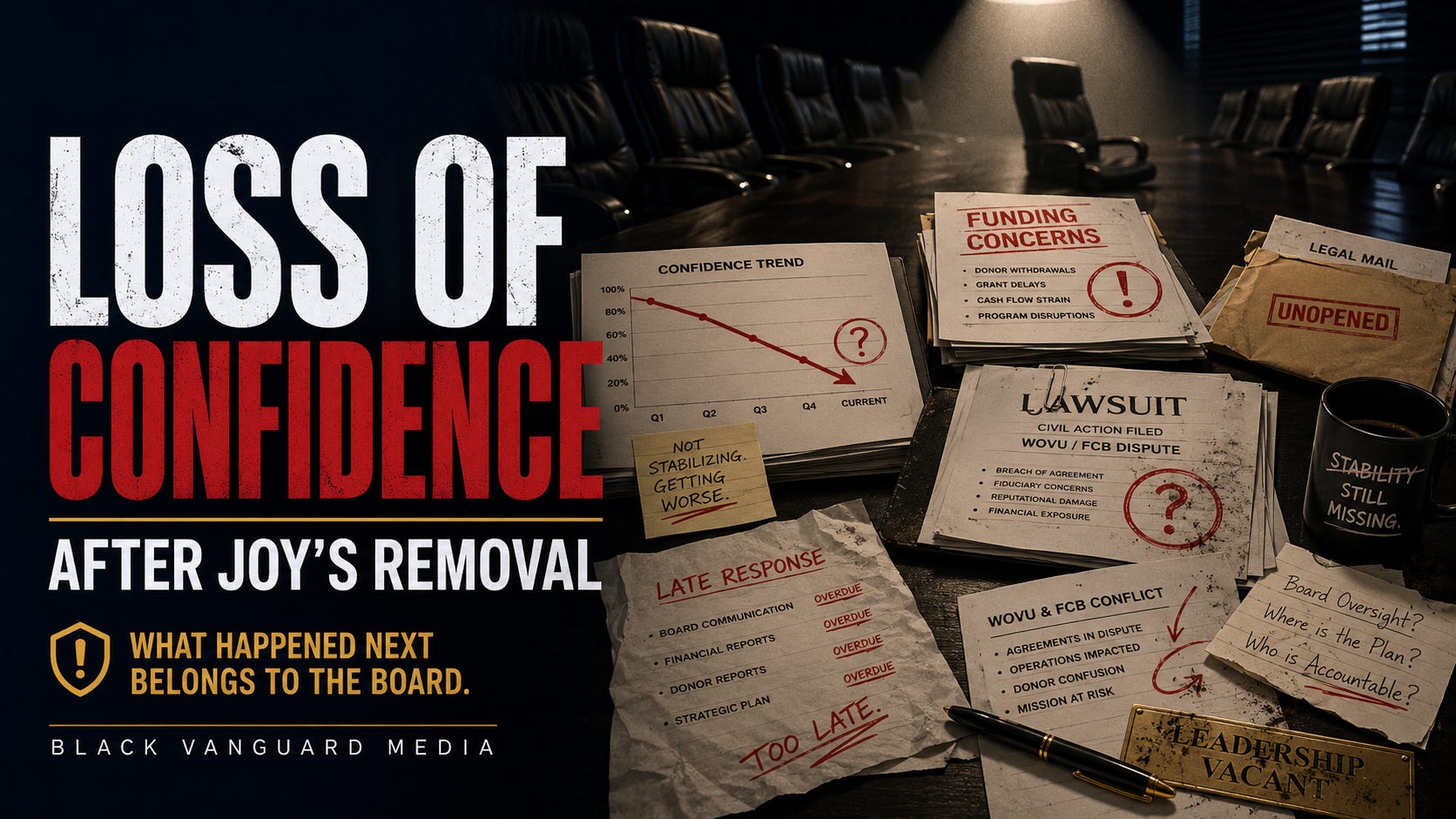
The Loss of Confidence After Joy’s Removal
Another issue deserves attention: what happened after Joy was gone.
BBC’s current narrative wants the public to focus backward. It wants the story to end with Joy’s departure. But the real test of the board’s theory is what happened after new leadership took control.
If Joy was the problem, then BBC should have stabilized quickly after her removal.
Did it?
The emerging record suggests the opposite.
There were questions about loss of confidence from key public relationships. There were concerns about funding. There were issues with WOVU. There was conflict with FCB. There was a lawsuit. There was a missed response deadline. There was unopened legal mail. There was the removal of Roney. There was a scramble to retain counsel. There was a counterclaim that attempted to shift blame outward.
That sequence does not strengthen BBC’s case against Joy.
It weakens it.
Because once Joy was gone, the board and new leadership had control.
And what happened next belongs to them.
The Parker Factor
Jamie V. Parker is also part of this governance story.
Parker was not a bystander. She was board president when FCB/UVPM’s operations were suspended. She later became Interim Executive Director. Publicly available professional materials identify her as an Ohio attorney with experience in labor and employment law, mediation, human resources, employee relations, compliance-risk mitigation, policy and procedure creation, and leadership-team conflict resolution.
That matters because BBC’s post-Joy decisions were not happening in a boardroom without legal sophistication.
When an organization led by a board president with legal training suspends a contractor’s operations, disputes an agreement, later faces litigation, misses a response deadline, and claims it believed someone else had legal counsel handling the matter, the public has a right to ask difficult questions.
What process did BBC follow?
What legal risks did the board evaluate?
What written notices were provided?
What contract provisions were considered?
Who verified that counsel had appeared?
Who tracked the court deadline?
Who ensured legal mail was opened?
Who protected the organization from default?
These are not minor administrative questions.
They go to the heart of governance.
And they make it harder for BBC to reduce the story to Joy Johnson.
Scapegoating Is Not Strategy
At some point, every institution must decide whether it wants accountability or cover.
Scapegoating may work for a short time. It may calm nervous funders. It may give board members a script. It may create enough confusion to delay scrutiny.
But scapegoating does not repair systems.
It does not restore trust.
It does not explain missed legal deadlines.
It does not answer financial oversight questions.
It does not excuse board inaction.
It does not erase public reporting about the CDC system.
It does not undo the fact that Joy warned people.
It does not change the reality that BBC had board-level responsibility.
And it does not make a former executive responsible for decisions made after she was removed.
Joy Johnson deserves to be judged by the full record, not by a narrative created after BBC’s governance failures became public.
The full record shows a leader operating inside a broken system, warning others about that system, trying to modernize operations, attempting to reduce financial strain, and seeking a path forward for WOVU.
BBC’s current narrative asks the public to forget all of that.
Black Vanguard Media will not.
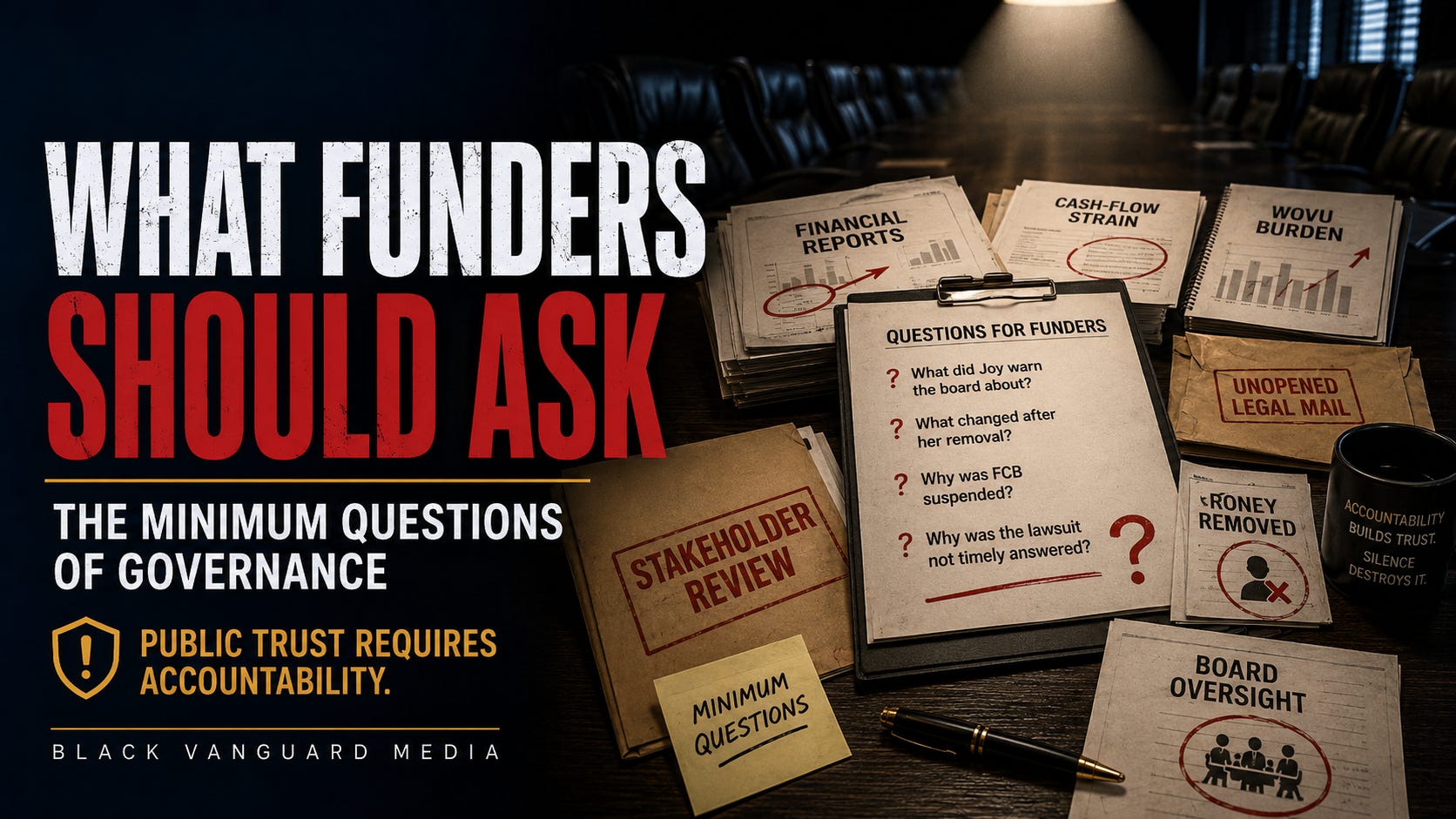
What Funders and Stakeholders Should Ask
Anyone funding, supporting, partnering with, or publicly endorsing BBC should ask serious questions.
Not because of gossip.
Not because of personality conflict.
Not because of one lawsuit alone.
But because public trust requires governance discipline.
Funders should ask:
What did Joy Johnson warn the board about before her removal?
What documentation did she provide?
What financial reports did the board receive?
What role did the treasurer play in understanding BBC’s finances?
What did the board do in response to documented funding delays and cash-flow strain?
What did the board know about WOVU’s financial burden?
What did BBC approve regarding FCB?
What changed after Joy was removed?
Why was FCB suspended?
Why was the lawsuit not timely answered?
Why was legal mail reportedly unopened?
Why was Roney later removed?
Why is BBC now attacking Joy instead of publicly accounting for its own governance decisions?
Those are not unfair questions.
They are the minimum questions any serious funder should ask when a community institution’s internal crisis becomes public.
The Real Story
The real story is not that Joy Johnson hid a crisis.
The real story is that Joy Johnson saw one.
The real story is not that Joy Johnson created a broken system.
The real story is that she warned BBC about it.
The real story is not that Joy Johnson alone was responsible for BBC’s condition.
The real story is that BBC’s board had fiduciary duties and now appears to be trying to escape the consequences of its own oversight failures.
The real story is not that FCB was brought in to exploit WOVU.
The real story is that WOVU needed a sustainable model, and FCB provided a path toward growth.
The real story is not that Jerry Primm created BBC’s problems.
The real story is that BBC is invoking names and relationships to distract from governance questions.
And the real story is not that Joy’s removal solved BBC’s problems.
The real story is that after she was gone, the problems became public.
That is why the scapegoat strategy must be exposed.
Because if community institutions are allowed to blame leaders for the very problems those leaders warned about, then no honest leader is safe.
And if boards can ignore warnings, remove the messenger, and then smear the messenger when consequences arrive, then governance becomes theater.
BBC’s funders, partners, and community stakeholders deserve better than theater.
They deserve the truth.
This is Part II.
And the record is only getting clearer.
The Boardroom Breakdown Part I
Letter from Administration regarding instability in the CDC ecosystem
Local officials call the local CDC system broken
Cleveland City Council proposes major funding overhaul for CDC’s