
Scripture, history and the Civil Rights Movement teach us what happens when ordinary people refuse to give up.
By Jerry Primm II | Black Vanguard Media
I sometimes wonder whether people believe the changes Dr. Martin Luther King Jr. helped bring about happened overnight. I wonder whether they understand how long those campaigns lasted, how many people participated, and how many initially refused to participate because they feared the consequences.
I wonder whether people realize that the masses did not immediately embrace Dr. King. Many Black Americans feared losing their jobs, their homes or their businesses. Others feared retaliation from the Ku Klux Klan, local law enforcement or white citizens who were determined to preserve segregation.
And yet, despite those fears, people eventually stood up. They organized. They sacrificed. They stayed the course.
As I reflect on the work we have been doing for approximately three years to address the economic disparities documented in Cuyahoga County, I find myself asking a similar question: Do people understand that meaningful change requires a sustained campaign?
We cannot expect decades of economic inequity to disappear after a few meetings, a series of articles or even an election. The work requires patience, discipline, courage and a commitment to continue even when the results are not immediately visible.
Scripture speaks directly to this responsibility.
In Galatians 6:9, we are reminded:
“And let us not be weary in well doing: for in due season we shall reap, if we faint not.”
The promise is not that we will reap tomorrow. The promise is that there will be a harvest in due season, provided we do not abandon the work.
That is a lesson worth remembering as we continue our campaign for economic justice in Cuyahoga County.
They Faced Lynch Mobs. What Are We Afraid Of?
The men and women who participated in the Civil Rights Movement faced dangers that many Americans today can scarcely imagine.
They confronted lynch mobs, the Ku Klux Klan, police officers armed with clubs, German shepherds and high-pressure fire hoses. They lived under Jim Crow laws that legally enforced racial segregation. In many communities, the institutions responsible for protecting citizens were themselves instruments of racial oppression.
In Birmingham, Alabama, in 1963, police used dogs and fire hoses against demonstrators, including children. In Mississippi, three civil rights workers — James Chaney, Andrew Goodman and Michael Schwerner — were murdered in 1964 for their involvement in the struggle for voting rights.
These were not hypothetical threats. These were real consequences.
And still, people continued.
The Montgomery Bus Boycott lasted 381 days. For more than a year, Black residents walked, organized carpools and found alternative transportation rather than surrender their demand for equal treatment. Many of them were domestic workers, laborers and ordinary citizens who could least afford the inconvenience and sacrifice.
Imagine what might have happened if they had decided after 30 days that the campaign was taking too long.
Imagine if, after six months, they had concluded that the political establishment was too powerful and that nothing would ever change.
The boycott succeeded because thousands of people made a collective decision to continue.
Hebrews 12:1 tells us:
“Let us run with patience the race that is set before us.”
And Hebrews 12:4 adds:
“Ye have not yet resisted unto blood, striving against sin.”
Our predecessors literally shed blood in the struggle for justice. We have inherited the benefits of their courage. The question is whether we have also inherited their willingness to sacrifice.
Today, we are asking people to read government reports, attend public meetings, organize their communities and demand accountability for the expenditure of public dollars.
Certainly, there are people who fear political or economic retaliation for challenging the established order. Those concerns should not be dismissed. But history reminds us that fear cannot become a permanent justification for inaction.
If those who came before us had waited until it was safe to stand up, where would we be today?
Dr. King Warned Us About the North
One of the greatest misconceptions about the Civil Rights Movement is that racial injustice was primarily a Southern problem.
Dr. King knew otherwise.
On August 5, 1966, while leading an open-housing march in Chicago, King encountered an angry white mob. Demonstrators were attacked with rocks, bricks and bottles. King himself was struck in the head by a rock.
After the march, he remarked:
“I have never seen anything so hostile and so hateful as I’ve seen here today.”
This was a man who had already confronted racial violence in Birmingham, Selma and Mississippi.
In his August 21, 1966, appearance on Meet the Press, King discussed how racial hostility in Northern communities had often remained beneath the surface until the Civil Rights Movement challenged established arrangements.
In a 1967 interview, King also challenged the notion that Northern and Western liberals were necessarily prepared to make the sacrifices required for genuine racial equality. Supporting civil rights in principle was one thing. Supporting changes that affected one’s own neighborhood, institutions or economic interests was another.
His observations remain relevant today.
Cleveland is not Birmingham in 1963. Cuyahoga County does not operate under the Jim Crow laws of the segregated South. But the absence of those laws does not mean that economic injustice has disappeared.
A community can celebrate Dr. King’s birthday, elect Black officials, profess its commitment to diversity and still maintain economic arrangements that leave Black businesses with disproportionately limited access to public contracting opportunities.
That is why we must examine outcomes rather than simply accept declarations of support.
As we discussed in our previous article, Dr. King Warned Us in 1967, the challenge is not merely to identify people who say they support equality. It is to determine whether our institutions are producing equitable results.
Three Disparity Studies. Approximately Three Years of Organizing.
Cuyahoga County has commissioned disparity studies in 2014, 2020 and 2025. Taken together, these studies provide more than a decade of opportunities to examine disparities in public contracting and determine what corrective measures are necessary.
For approximately three years, we have been organizing around these issues.
Some may wonder why we are still discussing them. Others may question why the problem has not already been resolved.
But those questions reveal a misunderstanding of how meaningful institutional change occurs.
The Montgomery Bus Boycott did not succeed after the first meeting. The Civil Rights Act of 1964 did not pass after the first march. The Voting Rights Act of 1965 did not become law simply because someone documented voter suppression.
Those victories required sustained campaigns.
The same principle applies to economic justice.
Our responsibility is not merely to acknowledge that disparities exist. It is to examine the data, identify the barriers, develop lawful solutions, engage elected officials and public institutions, and establish measurable benchmarks for progress.
We must continue asking how much public money is being spent, which businesses receive those dollars, whether qualified Black-owned businesses have meaningful access to contracting opportunities, and whether corrective policies are producing measurable improvements.
As we argued in Keep Your Eyes on the Money, political participation must ultimately be connected to tangible economic outcomes.
A disparity study is not the finish line. It is evidence that should inform the work ahead.
The Persistent Widow: Keep Coming Back
In Luke 18:1–8, Jesus tells the parable of a widow who repeatedly approaches an unjust judge seeking justice.
The judge initially refuses. But eventually, he says:
“Yet because this widow troubleth me, I will avenge her, lest by her continual coming she weary me.”
The widow did not possess the judge’s authority. She did not control the institutions of government. She did not have the resources or influence that others might have enjoyed.
What she possessed was persistence.
She kept coming back.
There is a powerful lesson in this parable for anyone involved in community organizing.
We cannot attend one County Council meeting, ask one question, receive one unsatisfactory answer and conclude that the work is finished.
We must keep coming back.
We must continue examining the reports. We must continue engaging elected officials. We must continue organizing business owners, community leaders, churches and residents. We must continue monitoring whether public commitments produce actual results.
The parable is fundamentally a lesson about persistent prayer and faith. Its message also reminds us that an initial refusal should not extinguish our determination to pursue justice.
A refusal today does not have to become a permanent defeat.
God Heard the Cries of the Oppressed — and Called Someone to Act
In Exodus 3:7, God tells Moses:
“I have surely seen the affliction of my people which are in Egypt, and have heard their cry by reason of their taskmasters; for I know their sorrows.”
But God does not stop there. In verse 10, He tells Moses:
“Come now therefore, and I will send thee unto Pharaoh, that thou mayest bring forth my people the children of Israel out of Egypt.”
God heard the cries of the oppressed, but Moses was called to act.
And Moses did not accomplish his mission through a single conversation with Pharaoh. There was resistance. There were setbacks. There were moments when the people themselves became discouraged.
The journey required faith, leadership and perseverance.
This is an important distinction for those of us who believe in the power of prayer.
We should pray for justice. We should pray for our elected officials. We should pray for the prosperity of our communities.
But we should also recognize that we may be among the people called to do the work.
James 2:17 reminds us:
“Even so faith, if it hath not works, is dead, being alone.”
We cannot profess a commitment to justice while consistently refusing to participate in the work necessary to achieve it.
Our churches, business organizations, civic associations and community institutions have an opportunity to help turn faith into action. They can educate their members, convene discussions, support entrepreneurs and engage public officials.
The question is not whether we believe that injustice should be corrected. The question is what we are willing to do about it.
We Must Have a Mind to Work
The story of Nehemiah provides another important lesson.
Nehemiah was determined to rebuild the walls of Jerusalem. He faced ridicule, threats and attempts to distract him from his mission.
Nevertheless, the people continued working.
Nehemiah 4:6 tells us:
“So built we the wall; and all the wall was joined together unto the half thereof: for the people had a mind to work.”
The wall was eventually completed in 52 days, according to Nehemiah 6:15.
Nehemiah did not rebuild Jerusalem’s walls alone. The accomplishment required people to work collectively, with different individuals accepting responsibility for different portions of the project.
When opponents attempted to distract him, Nehemiah responded in chapter 6, verse 3:
“I am doing a great work, so that I cannot come down.”
Those words should resonate with anyone engaged in a sustained campaign.
There will be distractions. There will be political disagreements. There will be people who want to redirect the conversation. There will be individuals more concerned with personalities, positions or receiving credit than with accomplishing the objective.
We cannot allow those distractions to determine the future of this work.
Our objective is to correct documented economic disparities and expand meaningful economic opportunities.
The mission must remain more important than any individual.
For Such a Time as This
In Esther 4:14, Mordecai challenges Esther to consider whether her position carries a responsibility beyond her personal interests.
“And who knoweth whether thou art come to the kingdom for such a time as this?”
Esther had access to power. She also understood that using that access to defend her people carried considerable personal risk.
She had a choice.
She could remain silent and attempt to protect her position, or she could use her influence to help those whose lives were threatened.
That question remains relevant to our elected officials, business leaders, pastors, professionals and community leaders.
What is the purpose of gaining influence if we are unwilling to use it when our community needs us?
What is the purpose of gaining access to institutions if we are unwilling to challenge those institutions when their policies produce inequitable outcomes?
And what is the value of political representation if it does not help expand economic opportunities for the people being represented?
These questions are not intended to condemn everyone who holds a position of influence. They are an invitation to recognize the opportunity that comes with that influence.
Perhaps some of us have been placed in our respective positions for such a time as this.
Black Economic Advancement Benefits Everyone
There is another dimension to this conversation that must not be overlooked.
The fight for economic justice is not a campaign against white people. It is not an effort to diminish the prosperity of white businesses or white families.
It is a campaign to expand opportunity and correct inequities that prevent our entire region from reaching its economic potential.
Jeremiah 29:7 offers a powerful perspective:
“And seek the peace of the city whither I have caused you to be carried away captives, and pray unto the LORD for it: for in the peace thereof shall ye have peace.”
The New International Version expresses the connection to shared prosperity clearly: “If it prospers, you too will prosper.”
That is an economic principle as much as it is a moral one.
When a Black-owned construction company grows, it may purchase materials from a white-owned supplier. It may employ workers of different races. It may borrow money from a regional bank, purchase insurance, hire accountants and attorneys, and invest in commercial property.
The dollars generated by that business do not remain confined to one racial community.
When more Black families achieve economic stability, they purchase homes, support local businesses, invest in education and create opportunities for future generations.
Government can benefit from a broader tax base. Businesses can benefit from more customers. Workers can benefit from additional employment opportunities. Communities can benefit from increased investment.
Greater Atlanta provides an example of a metropolitan economy where substantial Black wealth and substantial white wealth coexist. Its experience also reminds us that economic growth does not automatically eliminate inequality. Nevertheless, it demonstrates why we should reject the assumption that Black prosperity must come at the expense of white prosperity.
Black economic advancement does not require white economic decline.
That is a message I want our white readers, business leaders and neighbors to understand.
You have a stake in correcting these disparities. Not simply because it is the morally right thing to do, but because expanding economic participation can help build a stronger, more prosperous region for everyone.
As Paul writes in 1 Corinthians 12:26:
“And whether one member suffer, all the members suffer with it; or one member be honoured, all the members rejoice with it.”
Paul was describing the interconnectedness of the body of Christ. The principle offers an important illustration for our community as well.
We are more connected economically than many of us recognize.
The Next Phase of the Campaign: We Need Allies
Dr. King did not accomplish what he accomplished alone.
The Civil Rights Movement was sustained by Black churches, students, labor organizers, community organizations, business owners and ordinary citizens. It also benefited from white allies and people of different religious, racial and economic backgrounds who recognized that racial injustice was not somebody else’s responsibility.
We must recognize the same opportunity today.
Correcting economic disparities in Cuyahoga County will require persistence, courage and a willingness to stay the course. But it will also require something else: allies.
We need people who understand that the economic advancement of their neighbors can contribute to their own prosperity. We need business leaders who recognize the value of expanding the pool of qualified contractors. We need elected officials who are prepared to translate public commitments into measurable outcomes.
We need churches, civic organizations, financial institutions and residents who are willing to participate in building a stronger regional economy.
Ecclesiastes 4:9 tells us:
“Two are better than one; because they have a good reward for their labour.”
And verse 12 reminds us:
“A threefold cord is not quickly broken.”
The work ahead requires us to understand how political power, economic power and community influence can be brought together to accomplish shared objectives.
In our next article, we will examine the importance of allies through the lens of Clarence N. Stone’s landmark book, Regime Politics: Governing Atlanta, 1946–1988. We will explore how Black political leadership and predominantly white business interests helped shape Atlanta’s development, what that coalition accomplished, where it fell short, and what Cleveland can learn from its experience.
We will examine why building a coalition does not require us to compromise our commitment to justice. It requires us to understand how to assemble the resources and relationships necessary to achieve it.
For now, however, we must remain committed to the work already underway.
An Invitation to Participate
On Tuesday, November 17, 2026, at 6 p.m. Eastern, we will continue our work through the Cuyahoga County Disparities Report Planning Session.
This is not the beginning of another conversation about economic disparities. It is the continuation of approximately three years of organizing around a documented problem that requires sustained attention.
We invite Black and white residents, business owners, clergy, community leaders and anyone genuinely interested in helping develop constructive solutions to participate.
We are not asking people to choose between Black prosperity and white prosperity. We are asking them to help build a region where economic opportunity is not determined by race.
Our predecessors confronted lynch mobs, police dogs, fire hoses and laws designed to keep them subordinate.
They did not have the luxury of knowing how long the struggle would last.
They did not wait until everyone agreed with them.
They did not wait until victory was guaranteed.
They kept showing up.
And because they stayed the course, we inherited opportunities that many of them never lived to enjoy.
Now it is our responsibility to continue the work.
We honor Dr. King with our words. We honor his legacy with our work.
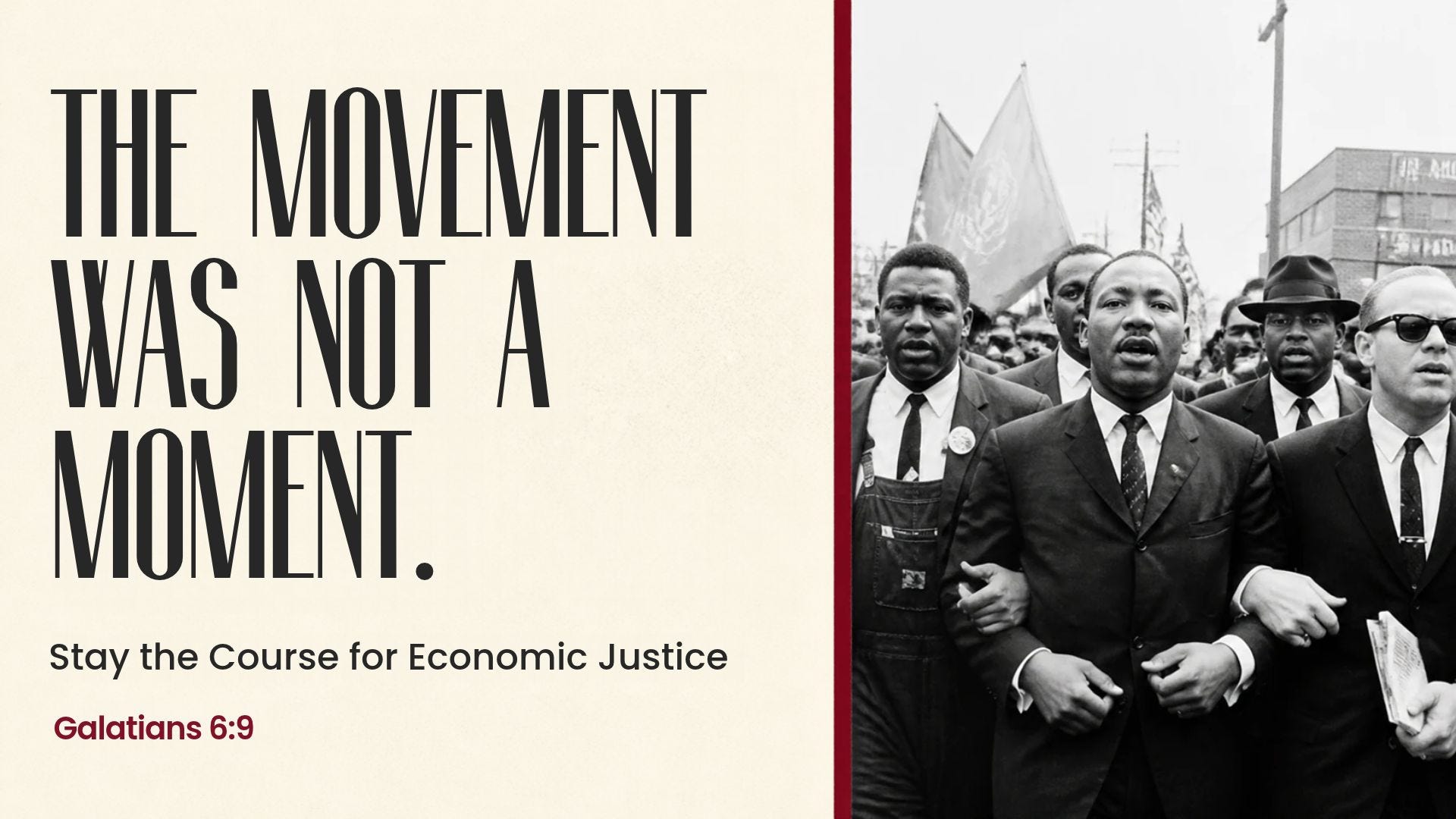
And as Galatians 6:9 reminds us, we shall reap in due season, if we faint not.
The movement was not a moment.
Neither is ours.